Mochuda’s Expulsion636 CE
In 636, Carthach (Mochuda), abbot of Rahan in County Offaly, was expelled from his monastery at Eastertide. The annals record the event but give no motive or account of its procedure. Tradition associates the removal with Blathmac of the Uí Néill, though his precise role is uncertain. The expulsion may have involved ecclesiastical and political rivalries, rather than solely disagreement over Easter calculation. Mochuda subsequently moved to Déisi Muman, beginning his association with Lismore in County Waterford. The episode shows how monasteries were embedded in early Irish power, landholding, economy and kinship.
Dateline
In 636 CE, the clearest Irish event is an expulsion rather than a battle or royal accession: Carthach, better known as Mochuda or Mo Chutu, was driven from the monastery of Raithen, modern Rahan in County Offaly, at Eastertide. The terse record in the annals gives neither a speech, a march nor a legal judgement. Yet this removal of a prominent abbot from a major midland community was politically meaningful, religiously charged and consequential for the history of southern Ireland. Modern reference scholarship places the expulsion in 636, while also warning that the early annals preserve difficult and sometimes displaced chronological systems. The year should therefore be approached through its securely connected event, not through later legend presented as contemporary fact.
An Easter Expulsion
The Annals of Ulster couple two items: the killing of Ernáine son of Fiachna, who had defeated Máel Fithrich son of Áed Allán at Leitheirbe, and the expulsion of Carthach from Raithen at Eastertide. Chronicon Scotorum preserves the same pairing, using the Latin phrase in diebus Paschae, ‘in the days of Easter’. This is valuable precision by annalistic standards: the action belonged to the Easter season, although the sources do not provide a day, place of assembly or procedure. Ernáine’s killing is equally spare. It confirms continuing local armed competition, but the evidence does not permit a responsible reconstruction of its causes, the location of Leitheirbe, or the size of the forces involved.
Carthach was not merely an isolated holy man. He was abbot of Rahan, a monastery in Uí Néill territory, and came from the Ciarraige Luachra of Kerry. His position linked a religious household, landed resources, clients and dependants, and the patronage of powerful families. In early medieval Ireland, monasteries were not separate from secular society in the modern sense. They offered worship, learning and burial, but they also held land, received food-rents and gifts, employed craftspeople, maintained livestock and possessed political usefulness. To displace their leader was therefore an intervention in the organisation of a substantial local community.
Rahan, Brega and Royal Authority
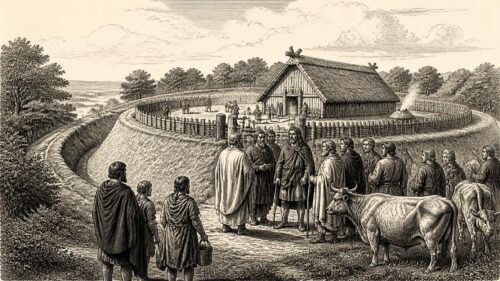
The tradition identifies Blathmac, son of Áed Sláine, as the secular force behind Mochuda’s removal. Blathmac belonged to Síl nÁedo Sláine, an important Uí Néill dynasty based in Brega and the central plain. That attribution is plausible enough to be taken seriously, but it needs careful framing. Blathmac was advancing within the politics of the midlands; he should not simply be called king of Tara in 636. His later prominence has encouraged sources and hagiographers to project greater authority backwards. The political order was layered: local kings, regional dynasties, powerful ecclesiastical communities and the overkingship claimed by Domnall mac Áedo all overlapped, competed and negotiated.
Rahan’s location made it especially exposed to this kind of pressure. It stood in the central Irish zone where Uí Néill interests, smaller peoples and ecclesiastical estates met. A monastery could strengthen a ruler through prayer, prestige, literacy, hospitality and the management of productive land; equally, an independently rooted abbot could become an inconvenient focus for rival alliances. The sources do not say that Blathmac personally ordered the expulsion, nor do they describe violence against the community. They do show that the event became remembered as an affair in which secular authority and a monastery collided. That memory itself reveals how difficult it was to separate religious leadership from the politics of kin and territory.
Was Easter the Issue?
The Easter timing has prompted a long-standing explanation: that Mochuda’s community may have been caught in the controversy over how to calculate the date of Easter. Irish and British churches did not all use the same computistical practice during the seventh century, and the question mattered because it regulated the central annual feast, fasting and communal observance. The annals, however, do not say that a dispute over Easter caused the expulsion. The modern assessment is appropriately cautious: Mochuda may have favoured Roman reckoning, but ecclesiastical rivalry or conflict between groups and kindreds is more likely than a single doctrinal cause. Easter is firmly recorded as the season; the motive remains uncertain.
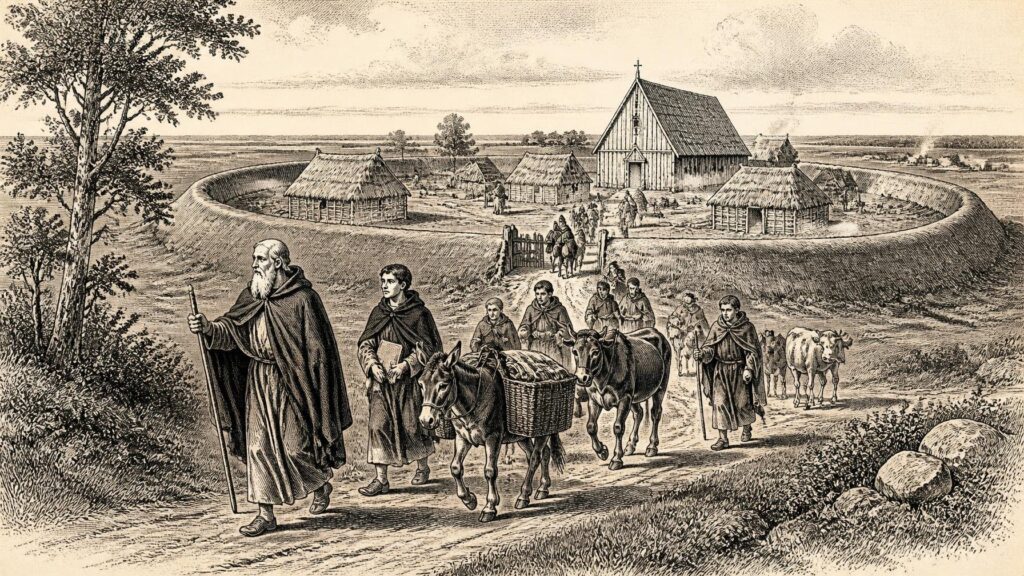
That distinction matters because later stories are vivid. Medieval Latin and Irish Lives of Carthach, composed centuries after his death, portray a large and afflicted community leaving Rahan: monks, nuns and people with leprosy accompany their dispossessed leader. An eighth-century Irish tract, Indarba Mo-Chuda a rRaithin, also elaborates the banishment. Such narratives show how later religious communities understood Mochuda’s authority, compassion and legitimate claim to Lismore. They cannot, without corroboration, establish the number of followers in 636, the identity of every opponent, a precise route south, or the emotional scenes they describe. Their value is greatest as evidence of commemoration and institutional memory.
From Midlands to Déisi
The expulsion is directly connected with Mochuda’s move south into Déisi Muman and the beginning of his association with Lismore on the Blackwater in present-day County Waterford. The connection is secure: the Annals of Inisfallen place the expulsion and the foundation of Les Mór together, although under a differently shifted annal year, while modern biography states that Mochuda went south after leaving Rahan to found Lismore. It would be too definite, however, to claim that all buildings, boundaries and personnel of the new foundation were established in 636 itself. The evidence supports a transition begun by the expulsion, not a detailed timetable for construction.
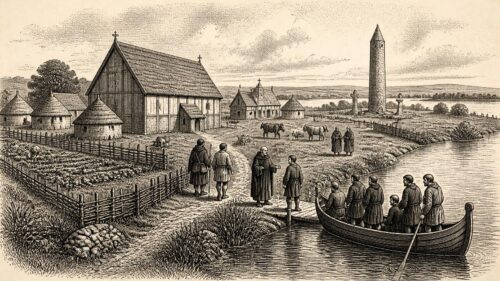
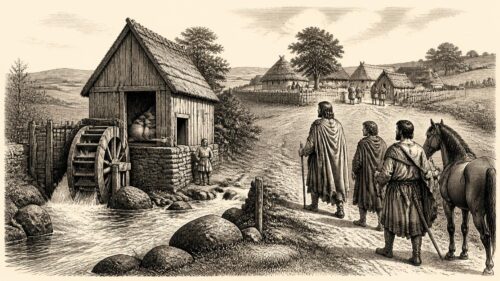
The change of setting was important. Rahan belonged to the midlands and Uí Néill political country; Lismore lay beside the Blackwater in Munster’s Déisi region. Rivers were practical routes through a landscape with no towns in the later medieval sense, moving people, food, timber and messages as well as offering water and potential power for mills. Archaeological research indicates that Irish communities of this period were already making sophisticated use of water-power and locating larger monasteries with environmental resources in mind. Lismore’s later greatness should not be read back wholesale into 636, but the choice of a riverside site was an intelligible and promising response to displacement.
Life Beyond the Annals
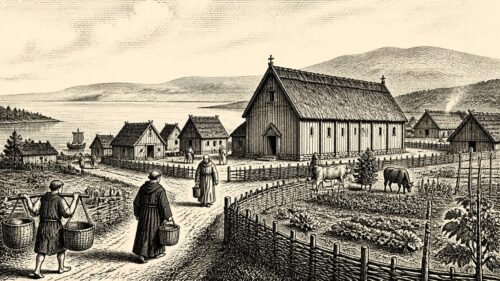
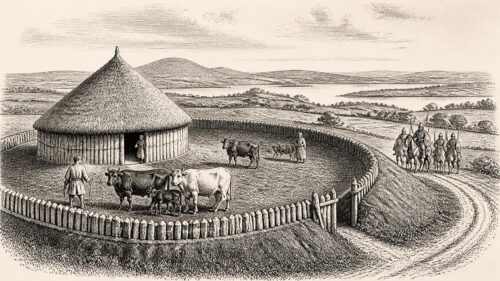
Most people living through 636 did not appear in the annals. Their world was overwhelmingly rural. Farm households commonly occupied ringforts or other enclosed homesteads, where timber or stone buildings sheltered families, animals, stores and working spaces. Cattle were central to food, dairying, wealth and political exchange, alongside sheep, pigs, crops and woodland resources. Daily tasks included grinding grain, tending stock, weaving, leatherworking, metalworking and food preparation. The annal of Mochuda’s expulsion matters partly because a monastery concentrated these ordinary activities: a religious settlement depended on surrounding cultivators, animal keepers, tenants, donors and craftsmen.
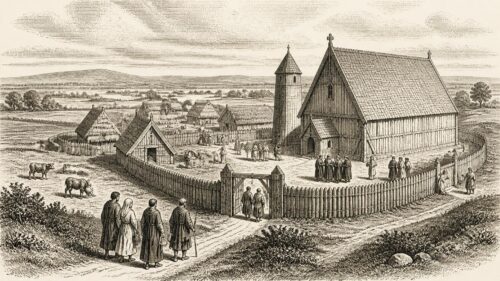
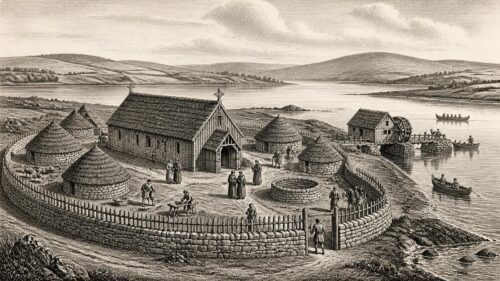
Monastic communities also extended the cultural reach of Christianity. They created places where Latin literacy, biblical learning, prayer and the recording of the past could be sustained, while Irish language, genealogies and local identities remained central to social life. Their enclosures often echoed the circular form of secular settlements, but could contain spaces for worship, craft activity, storage, cultivation and livestock. The physical remains visible at many famous sites are usually later than 636, so they must not be treated as a literal picture of Rahan or early Lismore in this year. Even so, archaeology and comparative evidence explain why the loss or gain of a monastery could reshape a district.
A Year on the Edge of Change
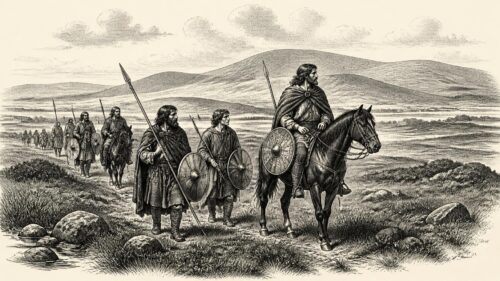
It is tempting to turn 636 into a prelude to the famous battle of Mag Roth, but that battle belongs to 637 in modern historical dating. The temptation arises because the transmitted annals have internal chronological offsets: an entry headed U637 in the Annals of Ulster is labelled AD 636 in the edition, while independent scholarship dates Mag Roth to 637. A year-by-year history should resist folding that later conflict into 636 merely for dramatic effect. What can responsibly be said is that Ireland in 636 already contained the strained political relationships from which major confrontations could develop: Uí Néill dynastic manoeuvring in the midlands, active local warfare, and monasteries whose allegiance and resources mattered.
Mochuda’s Easter exile therefore gives 636 its distinctive character. It was a year in which religious authority proved mobile but vulnerable, and in which removal from one political landscape opened the possibility of a new foundation in another. The sources do not allow a romantic procession of hundreds across Ireland, nor a simple verdict that theology alone caused the rupture. They do allow something more historically useful: a view of a monastery as a living institution embedded in power, economy and kinship. From that disruption emerged Lismore’s future significance as a southern centre of learning and church life, even though its later achievements lay beyond the calendar year itself.

Primary Sources
- The Annals of Ulster, Year U636
- Chronicon Scotorum, Annals CS635–CS639
- Annals of Inisfallen, Annals AI634–AI643
- Annals of the Four Masters, Annal M636
- Carthach (Mochuta)
- Blathmac
- Domnall
- The Annals of Tigernach
- Chronological Synchronisation of the Irish Annals
- The Chronological Apparatus of the Annals of Ulster AD 431–1131
- Ireland in the Seventh Century: A Tour
- Kingship, Society, and Sacrality: Rank, Power, and Ideology in Early Medieval Ireland
- Theme and Variations: Christianity and Regional Landscapes in Early Medieval Ireland
- Water-Power as a Factor of Industrial Location in Early Medieval Ireland
- Animals and the Economy of Medieval Ireland: A Zooarchaeological Analysis of the Faunal Remains from Caherconnell Cashel, Co. Clare
- Early Christian Monasteries
- Early Medieval
- Ringforts
- Early Medieval Farmsteads
- Clonmacnoise, County Offaly
- Saint Moling’s Millrace, St Mullins County Carlow
- Rahan Monastic Site
- Exploring the Irish Annals