Áed’s Obituary639 CE
In 639, conventionally dated despite conflicting annalistic chronology, Áed Dub, bishop and abbot of Kildare, died. A member of the Uí Dúnlainge dynasty, he embodied the close connection between ecclesiastical office and political authority in Leinster. His death left a vacancy at a wealthy church whose resources, cult of Brigit and regional connections gave it major influence. Annals also record the deaths of church leaders at Nendrum and Leighlin, Ailill son of Áed Rón, and Dúinsech, wife of King Domnall of Tara, as well as Congal son of Dúnchad’s killing. These terse notices reveal an Ireland linked by kinship, churches and patronage rather than central rule.
Dateline
In 639 CE, the most significant Irish development that can be placed with reasonable confidence in this calendar year was the death of Áed Dub, bishop and abbot of Kildare. His obituary is brief, but it illuminates a great deal: in seventh-century Leinster, an important church could be led by a member of a ruling dynasty, and religious office could be an instrument of regional authority as well as pastoral care. The year’s surviving notices also record deaths at Nendrum and Leighlin, the killing of a man named Congal son of Dúnchad, the death of Ailill son of Áed Rón, and the death of Dúinsech, wife of Domnall son of Áed. These were not necessarily events of equal weight, nor can every individual be securely identified. Together, however, they show a politically divided island knit together by ecclesiastical communities, dynastic marriages and the compressed reporting of the annals.
A Year With Difficult Dates
There is an important chronological warning. The Annals of Ulster group these entries under U639, but their own heading equates that annal-number with AD 638. The related Chronicon Scotorum places much the same cluster under 639, while the Annals of Tigernach place it under 641. Modern reference scholarship nevertheless dates Áed Dub’s death to 639. This does not mean that medieval writers supplied an exact modern-style date. Rather, the notices belong to a short and chronologically unsettled sequence in the transmitted annalistic tradition. It is safest to treat 639 as the conventional placement for Áed Dub’s death and as the year to which the surrounding notices are closely connected, while recognising that the source tradition does not permit precision to a particular month or day.
This caution matters especially because the annals were not diaries. They were compiled, copied and reorganised over centuries, preserving terse records whose original dates could be shifted by lost or duplicated calendar headings. Their economy is revealing in itself. A killing receives no explanation; an abbot’s death is sufficient news; the death of a ruler’s wife is preserved without a personal ancestry or account of her influence. Silence should not be filled with invented battles, harvest failures or successions. Nothing securely datable to 639 demonstrates a nationwide war, famine, epidemic or diplomatic settlement in Ireland. The year is instead best approached through the institutions and people whom the record does name.
The Death of Áed Dub
Áed Dub, whose name means “black” or “dark-haired”, held the combined offices of abbot and bishop at Cell Dara, Kildare. He was no isolated churchman. He belonged to the Uí Dúnlainge, a powerful north-Leinster dynasty: his father Colmán Már and his brother Fáelán were associated with the overkingship of Leinster. Later genealogical and ecclesiastical material calls him ríg-escop Cille Dara agus Lagen uile, “royal bishop of Kildare and all Leinster”. The title is ambitious, and should not be read as evidence of a neat territorial diocese in the modern sense. Yet it accurately conveys the fusion of aristocratic status and ecclesiastical leadership embodied by Áed Dub.
His death therefore mattered in two overlapping spheres. Within Kildare, it created a vacancy at the head of a wealthy and prestigious religious community. Within Leinster, it removed a close kinsman of the dynasty that was steadily increasing its influence across the central plain. The Uí Dúnlainge did not rule an uncontested, unified province. Leinster contained competing peoples and royal kindreds, while the strongest kings beyond its borders could intervene in its affairs. Still, the location of Kildare in the Liffey plain, amid major royal landscapes and routes, made its leadership politically valuable. The abbacy and episcopacy were offices through which land, dependants, sanctuary, learning and the prestige of Brigit’s cult could be organised.
There is no evidence that Áed Dub died violently. The annalist uses the conventional language of repose, unlike the separate entry recording Congal son of Dúnchad’s killing. That distinction is small but meaningful. An obituary of peaceful “repose” presents Áed’s death as an ordered ecclesiastical transition, even though the identity of the immediate successor and the practical negotiations around succession are not recorded. A nephew, Óengus son of Áed Find, later became bishop of Kildare, while another relative, Brandub, is known as abbot. Such kinship links demonstrate that control of Kildare remained closely interwoven with the political family of north Leinster.
Kildare’s Expanding Claims
The fullest surviving picture of seventh-century Kildare comes not from the annal for 639 but from Cogitosus’s Life of St Brigit, written probably not long after 650. It must not be treated as a literal report from the year of Áed Dub’s death: hagiography promoted a saint and the community that guarded her cult. Nevertheless, its claims make much better sense when read against the institutional standing represented by Áed’s obituary. Cogitosus depicts Brigit’s foundation as a major place of pilgrimage and refuge, with royal treasures deposited there and a far-reaching paruchia, or sphere of ecclesiastical association and obligation.
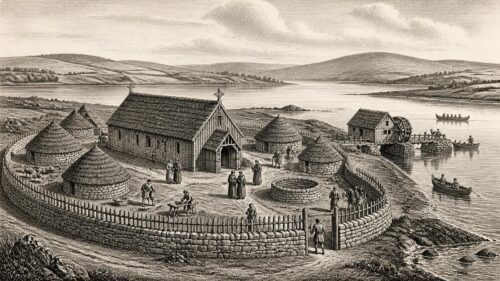
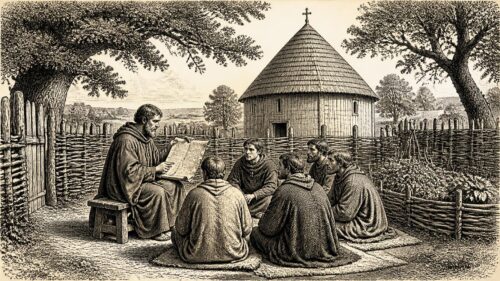
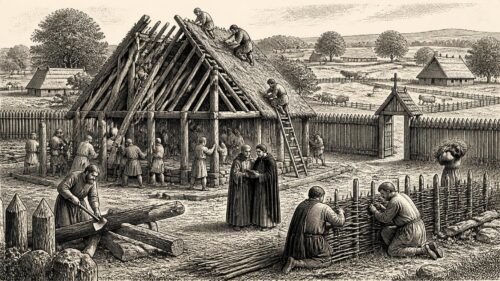
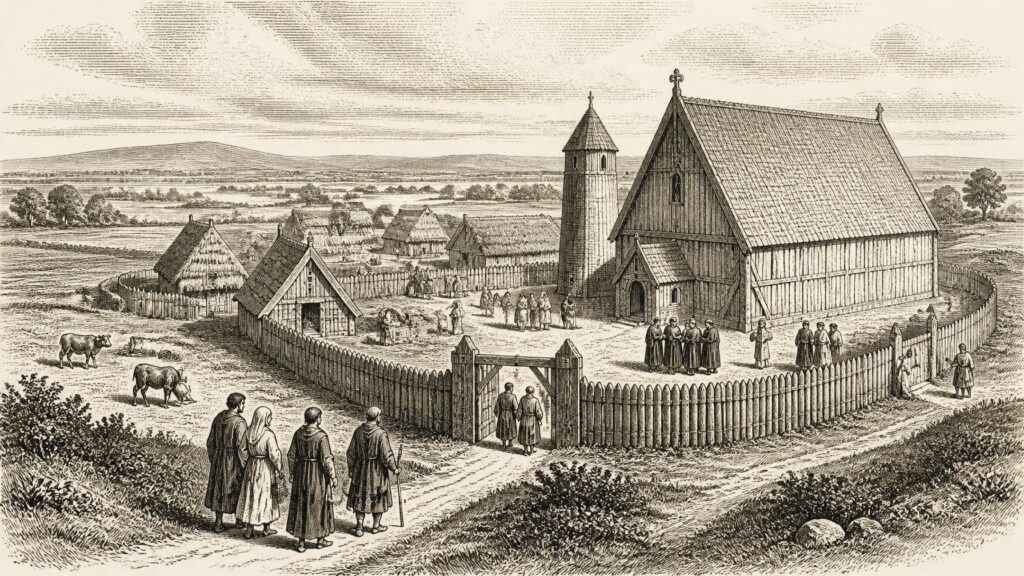
His celebrated description of Kildare’s church also suggests a community of unusual scale and aspiration. The establishment accommodated religious women on one side and monks and priests on the other, with distinct spaces within a single great church. This was not simply a secluded monastery in the later popular sense. Such a community required food supplies, accommodation, agricultural land, craft production, visitors, liturgical personnel and ties to lay patrons. Its church was a setting for worship and burial, but also a public statement of authority. Kildare’s claim to precedence over Irish churches was emphatically rhetorical and contested, particularly by Armagh; it should not be mistaken for accepted supremacy. Yet the very making of that claim indicates the competitive ecclesiastical environment in which Áed Dub had worked.
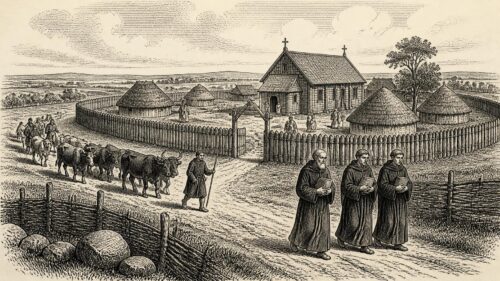
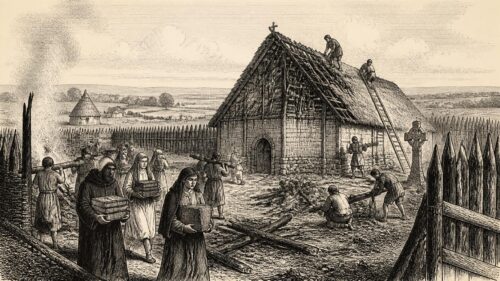
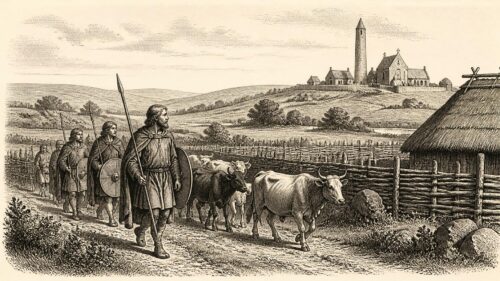
For ordinary people living on the surrounding plain, this institutional world would have been tangible. Dependants may have owed labour, renders in foodstuffs or other services to ecclesiastical landlords; travellers and petitioners could seek hospitality or protection; and local elites had reasons to endow churches where their names, burial and salvation might be remembered. The surviving texts do not permit a reconstruction of one household’s life in 639. They do, however, show why a great church such as Kildare was central to settlement and the regional economy, rather than an isolated spiritual enclave.
Leinster, Tara and Dynastic Loss
The annals also note the death of Ailill son of Áed Rón. Chronicon Scotorum calls him king of Leinster, whereas the Annals of Ulster gives only his pedigree. That difference is a reminder that titles in later copies must be handled carefully. Whether or not Ailill was universally recognised as overking, his inclusion among the year’s notable dead points to the continuing importance of Leinster’s royal politics at the very moment Kildare lost its bishop-abbot. The notices do not document a succession struggle, and none should be assumed. They do show that dynastic and ecclesiastical change occurred side by side.
Dúinsech, identified as the wife of Domnall son of Áed, belonged to an even wider political network. Domnall, of Cenél Conaill in the north-west, was king of Tara and one of the most powerful Irish rulers of his generation. He had emerged victorious from the great conflict at Mag Rath in 637, defeating Congal Cáech of Ulaid and strengthening his position. Dúinsech’s death is conventionally associated with this annalistic cluster, although modern chronological reconstructions often place it in 638. Her notice gives no parentage and does not identify her children, but its preservation beside royal and ecclesiastical obituaries indicates that queenship and elite marriage mattered to the annalists’ political horizon.
The killing of Congal son of Dúnchad is still more opaque. He should not be conflated with the better-known Congal Cáech, who had fallen at Mag Rath. The annals provide neither location nor motive, nor do they identify the killer. In a society where kindreds competed for land, rank and clientship, a killing could have serious local consequences; but the evidence does not license a narrative of feud or rebellion. It is a useful corrective to the temptation to turn every annalistic death into a national event.
Churches Across the Island
Two further religious deaths broaden the year beyond Kildare. Crídán of Nendrum, described alongside Áed Dub as a bishop, died at the island church of Nendrum in Strangford Lough. Do-Laise moccu Imdae, abbot of Leithglenn, or Leighlin, also died. These notices demonstrate a dispersed but connected Christian landscape: Nendrum looked towards the northern Irish Sea world, while Leighlin lay in south Leinster near the Barrow corridor. Neither entry tells us the size of its community, the form of its buildings or its estate. What they securely show is that abbots and bishops at several centres were figures whose deaths deserved commemoration in the same historical record as kings and royal spouses.
The clustering of obituaries should not be read as evidence of a disease outbreak. Medieval annals often grouped deaths for reasons of compilation, and no source for this year reports pestilence. Nor is there a securely recorded environmental crisis for 639. The responsible picture is quieter: churches continued to anchor local communities; rulers and their families competed for precedence; agricultural production and livestock sustained both secular households and religious foundations; and movement by road, river and sea connected regions that later maps can make seem remote.
Irish Affairs in a Wider Sea
The Ulster annal also includes “the battle of Oswald, king of the Saxons”, while the Tigernach tradition identifies a battle between Oswald and Penda. This is an English event rather than an Irish one, and its date is one of the clearest signs that the annalistic sequence has drifted: Oswald was killed at Maserfield in 642. Its presence nevertheless reveals the range of information available to Irish chroniclers. Ireland’s learned communities followed affairs in Britain and the Irish Sea zone, where church links, dynastic contacts and seaborne travel carried news as well as people and books. It cannot be used to claim Irish participation in the battle.
Thus 639 is not a year of one dramatic, securely dated national turning point. Its importance lies in the death of Áed Dub and in what that death exposes. Kildare was already a major Leinster institution whose spiritual authority, landed resources and political connections could not be separated. Around it, royal families endured bereavement and uncertainty, while bishops and abbots at Nendrum and Leighlin marked the reach of organised Christianity across the island. The surviving record is fragmentary, but it preserves a real structure of power: Ireland’s many kingdoms were held together not by a single state, but by kinship, churches, patronage and memory.

Primary Sources
- The Annals of Ulster: Year U639
- The Annals of Ulster: Year U639 (Latin text)
- Chronicon Scotorum: Annals CS635–CS639
- Chronicon Scotorum: Introduction
- The Annals of Tigernach
- Áed Dub | Dictionary of Irish Biography
- Cogitosus | Dictionary of Irish Biography
- Domnall | Dictionary of Irish Biography
- Brigit (Brighid, Bríd, Bride, Bridget) | Dictionary of Irish Biography
- Crimthann Cualann | Dictionary of Irish Biography
- Conláed (Conleth) | Dictionary of Irish Biography
- On the Life of St. Brigit
- On the Life of St. Brigit: Text
- Conversion and Consolidation in Leinster's Royal Heartland
- How Did Early Church Sites Differ from One Another? A Comparative Approach Within the Kingdom of Fir Maige, Ireland
- Monasticism and Its Limits: Rematerialising Monastic Space in Early Medieval Ireland
- Exploring the Irish Annals
- The Annals of Tigernach | National Library of Wales Archives and Manuscripts
- The Annals of Tigernach | National Library of Ireland Catalogue
- The Medieval World | University College Cork
- Corpus of Early Medieval Architecture of Ireland | University College Cork
- Early Monastic Churches | Ask About Ireland