Leinster Turmoil644 CE
Around 644, Irish annals record contested authority after the death of Domnall mac Áedo, with several Uí Néill rulers claiming or sharing the overkingship. In Leinster, Uaisle, wife of King Fáelán, died, highlighting dynastic links with the midlands. A battle at Cenn Con, probably involving Munster rivals, caused heavy losses, while kings of Osraige and Farney also died. Crónán, bishop of Nendrum, was commemorated, reflecting the importance of churches in literate and political life. The notices reveal a fragmented Ireland of regional kingdoms, alliances and recurring violence, rather than a unified state.
Dateline
In 644 CE, Ireland’s surviving annalistic tradition presents a compact but revealing cluster of deaths, warfare and disputed royal authority. Yet the date must be handled with care. The notices now grouped under 644 were copied into chronicles centuries after the events, and the parallel annals do not always place them in the same numbered year. What can responsibly be said is that, around this calendar year, the political order was unsettled after the death of Domnall mac Áedo, a major northern Uí Néill ruler, while Leinster, Osraige, Munster and the north-east each appear in the record through named people and institutions. The entries are brief, but their very selectivity shows what contemporaries or near-contemporaries thought worth preserving: rulers, royal marriages, battles, prominent churchmen and violent destruction.
A Question of Overkingship
The most important political notice attached to 644 concerns the kingship of Ireland. The Annals of Tigernach do not present a simple succession. Instead, they explicitly ask who ruled after Domnall and report that “some historians” held that four men exercised a joint or “mingled” sovereignty: Cellach and Conall Cáel, sons of Máel Cobo of the northern Cenél Conaill, alongside Diarmait and Blathmac, sons of Áed Sláine of Síl nÁedo Sláine in Brega. The same annal also states that Cellach and Conall “took the kingship of Ireland”.
This is unusually candid evidence of historical uncertainty within an Irish chronicle. It should not be converted into a modern-style regency, cabinet or constitutional co-monarchy. Early Irish overkingship rested on lineage, military following, client relationships, hostages, tribute and the ability to command recognition from other kings. A record of several possible rulers may therefore reflect overlapping claims and regional power rather than an orderly shared government. Nor should “king of Ireland” be understood as sovereign control of a unified state. Ireland was divided among many kingdoms, and even a powerful overking’s authority was negotiated and variable.
The uncertainty itself is historically meaningful. Domnall’s death had removed a ruler from the northern branch of the Uí Néill, but it did not settle the claims of competing kindreds. Cellach and Conall were his nephews; Diarmait and Blathmac belonged to another powerful Uí Néill branch based around Brega. The annal’s formulation captures a political landscape in which descent gave a claim, but effective lordship still had to be won and maintained. It is safer to see 644 as a moment of contested succession than to assign uncontested supremacy to any one man.
Uaisle and Fáelán
The year’s most striking personal notice is the death of Uaisle, daughter of Suibne son of Colmán, identified as the queen of Fáelán, king of Leinster. Her appearance by name matters. Women occur less frequently than men in the annals, and when they do, kinship and marriage commonly explain why their deaths were politically memorable. Uaisle’s father belonged to Clann Cholmáin, a leading dynasty of the midlands. Her marriage to Fáelán of Uí Dúnlainge therefore suggests a connection between the ruling circles of northern Leinster and Mide.
That connection should not be overstated as proof of a particular treaty in 644. No surviving source records a negotiation, dowry, hostage exchange or campaign arising from Uaisle’s marriage. But royal marriages were among the durable means by which early medieval dynasties built relationships across provincial borders. Fáelán had emerged in the preceding decades amid conflict within Leinster, and his position was closely associated with the rising fortunes of Uí Dúnlainge and with Kildare. Uaisle’s death, placed in the annalistic sequence for this year, offers a rare glimpse of the family alliances that underpinned such power.
It also warns against treating Leinster as a single obedient bloc. Fáelán is called king of Leinster in the notice, but other evidence indicates competing kings and local dynasties within the province. His practical authority was likely strongest in northern Leinster and around Kildare, while rivals such as Uí Chennselaig retained major interests farther south. In 644, as in the rest of early medieval Ireland, titles stated aspiration and precedence as well as settled command.
Cenn Con and Munster Rivalry
The annals record a battle at Cenn Con. The entry itself gives neither place, cause, victor nor casualty list. A related notice in the Annals of Inisfallen, entered under 645 rather than 644, identifies it as a struggle between Máel Dúin, son of Áed Bennán, and Aengus Liath of Áine, and says that there was heavy slaughter on both sides. This fuller wording makes clear that the conflict belonged to Munster’s internal politics, not a national war.
The differing annal dates are important. They prevent a claim that the battle can be fixed securely to a particular day, season or even, without qualification, to the modern calendar year 644. Nevertheless, its position close to the 644 sequence and its association with figures named there make it directly relevant to this year’s historical horizon. Aengus Liath is subsequently recorded as dead, while Máel Dúin had links to the powerful Eóganacht Locha Léin kindred of western Munster. The battle points to competition between regional lordships at a time when no single Munster king’s dominance should be presumed.
Another brief entry notes the burning of Iarnbadb, son of Gartnait. The wording is stark and the context absent. It may record the burning of a person, perhaps in a feud or attack, but the annal does not identify perpetrators, location or motive. It would be irresponsible to supply a story of execution, arson or dynastic revenge. What the notice does demonstrate is that chroniclers sometimes preserved individual acts of violence beside battles and royal deaths, reflecting a society in which personal status and family connections could make a single killing memorable.
Deaths Across Regional Ireland
Several deaths placed in this annalistic grouping illuminate the island’s political geography. Scanlán Mór, king of Osraige, died. Osraige lay between Munster and Leinster and was not a passive borderland: its rulers could pursue their own interests while being drawn into the competition of stronger neighbours. The annals do not name Scanlán’s successor or describe a crisis after his death. Still, the passing of a king in such a strategically placed kingdom mattered, because changes in local leadership could alter alliances, tribute and military obligations.
Aengus Liath of Glennamain also died, according to the Annals of Tigernach. Given the related account of Cenn Con, later tradition has naturally connected this death with the Munster conflict, but the annal does not explicitly say that he died of wounds received there. Cuanu son of Cailchín, described as king of Farney and “the Hero of Liathmuine”, is likewise entered among the dead. These notices preserve reputations as well as offices: a byname could carry a memory of prowess, locality or ancestry long after the circumstances of a life had vanished.
None of these obituaries permits a map of clear-cut succession in 644. They do, however, show that political life was intensely regional. The annal’s frame ranges from Leinster and Osraige to Munster, Farney and the Uí Néill heartlands; no single centre exhausts the history of the island. Kingship was reproduced through households, client peoples, churches, fosterage and marriage, as well as through victory in battle.
Crónán of Nendrum
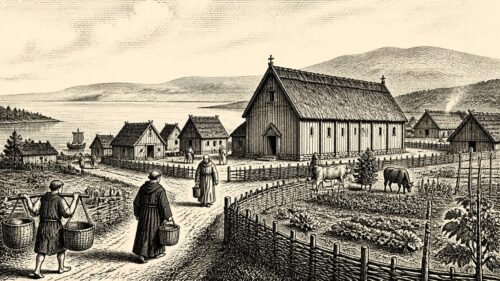
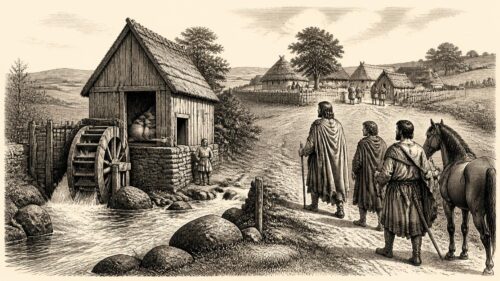
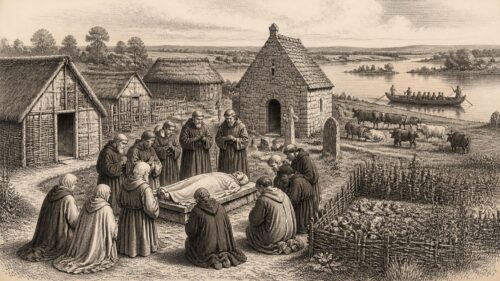
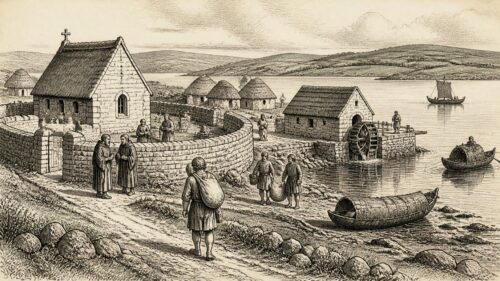
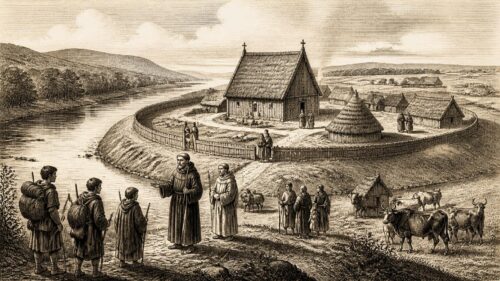
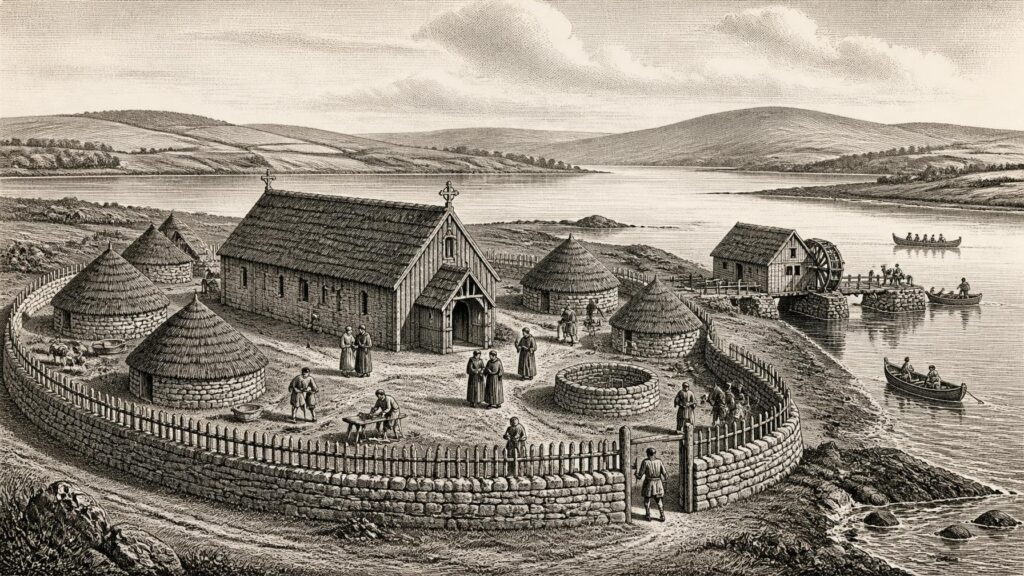
Church life is represented by the repose of Crónán, bishop of Naendrum or Nendrum, on Mahee Island in Strangford Lough. The use of “repose” marks a Christian death, while the designation “bishop” indicates that Nendrum was an ecclesiastical community of standing. Its location on a sheltered lough connected it to maritime routes across the north Irish Sea rather than isolating it from them. Archaeology has revealed a substantial enclosed settlement there and an early medieval tidal mill active in the seventh century, evidence of technical skill and organised use of shoreline resources.
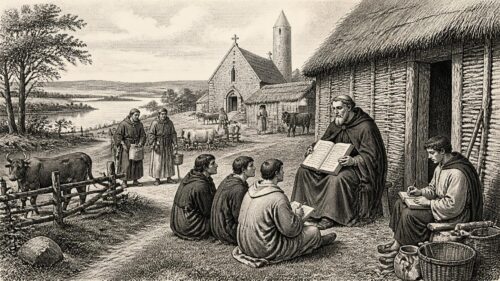
That mill cannot be dated specifically to 644, nor can Crónán’s death tell us how the community was governed day by day. But together they provide responsible context for the annal. Nendrum was not simply a remote place of prayer. Like other major Irish churches, it required food, labour, land, transport and learned personnel. Clerics participated in local society, received support from secular patrons and helped sustain literacy. The annals themselves, organised around kalends and linked to wider Christian chronology, are products of that literate ecclesiastical world.
Life Beyond the Notices
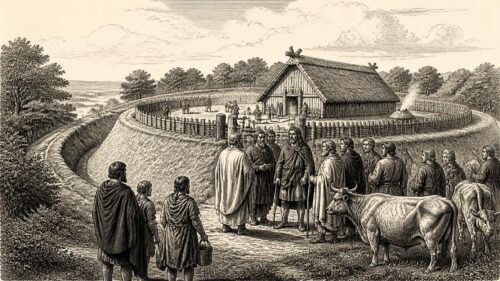
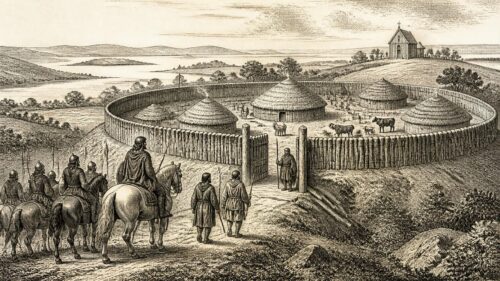
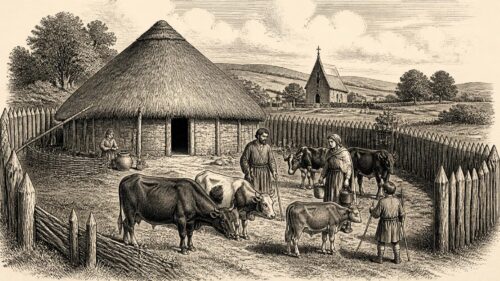
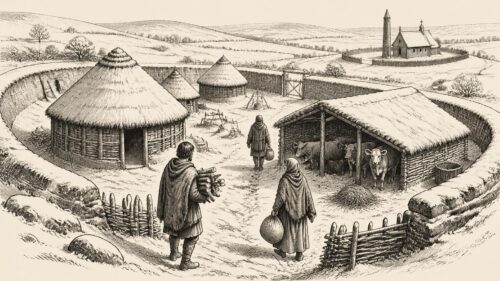
For most people, 644 was not experienced through annalistic succession disputes. Families lived in dispersed farming settlements, many within enclosed homesteads now known as ringforts or raths. Such places commonly contained houses, storage areas and space for animals; their banks and ditches helped protect valuable livestock and proclaimed household resources. Cattle remained central to wealth, food and exchange, while grain cultivation, dairying, woodland products and seasonal labour sustained rural life. Churches and kings depended upon this productive countryside for renders, hospitality and military service.
There is no reliable entry for a nationwide famine, epidemic, exceptional weather event or general social transformation in 644. Silence should not be mistaken for peace or plenty, but neither should it be filled with imagined catastrophe. The record instead preserves a year—or, more precisely, an annalistic cluster around the year—in which inheritance, marriage, battle and ecclesiastical leadership made the political world visible. Uaisle’s obituary, the unresolved succession after Domnall, the bloody but poorly located battle of Cenn Con, and Crónán’s repose at Nendrum together reveal an Ireland of regional powers held in balance by relationships that were continually vulnerable to death.
Primary Sources
- The Annals of Ulster, Year U643
- The Annals of Tigernach, Part 8
- Annals of Inisfallen, Part 21
- Chronicon Scotorum
- Annals of the Four Masters, Part 47
- Annals of the Four Masters (Irish Text), Part 47
- The Annals of Ulster (Irish Text), Part 213
- Chronological Synchronisation of the Irish Annals
- Chronological Synchronisation of the Irish Annals: Introduction
- Fáelán
- Nendrum Ecclesiastical Site
- Nendrum Monastic Site
- Early Medieval Archaeology Project
- Early Medieval Archaeology Project: January 2008 Report
- Clinging to Power: The Role of Vassal Peoples in Early Ireland
- Historical Truth or Literary Embellishment? Uncovering the Voices of Historical Queens in Medieval Irish Sources
- Imarcaigh Sund Ar Gach Saídh
- Ringforts / Ráthanna
- The Earthen Rath or Lios
- Churches and Ecclesiastical Enclosures / Shéipéil agus Ráthanna
- Dunleer – Rathdrummin
- Ordinary People in Early Christian Ireland