Inclusive Services
At a Glance
School Access
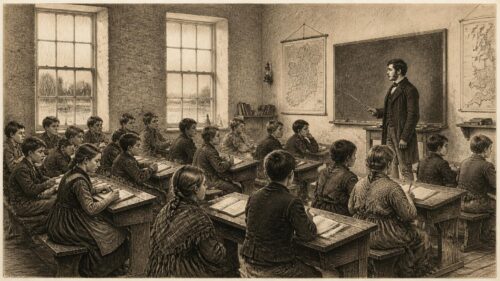
The surviving school-related records described by the National Archives show education as an administrated public activity rather than a private matter alone. The archives hold material from several schools and educational institutions, with records from the 1800s onward. The guide also notes that school registers can preserve home addresses, parents’ occupations, academic progress, attendance, religious affiliation, and the last national school attended, which makes the school a site where personal detail entered official record.
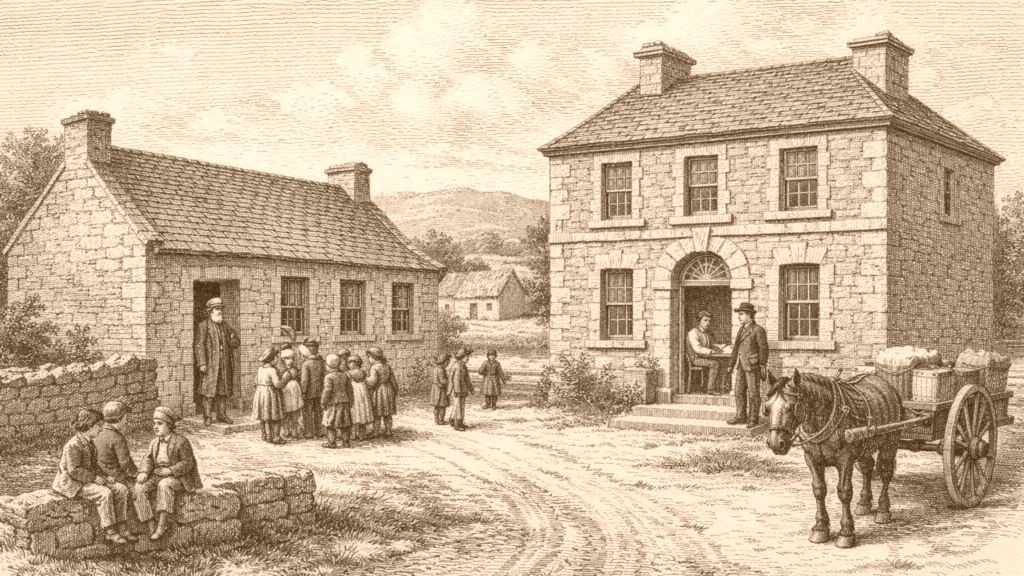
The same guide places the Commissioners for National Education in 1831 and says they were empowered to grant aid to existing schools, pay teachers, provide equipment, build new schools, appoint and pay inspectors, and establish a model school for teacher training. That description shows a system in which schooling depended on public authority, inspection, and finance. The later ending of the Board in 1922 is also noted, with its functions moving to the Minister for Education.
Public Records
The National Archives description of government research explains that departmental names and functions change over time and that older material may appear in hardcopy catalogues, not only online. It also states that private collections can matter for policy research, but access is not guaranteed if papers remain with families. In this setting, the search for school history depends on finding the right administrative trace rather than a single complete file series, and that trace may cross public and private custody.
The same catalogue guidance says each transferred record has a unique reference code, and that title and scope fields help researchers narrow searches. This is a practical expression of public service: records are organized for retrieval, security, and repeatable use. The guide also explains that hardcopy catalogues preserve material from the nineteenth and early twentieth centuries, including some archives of the Commissioners of National Education, which means older school administration survives in both paper and digital finding tools.
Inclusive Law
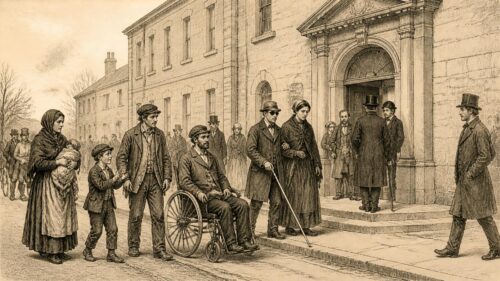
The Education Act 1998 gives the clearest inclusive statement in these records. Its long title says the Act is made in the interests of the common good for the education of every person in the State, including any person with a disability or other special educational needs. It also says the education system should respect diversity of values, beliefs, languages, and traditions, and should operate in partnership between schools, patrons, students, parents, teachers, other staff, the community, and the State.
The same Act sets out institutional supports that belong to public administration: recognition and funding of schools, boards of management, an inspectorate, the role of principals and teachers, and the National Council for Curriculum and Assessment. It also lists educational disadvantage, teaching through Irish, grievance procedures, and access-related matters among its parts. The structure shows inclusion not as a single clause alone, but as part of a wider regulatory framework for schools.
Teacher Records
The archival guide on education records shows that registers and salary books preserve the ordinary workings of schools. Registers can include particulars of the school, its patrons, controlling committee, schoolrooms, financing, attendance, and inspector reports. Salary books cover teachers’ pay, while files can concern maintenance and disputes between teachers and managers. These categories present inclusion as something administered through routine paperwork, not only through formal legislation or grand policy statements.
The same records also allow comparison across school types and administrative layers. National school registers note home addresses, religious affiliation, residence, and parents’ occupations, while daily report books record attendance class by class and day by day. That level of detail reveals the school as a place where public service and local social information met in one file structure. The evidence is descriptive rather than exhaustive, but it is clear about what was recorded.
Historical Contrast
A contrast appears when nineteenth-century commentary on Irish primary education is set beside the modern statute. The earlier text describes severe discipline, long hours, morning and night schools, and a broad sense that primary education had failed to secure lasting habits of reading and writing. It also says many pupils who passed through ordinary classes later slipped back into near illiteracy. This is a critique of outcomes, not a legal definition of inclusion.
Against that background, the later legal language of every person in the State and special educational needs marks a different administrative register. The Act’s emphasis on accountability to students, parents, and the State, together with partnership among schools and the wider community, places inclusion within public service rather than private benevolence. The contrast is textual and chronological: one source criticizes schooling practices, while the other defines the duties of a statutory system.
Service Networks
Public services beyond education help frame the school records. The Office of Public Works archive is described as a large record set dating from 1831, with material on public infrastructure and services, including working papers, correspondence, reports, and plans. Among its categories are National Schools, showing that school buildings and related administration belonged within a broader state portfolio of roads, harbours, civil buildings, and other public works. The archive’s scale reinforces the bureaucratic setting of schooling.
The OPW guide also notes that some records predate the office itself because responsibilities passed from older bodies. That detail matters for school history because it shows how public services can accumulate through institutional succession rather than a single founding act. In this documentary landscape, schools appear as one part of a network that includes buildings, inspection, finance, records management, and later statutory inclusion. The comparison is cautious, but the continuity of administration is visible.