

Equal Dwellings
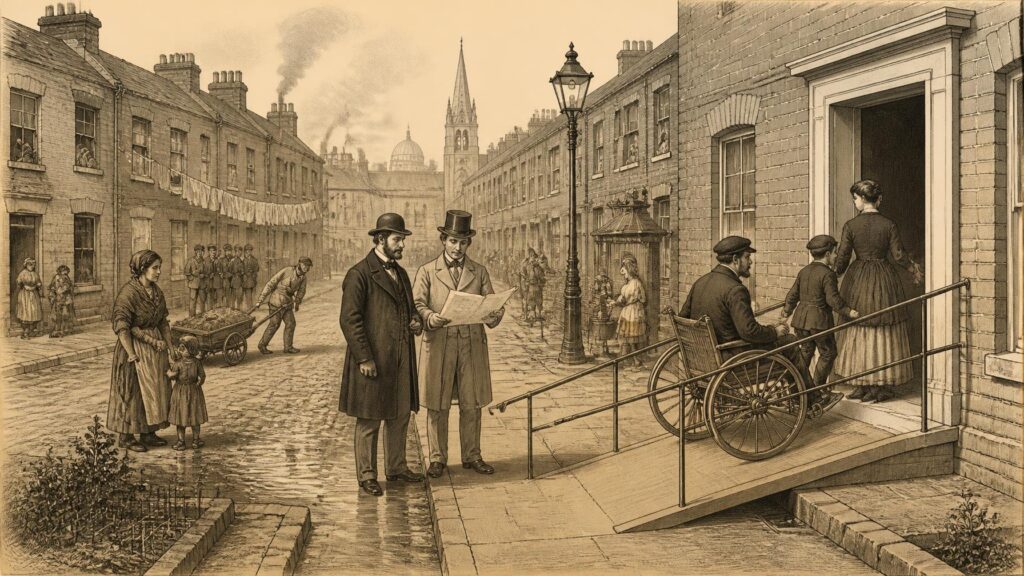
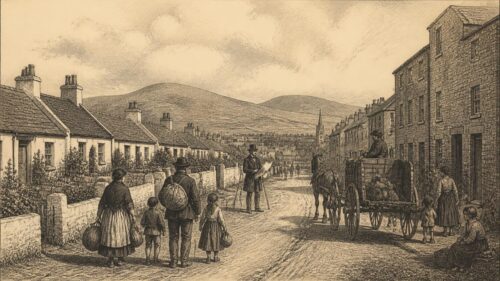
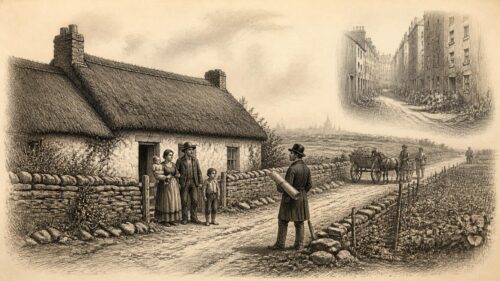
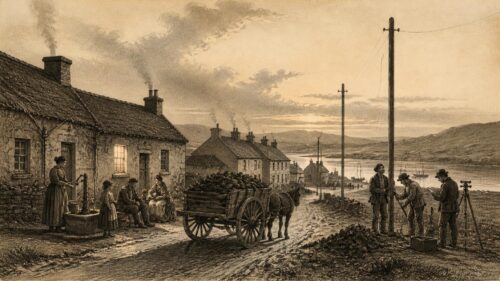
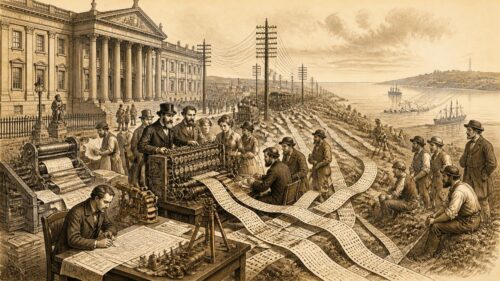
AI generated historical illustration, not a contemporary photograph.
At a Glance
Housing is never merely shelter. In Irish history it has also been a public instrument: a means of confronting disease, overcrowding and poverty, of building the legitimacy of a new State, and, more slowly, of deciding who could participate in ordinary civic life. The history of disability rights gives that final question special force. A dwelling may exist, a service may be publicly funded, and a legal entitlement may be declared, yet none necessarily ensures that a disabled person can enter a building, obtain suitable accommodation, choose where to live, or receive the supports required to remain part of a neighbourhood.
This is principally a history of the Republic of Ireland. Before independence, housing law in Ireland developed within the United Kingdom; after 1922, the Irish Free State and then the Republic created their own housing, health and equality frameworks. Northern Ireland has its own, distinct legislative and administrative history and should not be silently folded into a narrative based upon statutes enacted by the Oireachtas. The shared island experience of poverty, emigration, institutional care and voluntary provision nevertheless supplies important context.
The connection between public services, housing and disability rights was not always named in those terms. Nineteenth-century legislators spoke of lodging houses, sanitation and the labouring classes. Mid-twentieth-century officials often approached disability through medical care, charitable endeavour and segregated provision. By the later twentieth century, disabled people and their organisations increasingly pressed a different claim: disability was not simply an individual condition to be managed but a question of barriers, citizenship and equality. Housing became central to that claim because one cannot exercise civic rights fully from an inaccessible house, an unwanted institution, or a community without appropriate supports.
Urban Origins
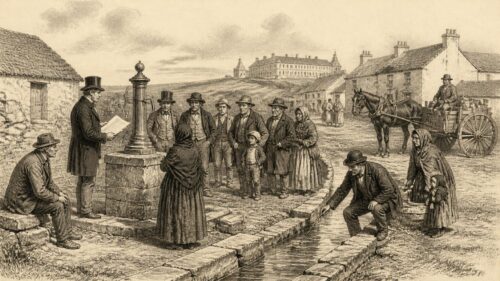
The earliest modern roots of Irish public housing lie in the crowded and unhealthy towns of the nineteenth century. Dublin, in particular, was associated with severe tenement conditions. Reform was driven not by a mature idea of social citizenship, still less by disability rights, but by an overlapping concern for order, disease, mortality and the housing of people on low incomes. Municipal intervention grew from the recognition that private arrangements had not supplied habitable accommodation for many urban residents.
Michelle Norris’s historical survey of Irish social housing identifies the mid nineteenth century as the foundation period and notes that Ireland’s first significant social-housing legislation was the Labouring Classes (Lodging Houses and Dwellings) Act 1866. Its immediate setting included disease epidemics in Dublin, while its model came from earlier British legislation. The importance of that fact is twofold. First, Irish public housing was shaped by imperial law before the establishment of an independent Irish State. Second, the original rationale was collective public health as much as individual welfare. The dwelling entered public policy because poor housing harmed whole cities.
This sanitary inheritance mattered long afterwards. It established the principle that housing conditions could be an object of public authority, inspected and improved through legislation, local bodies and public finance. It did not establish a general right to a home. Nor did it make accessibility a routine design requirement. Yet it created the institutional language from which later claims could grow: suitability, fitness for habitation, overcrowding, local responsibility and public expenditure.
It is tempting to describe early reform as the beginning of inclusion. That would be too generous. Contemporary legislation and administration were primarily concerned with the physical condition of the housing stock and with urban disorder, not with disabled people’s autonomy or equal participation. Persons with impairments were present in every class and neighbourhood, but the historical records rarely accorded them the political voice later associated with disability movements. The absence of that voice in official housing discourse is itself significant evidence of the limits of the period.
Colonial Frameworks
Before 1922, Ireland’s housing system developed under a constitutional arrangement in which key legislation came from Westminster. This shaped both the sequence and character of public intervention. As Norris observes, the different legislative and financial arrangements used for Ireland and Britain before independence meant that Irish social housing did not simply replicate the British pattern, even where Acts had a common origin. Local conditions, rural settlement, landlordism, municipal capacity and nationalist politics all affected what could be built and for whom.
Housing policy also had a rural dimension. Labourers’ cottages and schemes associated with rural local authorities addressed a form of deprivation different from Dublin tenements. The resulting Irish tradition was therefore not confined to municipal flats or urban clearance. It included small houses, rural improvement and the use of public assistance to stabilise households. This breadth later encouraged an unusually strong association between State-supported housing and home ownership, rather than a permanently large rental sector alone.
For the purposes of disability history, the colonial framework also illustrates a recurring problem: provision may be technically public without being designed around the needs and choices of those who use it. A house supplied under a general scheme might relieve overcrowding while remaining difficult to enter, unsuitable for a person with limited mobility, distant from family supports, or tied to institutional rather than community care. Such questions rarely appeared as explicit statutory categories at the time. They must therefore be treated as historical interpretation, not as rights already recognised by nineteenth-century lawmakers.
Folklore and retrospective memory sometimes portray the older Irish home as naturally accommodating because of kinship, neighbourliness or rural mutual aid. Such memories may preserve real experiences of care, but they cannot substitute for evidence about tenure, income, accessibility or personal choice. Family support could be generous; it could also conceal dependence, overcrowding and exclusion. The historical record cautions against treating domestic affection as a replacement for public responsibility.
State Building
Independence gave housing a new political significance. The Irish Free State inherited a severe housing problem and limited financial resources, but it also inherited the possibility of using housing to demonstrate practical State capacity. In the decades that followed, local authorities became major providers of rented dwellings, while State policies encouraged construction, purchase and the spread of owner occupation. Housing was associated with family formation, public health, employment and the consolidation of a national society.
The scale of social housing in the middle decades of the twentieth century is important. UCD research notes that local authorities supplied most social housing until the 1980s and that social housing represented a substantial share of total Irish output in the 1930s, 1940s and 1950s. By 1961, according to the same research, 18.4 per cent of the population was accommodated in this sector. These figures do not describe a complete welfare state, nor do they prove that every dwelling was adequate. They do show that public housing was once a central part of Irish housing supply rather than a marginal residual service.
This achievement had uneven consequences. A house-building State could reduce overcrowding and offer a stable home to many families, but its models were often conventional: nuclear households, standard plans, family-based care and limited attention to variation in bodily or sensory needs. In this respect, the history of public housing and the history of disability provision initially ran alongside each other rather than fully meeting. Housing departments concentrated upon supply and allocation; health and voluntary bodies often dealt with disability services.
That division had practical consequences. If an adult required personal assistance, therapeutic support or adapted accommodation, no single public body necessarily viewed the whole situation as its responsibility. Housing could be treated as a matter for a local authority, care as a matter for a health body, income as a welfare matter and access as an exceptional expense. The later language of coordinated services emerged precisely because people encountered the gaps between those separate systems.
Separate Services
For much of the twentieth century, disability in Ireland was commonly organised through a medical and charitable model. The National Disability Authority has described the older approach as one in which disability was located mainly within health policy and services were largely dependent on the voluntary sector. This description is not a claim that voluntary organisations did no good; many created services, advocacy and community connections where State provision was weak. It does, however, identify a structural fact: disabled people’s access to support often depended upon diagnosis, philanthropy, family resources and institutional arrangements rather than an enforceable general right to equal participation.
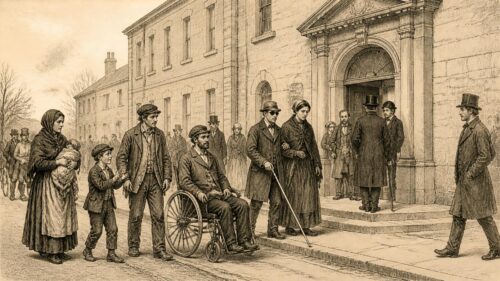
Institutional provision formed part of this history, particularly for people with intellectual disabilities and mental-health needs. The historical significance of institutions cannot be reduced to a single verdict. They could provide care, employment and residence in circumstances where families lacked money, accommodation or support. Yet the institutional model also placed decisions about everyday life, relationships and residence in the hands of professionals, religious bodies or administrators. The central disability-rights challenge was not merely to improve conditions within services but to ask whether the service itself permitted a person to live as an ordinary citizen in the community.
Housing is decisive here. A policy of community inclusion requires a real place to live, not only a philosophical preference for community. It requires a dwelling that can accommodate an individual, proximity to relationships and services, and supports that do not collapse when a person leaves congregated care. The move from institutional accommodation towards community living therefore made housing authorities, planners and mainstream service providers participants in disability policy, whether or not they initially saw themselves in that role.
Interpretation is necessary at this point. The division between “housing” and “care” may appear administratively tidy, but historically it often obscured the lived unity of both. A person’s ability to make tea, travel, receive visitors, keep a job or attend a public office can depend simultaneously on the layout of a home, income, transport, personal assistance and the willingness of public bodies to coordinate. Later policy did not invent these interdependencies; it named more plainly what disabled people and families had long experienced.
Housing Priorities
The Housing Act 1966 provides unusually direct evidence that disability had entered statutory housing thought, although in language now dated. Section 60 required a housing authority to prepare a scheme governing priorities in the letting of its dwellings. In framing or amending that scheme, the authority was to consider, among its primary objectives, the provision of adequate and suitable accommodation for people, including elderly or disabled persons, who were in need and unable to provide it from their own resources.
This was a meaningful advance, but it should be understood precisely. The Act did not create an unconditional individual right to a particular dwelling. It imposed a duty upon housing authorities to make priority schemes and directed their attention towards need, suitability and people unable to secure accommodation themselves. Its significance lies in the recognition that disability could make ordinary housing provision inadequate. “Suitable” accommodation implied, at least in principle, that the physical and social characteristics of a home mattered as well as its existence.
The Housing Act 1988 developed the machinery of housing-need assessment. It included disabled people among the categories of need to which an authority could have regard, alongside overcrowding, homelessness, medical or compassionate circumstances, old age and an inability to meet accommodation costs. The Act also required notice to relevant health boards and allowed engagement with voluntary or non-profit organisations. That design acknowledged, however imperfectly, that housing need could not be measured by income alone.
The wording of both Acts reveals the period’s transition. Disability appears in categories of need and priority, often alongside age, illness or hardship. This was more responsive than a system blind to impairment, but it still tended to frame disabled people as recipients of special consideration rather than as rights-holders entitled to shape ordinary public provision. The change from welfare priority to equality right would become one of the defining developments of the following decades.
Community Change
During the 1980s and 1990s, Irish disability policy changed in language, organisation and ambition. International disability activism, the growing authority of disabled people’s organisations and broader equality debates all contributed to a challenge to medicalised assumptions. The question shifted from “what service should be supplied to this patient?” towards “what barriers prevent this citizen from participating?” That shift was neither automatic nor complete. It was contested, gradual and dependent on political organisation.
The establishment of the Commission on the Status of People with Disabilities in November 1993 was a major landmark. Its 1996 report, A Strategy for Equality, resulted from extensive consultation and became a pivotal document in the Irish movement from a service-centred approach to an equality-centred one. The National Disability Authority characterises the report as a milestone and records that the Commission was asked to examine the lives of disabled people and propose practical improvements.
The Commission’s importance lay partly in its scale of ambition. It did not confine disability to health departments. It considered rights, education, transport, information, access and participation. It recommended a Disabilities Act and criticised fragmentation across government. In housing terms, this approach made it increasingly difficult to regard an inaccessible flat, a rigid allocation system or a lack of community supports as merely technical inconveniences. They were barriers produced or perpetuated by public arrangements.
The report should not be romanticised as an instant revolution. Recommendations do not implement themselves, and later policy documents acknowledge lengthy and uneven development. Nevertheless, the Commission changed the terms of argument. It gave institutional form to the proposition that disabled people should be consulted about the policies that shaped their lives. It also helped establish mainstreaming: the idea that ordinary departments and public bodies, rather than a specialist disability service alone, must take responsibility for inclusion.
Equality Turning
The late 1990s and early 2000s brought legislation that made equality more tangible across daily life. The Employment Equality Act 1998 included disability among protected grounds and addressed reasonable accommodation in employment. The Equal Status Act 2000 extended anti-discrimination principles into the provision of goods and services, accommodation, education and clubs, subject to the statutory detail and exceptions of the Act. These laws were not housing policy in the narrower sense, but they mattered for housing because discrimination can occur through access to accommodation, service procedures and the ordinary institutions that make community life possible.
This legal development illustrates why disability rights cannot be isolated from public services. A person may be allocated a dwelling yet be excluded if the landlord, local office, public counter, information system or transport connection is inaccessible. A tenant may need adaptations, communication in an accessible format, or supports coordinated across bodies. Equality law made it more difficult to treat such matters as private misfortunes or discretionary favours.
There were limits. Legal protections depend on definitions, procedures, resources, knowledge and enforcement. Litigation and complaint mechanisms can remedy particular wrongs but do not by themselves produce accessible housing stock, trained staff or adequate supports. A historically responsible account must therefore resist a simple story in which legislation solved earlier exclusion. Laws altered obligations and expectations; implementation remained an administrative and political struggle.
The most enduring achievement of the equality turn was conceptual. It separated disability from the assumption of incapacity. It made room for the understanding that a person may be prevented from taking part not solely by impairment but by stairs, narrow doors, information barriers, institutional routines, poverty and prejudicial assumptions. This social understanding of disability had profound implications for the design of homes and public services alike.
Legal Architecture
The Disability Act 2005 was a central product of this period. Its long title set out objectives including assessment of certain health and education needs, the making of ministerial plans, improved access to public buildings and public services, equality, social inclusion and related matters. The Act did not constitute a complete constitutional bill of rights, and its provisions were shaped by resource qualifications and phased commencement. Yet it placed disability access and public-service duties within a distinct statutory framework.
Part 3 of the Act was particularly important to the built environment and public administration. It required specified Government departments to prepare sectoral plans. It also addressed access to public buildings and access to services supplied by public bodies. The National Disability Authority explains that the wider National Disability Strategy built upon a policy of mainstreaming and that the 2005 Act gave legal effect to the approach of requiring mainstream public services to include disabled people.
That phrase, “mainstream public services”, marks a significant historical departure. Under an older model, disability might be referred away from ordinary provision towards specialist institutions or charities. Mainstreaming instead held that the normal machinery of government should become inclusive: housing, transport, communications, education, employment and public buildings. The burden of adaptation was no longer supposed to rest exclusively with the individual or family.
The legislation should be read as an architecture rather than a single door. Needs assessment, service statements, sectoral planning, accessibility standards and complaints procedures each addressed a different part of the relationship between citizen and State. No component was sufficient by itself. Together they reflected the recognition that disability exclusion arose through systems. This was especially relevant to housing, where construction, allocation, adaptation, care and neighbourhood services are often administered by different institutions.
Domestic Access
Housing has a special place in disability history because it is the setting in which privacy, family life, personal assistance and independence are negotiated. Accessible public buildings matter, but a person who cannot use the bathroom, leave the front door safely, receive friends or obtain necessary support at home remains excluded in a more fundamental way. Housing policy therefore had to move beyond simply counting units.
The public vocabulary of “adaptation” reflects this problem. Grants and works such as ramps, level access, accessible bathrooms, widened entrances or other alterations can enable a person to remain in a familiar home. They can also reveal the limitations of standard construction. When a dwelling must be altered after the fact, accessibility may appear as a costly exception rather than a normal feature of good housing design. The historical movement towards universal access challenges that assumption without denying the continuing need for individual adaptations.
Social-housing allocation creates another tension. A local authority may recognise disability in its assessment of need, but the availability of a suitable home depends upon location, dwelling type, household circumstances and supply. An offer far from established supports may meet one administrative definition of housing need while frustrating another aim: choice. The later emphasis on independent living brought this issue into clearer view. Independence did not necessarily mean living without assistance; it meant having control over where and with whom one lived, with support arranged around that life.
Official housing strategies in the twenty-first century increasingly expressed this coordinated approach. The National Housing Strategy for Disabled People 2022–2027 frames housing as a cross-government matter involving local authorities, the Housing Agency, the Health Service Executive and several departments. It places independent living and community inclusion at the centre of its stated vision. As historical evidence, this shows how far the official formulation has travelled from the older separation of housing, health and voluntary care, even if the practical achievement of that vision must be judged separately.
Public Duties
The most important historical transformation is perhaps the movement from discretionary benevolence to public duty. Charity and family care did not disappear, nor should their contribution be dismissed. But a system based chiefly upon goodwill leaves essential matters contingent: a sympathetic official, a voluntary body with available funds, relatives able to provide care, or an exceptional grant. Rights-based policy seeks to make access less dependent on fortune.
In Irish housing law, the 1966 and 1988 Acts supplied frameworks for priority and assessment. Equality statutes addressed discrimination and accommodation in specified contexts. The Disability Act 2005 added duties concerning public buildings, services and planning. The legal landscape remains composite rather than simple. That complexity reflects the reality that a home is linked to many systems, but it can also make accountability difficult for citizens navigating them.
Public duty also changes the role of evidence. A person seeking help no longer appears solely as an object of welfare assessment but as someone whose circumstances should inform a public body’s obligations. This does not eliminate assessments or resource limits. It does change the terms on which they are made. The history of disability rights repeatedly shows that voice, representation and accessible information are necessary if formal duties are to be meaningful.
There is a caution here for historians. Contemporary language can make the past seem more coherent than it was. Local officials, voluntary providers, tenants, families and disabled people did not all share the same priorities. Progress occurred through negotiation and pressure, not by the steady unfolding of an agreed national plan. Public services improved in some places and periods while remaining fragmented in others. The record is one of reforms, partial achievements and recurring gaps.
Historical Balance
Documented evidence supports several firm conclusions. Ireland developed public housing from nineteenth-century sanitary and social reform; local-authority housing became a major element of national supply in the twentieth century; statutory housing frameworks came to recognise the needs of disabled people; and, from the 1990s, disability policy increasingly adopted equality, participation and mainstreaming as organising principles. The Commission on the Status of People with Disabilities and the Disability Act 2005 are clear landmarks in that transition.
Interpretation is needed when explaining the relationship between these developments. It is reasonable to conclude that the growth of rights language changed the meaning of suitable housing. Earlier legislation could identify disabled people as a category of need. Later law and policy increasingly asked whether ordinary housing and public services excluded people by design, practice or neglect. This was not merely a change of terminology. It changed what governments, local authorities and service providers could be expected to consider.
What cannot be responsibly asserted is that Ireland achieved a settled right to accessible, appropriate housing for every disabled person. The surviving policy framework demonstrates aspiration, duties and administrative structures; it cannot, by itself, prove uniform delivery. Nor should broad statistics on public housing be used to infer equal benefit across disability, gender, class, region or household type. Historical evidence is strongest when it distinguishes statutes and policy declarations from lived outcomes.
Folklore has its place only when treated carefully. Stories of neighbours building ramps, families adapting cottages or communities rallying around a person in need can reveal moral worlds and local practices. They may illuminate the human ingenuity that filled official gaps. But they do not show that those gaps were acceptable, or that informal care gave people freedom, privacy and choice. A history of rights must value mutual aid without mistaking it for a substitute for accessible public provision.
Continuing Questions
The modern Irish framework treats disability housing as a cross-government responsibility. That is the logical outcome of the historical path traced here. Local authorities hold statutory housing responsibilities; health services provide supports; national departments establish policy and funding arrangements; equality law regulates discriminatory conduct; and disabled people’s organisations continue to press for accountability. The division of labour can be useful, but it also creates the danger that each body will see only a portion of the person’s life.
The enduring question is therefore coordination with control. Housing and support must be coordinated, but not in a way that restores institutional control over private life. The most important lesson of the rights movement is that an adequate home is not simply a place assigned to someone. It is a base from which that person can make decisions, sustain relationships, use services and take part in the public world.
Irish history shows why this principle took time to emerge. Public authorities first confronted housing as sanitation and scarcity; later they built homes as part of social and national development; only gradually did law and policy recognise that design, access and support determine whether a home enables equal citizenship. The story is unfinished. Its historical achievement is not the elimination of barriers, but the establishment of a stronger public standard by which barriers can be identified, challenged and removed.
The article’s striking implication is that suitable housing cannot be separated from support, accessibility, transport and personal choice. Irish policy gradually moved beyond treating disability as a specialised welfare concern, yet the historical division between housing and care still illuminates why legal recognition alone may not secure community participation. The contrast between priority-based allocation under earlier Housing Acts and later equality-centred duties also raises questions about what meaningful inclusion requires in practice. How should contemporary Irish housing policy balance individual choice, adaptable mainstream housing, coordinated supports and scarce public resources so that disabled people can participate fully in neighbourhood life?