

Digital Republic
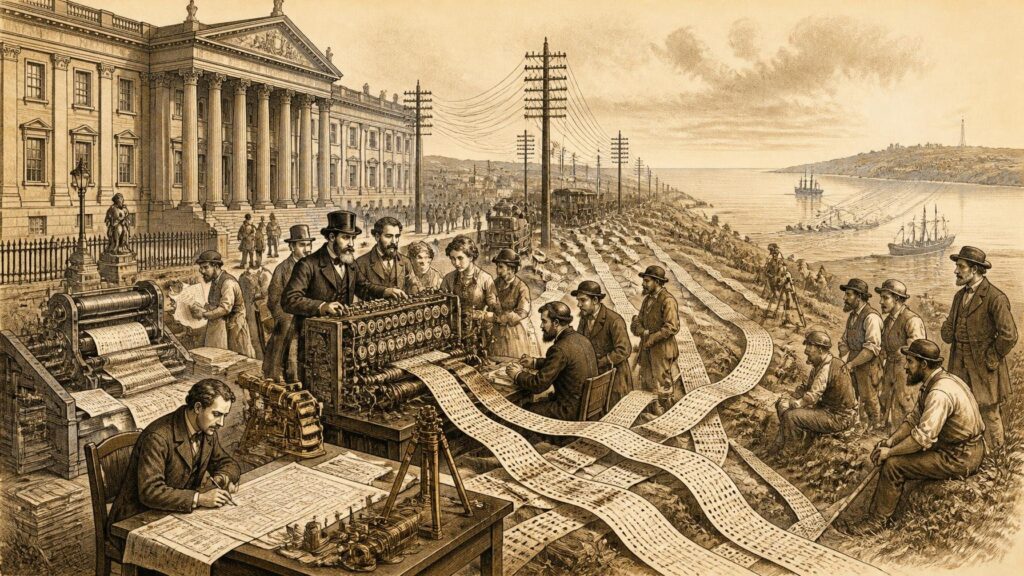
AI generated historical illustration, not a contemporary photograph.
At a Glance
Ireland’s AI strategy belongs to contemporary history rather than prophecy. It records how a small European state, already deeply woven into the global technology economy, attempted to turn rapid technical change into public policy: promoting innovation and enterprise while promising rights, trust, access, skills and democratic oversight. The documents are recent, and their outcomes remain uncertain, but they form a revealing archive of the Irish Republic’s ideas about the economy, citizenship and state capacity in the early twenty-first century.
Strategic Beginnings
The phrase “Digital Ireland AI Strategy” does not identify a single original document. Rather, it usefully describes a sequence of linked state programmes. The principal landmarks are the National Artificial Intelligence Strategy, AI – Here for Good, published in July 2021; Harnessing Digital – The Digital Ireland Framework, published in February 2022; the 2024 refresh of the AI strategy; and the 2026 National Digital and AI Strategy, Digital Ireland – Connecting our People, Securing our Future. Taken together, they show a change in governmental language. Artificial intelligence first appeared as a defined policy field requiring public trust and ethical safeguards. It was then incorporated into a wider national programme concerning infrastructure, public services, enterprise, regulation, skills and social inclusion.
This was not merely an exercise in renaming. The earlier AI strategy was organised around eight strands, including society, governance, enterprise adoption, public services, innovation, education, infrastructure and implementation. Its declared vision was that Ireland should become an international leader in using AI for the benefit of its people, through a responsible and person-centred approach. The language deserves attention. It avoided treating AI as a self-justifying technical inevitability. Instead, it presented the technology as an instrument whose legitimacy depended on public benefit, trustworthy governance and social acceptance.
The 2022 digital framework widened the frame. It placed digital transformation within four broad dimensions: enterprise, infrastructure, skills and public services. This represented a familiar Irish governmental method. Rather than create a wholly separate technological state, policy sought to coordinate existing departments, agencies, regulators, educational institutions and enterprise bodies. The strategy thus became a map of administrative relationships as much as a plan for software, networks or machine learning.
The historical importance of these texts lies partly in their effort to make disparate developments intelligible as one national story. Remote work, online commerce, broadband, cyber security, digital identity, cloud services, public databases and AI adoption had often developed through different institutions and at different speeds. The strategies placed them in a common account of national progress. Such coherence was aspirational as well as practical. It told citizens, businesses and international investors that Ireland intended to remain a technologically capable state while claiming that the gains of digitalisation should be shared more widely.
Economic Foundations
That ambition emerged from a distinctive economic inheritance. For decades, Ireland has sought international investment, export growth and participation in advanced industries. Its attraction as a European base for technology firms became an important feature of the country’s modern economic identity. The contemporary AI strategy repeatedly assumes this setting: Ireland possesses an established technology ecosystem, multinational companies, research expertise, a highly educated workforce and close access to European markets.
Yet the strategies do not simply celebrate foreign investment. They also reveal an enduring concern of Irish economic policy: how to secure domestic capability alongside international presence. A state can host major corporations without ensuring that local firms, workers, researchers, public bodies or communities acquire comparable advantages. For this reason, the policy documents give recurring attention to small and medium-sized enterprises, start-ups, research collaboration, skills development and regional access to connectivity. The object is not only to attract digital industry but to diffuse its capacities throughout the economy.
This ambition has historical roots in older debates about industrial development. Irish governments have long balanced the need for external capital against hopes for indigenous enterprise. In the digital era, that balance takes new forms. It concerns access to data, the ability of firms to adopt advanced tools, the availability of computing and communications infrastructure, the supply of technical specialists, and the capacity to translate research into practical services and products. AI policy therefore belongs to the history of economic development as much as to the history of information technology.
The official language of competitiveness should not, however, be confused with proof of evenly distributed benefit. European assessments have recognised Ireland’s significant digital strengths, including connectivity, digital skills and a dynamic information and communications technology environment. They have also identified continuing weaknesses: uneven digitalisation among smaller firms, insufficient growth in specialist employment, and incomplete transformation of some public services. The difference between high national rankings and uneven lived experience is central to understanding the strategy. A digital leader can still contain digital margins.
European Setting
Ireland’s strategy cannot be separated from the European Union. The state’s digital programmes were deliberately aligned with the EU Digital Decade, a policy framework built around infrastructure, skills, business transformation and digital public services. This alignment supplied common targets and measurements, but it also situated Ireland within a continental effort to regulate large technology platforms, improve cyber resilience, build technical capacity and protect fundamental rights in digital environments.
The European context is particularly important for AI. The European Union’s Artificial Intelligence Act established a risk-based regulatory structure. It did not prohibit AI as a category; instead, it classified uses according to the risks they pose and applied obligations accordingly. For Ireland, which hosts significant technology activity and has a prominent role in the enforcement of European digital rules, the Act required more than abstract approval. It required national institutions capable of supervision, coordination and enforcement.
The Irish response proposed a distributed model involving existing sectoral authorities, with central coordination. The General Scheme of the Regulation of Artificial Intelligence Bill 2026 envisaged an AI Office of Ireland as a single point of contact and coordinating authority. This administrative design is historically revealing. Rather than construct a wholly isolated technological regulator, the state proposed to work through bodies already responsible for particular sectors and legal functions. The choice reflects both practical limits and a constitutional instinct: regulation is most credible when it can be connected to established public responsibilities.
European law also altered the vocabulary of Irish policy. The 2021 strategy spoke prominently of ethical, responsible and trustworthy AI. By the middle of the decade, policy increasingly had to address compliance, standards, competent authorities, penalties, transparency and fundamental rights. This was not a rejection of innovation; official documents continued to regard AI as a source of productivity and service improvement. But it marked a recognition that technical enthusiasm without enforceable safeguards could weaken public confidence and expose citizens to harm.
There is a broader historical pattern here. Ireland’s modern development has often involved adapting national institutions to European frameworks, while seeking influence within them. Digital policy is another instance. The Republic presents itself as both a national innovator and a European regulatory actor. Whether those two roles always sit comfortably together remains an open question, especially where commercial speed, administrative resources and individual rights pull in different directions.
Public Trust
The phrase “Here for Good” was an unusually direct statement of political intent. It sought to answer a basic public question: why should citizens accept AI’s growing presence in workplaces, schools, services and everyday decisions? The strategy’s answer was not that the technology was unstoppable. It was that Ireland should shape its development so that it served societal good. This distinction matters. It frames AI as subject to public judgment rather than as an autonomous force before which society must simply adapt.
Trust was given institutional as well as rhetorical form. The AI strategy proposed public engagement and later supported the appointment of an AI Ambassador. The ambassadorial role was intended to encourage a national conversation, explain the technology and promote awareness of both opportunities and risks. Such an office may appear modest beside legislation or public investment, but it reveals an understanding that policy cannot succeed solely through expert administration. Citizens require intelligible explanations and meaningful grounds for confidence.
There are limits to what public communication can accomplish. Trust cannot be manufactured by agreeable language, and it cannot rest only on promises of future benefit. It depends on whether systems are accurate, contestable, secure and fairly used; whether people can understand significant decisions; whether personal data are properly protected; and whether harms can be identified and remedied. The official strategies acknowledge many of these concerns through their emphasis on governance, standards, ethics, privacy, cyber security and human oversight.
Public concern is also documented in European survey evidence. Irish respondents have expressed strong support for privacy, online safety, access to digital tools and basic skills, while many believe that AI should be carefully regulated even where regulation constrains developers. Concern about inaccurate information, data protection and job loss is not evidence of hostility to technology. It is evidence that adoption is political and social. The most durable digital policy must deal with these anxieties as legitimate questions, not as obstacles created by ignorance.
Folklore has little place in this record. There is no settled popular tale in which Irish society either eagerly welcomed artificial intelligence or uniformly resisted it. The documentary evidence points instead to ambivalence: interest in practical benefits, coupled with demands for safety, fairness and accountability. That complexity is more historically useful than a simple story of technological optimism or fear.
Service Reform
Digital transformation in government is often discussed as though it were merely a matter of convenience. Online forms, faster processing, digital identity and shared data may indeed reduce friction for users. But public service digitisation is also a transformation of the relationship between citizen and state. It changes how identity is proved, how records are held, how eligibility is assessed, how decisions are communicated and how errors are challenged.
The 2022 framework set an ambition for widespread use of inclusive digital public services. Its later successor continued this priority under the heading of a digital public service. In historical terms, this represents an attempt to modernise the machinery of administration without abandoning the state’s obligation to serve people who cannot easily use digital channels. The inclusion of accessibility, skills and support within the policy framework is important. A service cannot be called universal simply because it is available online.
Progress has been uneven. European reporting has described Ireland as performing strongly in several aspects of digital public service, especially services for businesses and advances in digital identity. Yet it has also pointed to weaker access to electronic health records and to uneven digitalisation in justice and health. These qualifications are valuable because they prevent the strategy from becoming a triumphal narrative. The state’s ability to launch a framework is not identical to its ability to integrate complex systems across public institutions.
Health is especially instructive. Medical information raises questions of confidentiality, interoperability, professional practice, consent and patient access. It cannot be reduced to a technical database project. A historical reading of digital reform must therefore notice institutional culture as well as equipment and software. Public systems carry records, routines and responsibilities accumulated over decades. Their reform requires negotiation between clinicians, administrators, technologists, patients, regulators and elected representatives.
AI introduces further difficulties. A public authority using automated assistance may gain speed or analytical capacity, but it must remain able to explain its actions and correct mistakes. The 2021 strategy recognised public services as a distinct strand rather than treating government as merely another customer for commercial technology. This was a sound distinction. Public power has special duties: legality, fairness, transparency, record keeping and equal treatment. Those duties do not disappear when an algorithm is involved.
Skills Question
Every Irish digital strategy has treated skills as an essential condition of success. This includes advanced expertise in computing and AI, but also the broader ability of citizens and workers to use digital services safely and effectively. The distinction is crucial. A country may produce highly skilled researchers and still leave many people unable to navigate increasingly online systems. Conversely, broad familiarity with digital tools does not guarantee the specialist capacity needed to develop, audit and govern complex AI systems.
The policies therefore address education at several levels: school curricula, further and higher education, lifelong learning, workforce adaptation and the attraction of international talent. They also acknowledge the future of work. AI may change tasks, redistribute authority, alter recruitment and create pressure for retraining. It may also generate new occupations, but the existence of new roles cannot be assumed to compensate automatically for losses or disruption elsewhere.
The official strategy is careful in places, describing the need to prepare workers rather than claiming to predict the exact labour market of the future. That caution is justified. Forecasts about technology and employment have often been overconfident. The historical record of automation shows that effects vary by sector, place, regulation, bargaining power, education and the choices made by employers. AI should be treated similarly: not as a single event but as a collection of applications whose consequences differ widely.
European reporting has identified a continuing shortage in the growth of ICT specialists, even alongside Ireland’s strong performance in basic digital skills. This is a significant tension. The state’s ambitions in AI, cyber security, digital government and high-value enterprise require people able not only to operate systems but to build, inspect, secure and regulate them. Skills policy is therefore not a supplementary social measure. It is part of national infrastructure.
There is also an equality question. The AI strategy explicitly addressed women’s participation in AI. That provision recognises that technical fields have historically been shaped by unequal access and representation. If the design and governance of AI are concentrated among narrow groups, systems may reproduce limited assumptions and social blind spots. Inclusion is not only a matter of fairness in employment; it bears on the quality, legitimacy and usefulness of the technology itself.
Material Limits
Digital policy can seem weightless because its language is filled with data, platforms and software. In reality, it depends on physical systems: cables, exchanges, mobile networks, data centres, electricity, devices, buildings and skilled maintenance. The Irish strategies repeatedly identify connectivity, secure infrastructure and cyber resilience as prerequisites for digital development. This is an important corrective to the idea that AI is simply an abstract intellectual resource.
Broadband and mobile coverage have particular historical importance in Ireland because geography and regional inequality have long shaped access to services and economic opportunity. The promise of remote work and distributed enterprise gained force during the COVID-19 pandemic, when digital tools supported work, education, commerce and public health activity. The 2022 framework drew heavily on that experience. It portrayed the pandemic as a period that accelerated digital use and made gaps in access more visible.
However, infrastructure alone does not guarantee equality. A connected household may still lack suitable devices, affordable services, confidence, time, accessible design or local support. A rural business may have broadband but struggle to find specialist staff or secure investment. A small firm may have access to cloud tools without knowing how to use data responsibly. The strategies recognise many of these problems, though recognising them is not the same as resolving them.
Cyber security is another material and institutional limit. Greater digital dependence expands the consequences of failure. Attacks, outages, fraud, misinformation and data breaches can interrupt services and damage public trust. The national frameworks therefore connect digital ambition to resilience. This is historically significant because it moves the story away from the older assumption that technological progress is simply additive. New systems create capacities, but they also produce dependencies that must be maintained and defended.
Environmental pressures must also be considered. Digital infrastructure consumes energy and requires land, water, equipment and supply chains. Official strategy documents frequently link digitalisation with climate objectives, arguing that technology can improve efficiency and reduce travel. That may be true in particular applications, but it should not be taken as a blanket environmental verdict. The relationship between digital growth and sustainability requires measurement, regulation and public debate rather than assumption.
Enterprise Adoption
For government, the economic promise of AI is particularly visible in enterprise adoption. Official plans expect digital tools to help firms improve productivity, develop services, reach markets and manage information. The 2021 AI strategy treated enterprise as a dedicated policy strand, while subsequent programmes increasingly connected AI with competitiveness and sectoral transformation. In 2026, government initiatives proposed sectoral champions and targeted strategies intended to encourage practical adoption.
This approach reflects a sensible observation: AI will not look the same in every part of the economy. Manufacturing, agriculture, tourism, finance, construction, health, education and professional services each have different data, regulatory conditions, work practices and risks. A generic national slogan cannot answer all their questions. Sectoral programmes may therefore be more useful than broad exhortation, provided that they do not become a substitute for independent assessment or worker consultation.
The emphasis on smaller firms is particularly important. Large multinational companies may have internal technical teams, substantial capital and access to specialist suppliers. Many smaller businesses do not. They may require advice, grants, shared services, training or trustworthy examples before adopting unfamiliar tools. European assessments have warned that parts of Ireland’s small and medium-sized enterprise base lag behind in digitalisation. The historical lesson is clear: national averages can disguise uneven capacity.
It would be premature to describe widespread AI adoption as an accomplished fact. Official strategies set objectives and report programmes, but implementation takes time. Businesses need credible evidence that a system solves a real problem, complies with law, protects confidential information and can be maintained. In some cases, the most appropriate decision may be not to use AI at all. Responsible adoption includes the capacity to reject unsuitable applications.
This is where the language of “trustworthy AI” has practical value. It should mean more than ethical branding. For enterprise, trustworthiness includes reliable performance, documented data practices, cyber security, legal compliance, human responsibility and a clear account of value. For workers and customers, it includes knowing when automated systems affect them and having routes to question consequential outcomes. These are conditions of durable adoption, not barriers external to innovation.
National Narrative
Digital strategy is also narrative. It tells a country what it is, what it hopes to become and what dangers it believes it can manage. The 2026 strategy, Digital Ireland – Connecting our People, Securing our Future, offers an especially clear example. Its title joins connection and security: openness to innovation alongside protection against risk. Its five ambitions—Apply, Grow, Invest, Lead and Empower—are arranged as an account of national action, from public service delivery and enterprise growth to infrastructure, regulation and citizen capability.
Such language should be read neither cynically nor uncritically. It is evidence of governmental priorities. It shows an Irish state that seeks to be seen as agile, internationally engaged, technologically literate and capable of coordinating complex policy. It also shows the pressures under which that state operates: geopolitical uncertainty, competition for talent and investment, regulatory obligations, public anxiety and the speed of technical change.
Interpretation must be distinguished from documentary fact. The documents themselves establish that government adopted these strategies, set objectives and committed departments and agencies to delivery. It is an interpretation to say that they represent a new form of national economic self-description, in which data, AI and regulatory capacity stand beside older language of industrial development and public administration. That interpretation is reasonable, but it remains an interpretation rather than a settled historical conclusion.
Nor should the strategies be mistaken for a national consensus. They are official texts, shaped through consultation and governmental decision-making, but they do not exhaust public opinion. Workers, teachers, patients, artists, small business owners, researchers, civil society organisations and technology companies may read the same programme differently. Historical judgment will depend on implementation: who benefited, who was excluded, which institutions gained capacity, which safeguards proved effective and whether people experienced digital public services as empowering or impersonal.
Unfinished Record
The history of Ireland’s digital and AI strategy is therefore unfinished. The 2021 AI strategy set an ethical and people-centred tone. The 2022 framework embedded digital transformation across enterprise, infrastructure, skills and public services. The 2024 refresh acknowledged changing circumstances and the need to implement European rules. The 2026 strategy brought digital and AI policy together in a more comprehensive governmental programme extending to 2030.
There are genuine achievements in this record: sustained policy attention, a clear recognition of rights and trust, investment in digital capacity, and an effort to connect technology policy with public service, education and regulation. There are also documented constraints: uneven public service transformation, specialist shortages, unequal enterprise readiness, cyber risks, infrastructure demands and widespread public concern about privacy, accuracy and employment. A responsible historical account must hold both sides together.
What remains uncertain is whether the state can turn strategic coherence into administrative reality. AI policy tests the capacity of government to coordinate institutions without concealing responsibility, to welcome investment without becoming dependent upon it, and to digitise services without excluding citizens. It tests whether regulation can be both capable and comprehensible. Above all, it tests whether the claim that technology is “here for good” can be made true by public choices rather than repeated as a slogan.
For Emerald Archives, the subject is best understood not as a tale of machines replacing an older Ireland, but as a chapter in the continuing history of the Republic governing change. The archives of the future will not judge these strategies by their ambitions alone. They will ask what happened in offices, classrooms, clinics, workplaces, towns and homes—and whether the digital republic promised in official papers became a republic in which more people could participate securely and fairly.









Ireland’s digital strategy presents AI not as an isolated innovation agenda but as a test of state capacity, linking European regulation, public-service reform, infrastructure and skills. The tension between digital strengths and uneven access is significant: strong connectivity and investment can coexist with limited SME adoption, specialist shortages and incomplete health or justice digitisation. The article suggests that trust depends less on language than on contestable, inclusive systems that citizens can understand and challenge. How should Ireland balance the efficiency promised by AI-enabled public services with the need to preserve oversight, accessible alternatives, and participation across regions and social groups?