
Jacobs History
At a Glance
Origins Waterford
Jacobs began in Waterford in 1851, when William and Robert Jacob started baking biscuits for Ireland. One account presents the company as rooted in the baking trade before it expanded into fancy biscuits, while another describes the firm as imagining and creating biscuits for Irish tastes from that date. Taken together, the surviving descriptions support a nineteenth century origin in Waterford and a later identity built around biscuit making rather than a single, fixed product line. [1] [2] [5]
The earliest corporate movement in Dublin is dated to 29 June 1851, when premises at 5 and 6 Peters Row were rented on the corner of Bishop Street. One later account says the company was operating from Peter’s Row by 1853, which is slightly later than the rental date but still confirms an early Dublin base. The evidence therefore shows an early move into the capital, though the wording differs on the exact stage of occupation. [6] [1]
Dublin Factory
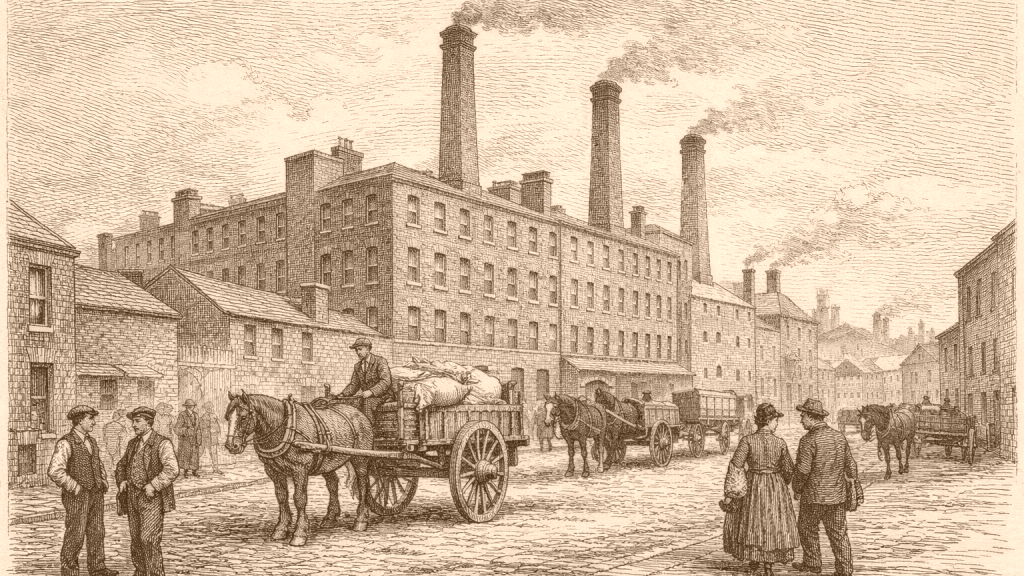
In Dublin, the Bishop Street site developed into a major industrial landmark. A later archival description calls it one of the city’s best known landmarks, with red brick towers and chimneys dominating the south inner city. Another account says the factory grew into a vast manufacturing hub. These descriptions are visual and spatial rather than statistical, but they consistently portray the same place as a large and familiar presence in the urban landscape. [3] [8] [9]
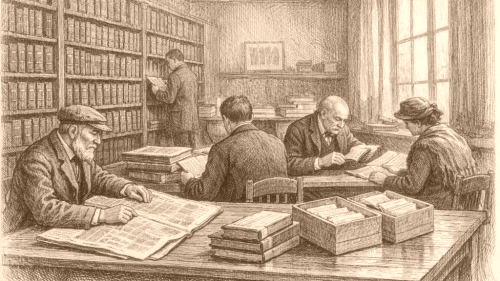
The archive also indicates that the company’s Dublin records cover more than 150 years of biscuit making and include recipes dating from the 1880s, marketing material, packaging, and advertising. That range is visible in the descriptions of mock ups, sample tins, brochures, posters, and commercials. The evidence does not list every item, but it clearly shows that the surviving collection extends beyond production records to present the firm as both a manufacturer and a producer of branded goods. [9] [6]
Workers Lives
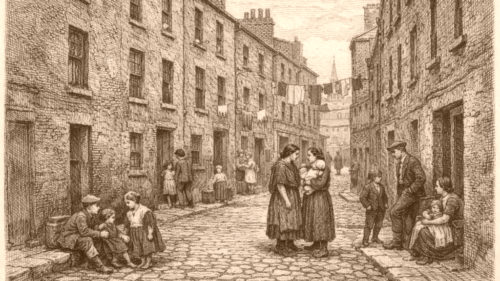
The National Archives census material opens a view onto individual workers and their households. Sarah and Katie O’Mara, aged twenty two and twenty, lived with family at 26 Marrowbone Lane and both worked in Jacobs. Thomas Broe, aged fourteen and a half, was employed as a packer. Ellen Byrne, aged sixteen, worked at Jacobs while living in an overcrowded tenement house with eleven people in two rooms. These returns show age, occupation, and domestic setting together. [3]
The same census discussion notes that dozens of other Jacobs workers appear across the city as packers, weighers, factory hands, clerks, and labourers, with most being young women. It also records that workers often wrote Jacobs explicitly on their census forms. This is an observable pattern within the described returns, not a claim about the whole workforce at all times. Even so, the material presents the factory as a substantial employer embedded in everyday urban life. [3] [6]
Rising Occupation
Jacobs appears in the records of the Easter Rising in two ways. One Dublin City Council account says Bishop Street was one of the sites occupied by the Irish Volunteers during Easter Week 1916. Another states that the factory was one of the positions seized by the rebels and was largely unscathed afterward. A separate archival blog also refers to the building as occupied by Volunteers. The accounts agree on occupation, though they differ in emphasis and detail. [7] [1] [6]
A related account by William George Smith, an assistant manager and St John Ambulance member, describes moving through the city during Easter Week and seeing the factory as peaceful and deserted from Peter Street. He also records emergency medical work elsewhere in Dublin, including hospital organization and ambulance service. This evidence connects Jacobs to the Rising through a named employee’s observations, but it does not by itself prove the full internal experience of the factory during the week. [7]
Products Marketing
Among Jacobs’ best known products, the cream cracker appears repeatedly. One source says it was invented in 1885 and became the company’s best seller; another says it was first appeared in 1885 and later became the best known Jacobs creation. The company’s own history page also presents the cream cracker as a central product. The evidence supports a strong emphasis on this biscuit, while leaving small differences in phrasing about who first developed it. [1] [2] [5] [8]
The marketing descriptions extend beyond the cracker itself. One archival source notes labels, posters, packaging, television and radio commercials, and sponsorship links, while another says the company became involved in early broadcasting and awards. The biscuit evolution page adds that themed biscuit names reflected topical interests and fashionable subjects. These observations show a company attentive to branding, though the evidence here speaks more about named products and packaging than about marketing results. [9] [4] [5]
Later Changes
By the twentieth century, Jacobs had expanded beyond Dublin. One Europeana account says a new factory opened in Aintree, Liverpool, in 1912 when Dublin had run out of space. Another later report says production was moved to Tallaght in 1975, after a decision in 1968 to purchase a suburban site. The factory closure material then places the last Dublin production at Tallaght in 2008 and the end of production in Ireland in 2009. The sequence is clear, even if dates are given from different vantage points. [1] [4] [6]
The same later sources also record ownership and organisational change. Jacobs merged with Bolands in 1966 under the name Irish Biscuits, continued to market products under both brand names, and later passed through ownership changes before production ended in Ireland. One archival report also notes the archive’s transfer to Dublin City Library and Archive and the opening of public access. The company history therefore survives in both industrial change and the preservation of records about it. [1] [6]
Source References
Hover over a number to see the source. Select it to open the source.

- [1] Jacob's Biscuit Factory in Dublin | Europeana
- [2] The Story of Jacob's Biscuits
- [3] Lives behind the Biscuit Factory: Jacob’s and the 1911 Census - National Archives
- [4] RTÉ Archives | Work | End Of An Era For Jacob's
- [5] The Biscuit Evolution! | Jacob's Biscuits
- [6] A Crackin' New Exhibition Explores the History of Jacob’s Biscuit Factory | Dublin City Council
- [7] Jacob’s Biscuit Factory, St John Ambulance and 1916 | Dublin City Council
- [8] RTÉ Archives | Work | Inside Jacob's Biscuit Factory
- [9] W & R Jacobs Archives at Dublin City Library and Archive | Dublin City Council

How did Jacobs Biscuit develop from a Waterford baking business into a Dublin manufacturing firm documented in twentieth century archival records?