
Irish Coffee
At a Glance
Origins Story
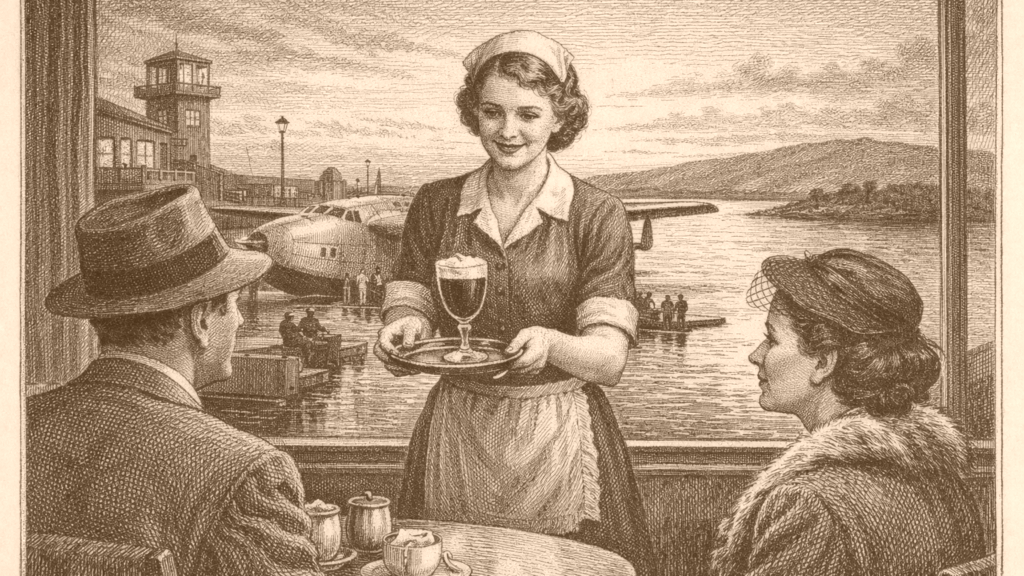
Irish coffee is presented in modern accounts as a drink born in the setting of wartime aviation at Foynes in County Limerick. One account places its invention in 1943, when returning passengers were served coffee with whiskey and sugared cream after a difficult flight; another dates the creation to late 1944 or early 1945. Both agree that Joe Sheridan was the chef associated with the drink’s origin and that Foynes was the place where it first emerged. [7][8][9][10]
The accounts also agree on the basic composition of the drink: hot coffee, Irish whiskey, sugar, and cream. The museum description says Sheridan added whiskey to the coffee and topped it with whipped cream, while the Oxford reference defines the drink in similarly simple terms. RTÉ likewise summarizes it as coffee with whiskey, sugar, and cream. These descriptions show broad consistency in ingredients, even where the surrounding story varies. [7][8][9][10]
Foynes Setting
The Foynes context is important because the drink is repeatedly linked to flying boat traffic and transatlantic travel. RTÉ describes the port town as part of a travel route involving American passengers, while the museum account places a restaurant and coffee shop in the terminal building. The Oxford reference adds that the drink was created for dignitaries touring the facilities there and at the new airport being built across the Shannon, showing that aviation infrastructure framed the origin story. [7][8][9]
The museum narrative adds a small but vivid detail: Sheridan is said to have shown the new drink in a stemmed glass and asked about its visual appeal. RTÉ does not include that exchange, and the Oxford entry does not mention the glass or the quoted line, so those elements belong only to the museum telling. What is directly shared across the accounts is the idea that the drink began at Foynes and was designed for travelers in transit. [7][8][9]
Spread Abroad
The drink’s later history is marked by movement beyond Ireland. The Oxford reference states that by 1947 it was being offered to travelers at Shannon, and that by 1953 Stanton Delaplane carried it to San Francisco, where Jack Koeppler helped recreate it at the Buena Vista Café. RTÉ and the whiskey museum also describe the drink’s spread to the United States, though they emphasize different intermediaries and dates. The shared pattern is clear: the beverage moved from Irish airport service into wider circulation. [7][9][10]
RTÉ adds a separate strand of evidence for international circulation in the 1950s. It mentions Irish coffee being promoted at Strasbourg in 1952 and reports substantial consumption in Las Vegas by 1957, alongside its appearance on menus in Los Angeles. These examples do not explain the original invention, but they do show the drink’s movement into diplomatic and commercial settings outside Ireland. Taken together, the accounts point to a rapid postwar diffusion. [7]
Recipe Meaning
The drink is consistently described as more than a recipe. RTÉ notes that it was once seen as a high form of sophistication, while the Oxford reference calls it one of the world’s most popular and lasting drinks. The museum and whiskey-museum accounts similarly frame it as emblematic of warmth and hospitality. These are modern characterizations rather than historical evidence about the 1940s moment itself, but they help explain why the drink endured in public memory. [7][8][9][10]
The sources also preserve a sense of how the drink was understood through technique. The Oxford entry says it requires brio and dexterity to build properly, and the whiskey-museum account stresses the difficulty of keeping the cream floating rather than sinking. That emphasis on method suggests that Irish coffee’s identity rested not only on ingredients but also on presentation. The evidence does not require any broader claim beyond this practical focus. [9][10]
Public Memory
Public memory of Irish coffee includes repeated efforts to name, display, and narrate its past. RTÉ refers to a 1958 radio item about a new spoon for pouring Irish coffee and to a Dublin revue called Irish Coffee. The museum site at Foynes presents the drink as still being served there, while the whiskey museum offers masterclasses. These later uses show a continuing commercial and cultural afterlife, though they do not change the basic origin narrative. [7][8][10]
The available accounts therefore present Irish coffee as a drink with a documented core and a layered retelling. The core is stable: coffee, whiskey, sugar, and cream first associated with Foynes and Joe Sheridan. Around that core, the exact year, the phrasing of Sheridan’s remark, and the route by which the drink spread are narrated in slightly different ways. Those differences are visible in the sources themselves and should be treated as variation in remembrance, not as contradiction resolved by inference. [7][8][9][10]
Historical Limits
The history of Irish coffee can be traced only as far as the available descriptions allow. Some details appear in multiple accounts, especially the Foynes setting, the involvement of Joe Sheridan, and the use of whiskey in coffee topped with cream. Other elements, such as the precise date and the exact wording of Sheridan’s reply, differ from source to source. The evidence therefore supports a short origin history rather than a single fully settled narrative. [7][8][9][10]
For that reason, the best-supported account is a modest one. Irish coffee appears to have begun as a practical warm drink for air travelers at Foynes, then gained wider fame through later travel writing, restaurant adoption, and public storytelling. The sources do not provide a complete chain for every stage, but they do show how a local service drink became a durable part of Irish culinary identity and international drink culture. [7][8][9][10]
