Dublin Housing
At a Glance
Urban Strain
At the turn of the twentieth century, Dublin is described as a depressed city shaped by declining industry, overcrowding, unemployment, and poor housing. One account links those conditions with disease and says the civic authority recorded measures to curb infectious illness. Another contemporary report, preserved in archival form, presents the housing question as one of the city’s most visible social pressures. These passages do not give a full urban survey, but they do show a shared concern with deprivation and dwelling conditions.
The same material also shows how housing was framed through official inquiry. A housing committee report was commissioned into the conditions of the working classes in Dublin in 1913. That report survives with a plan for workmen’s dwellings and compensation for tenement dwellers in Beresford Street and Church Street. The record is narrow in scope, yet it directly connects housing distress with official investigation and with proposed rebuilding on specific urban sites.
Tenement Conditions
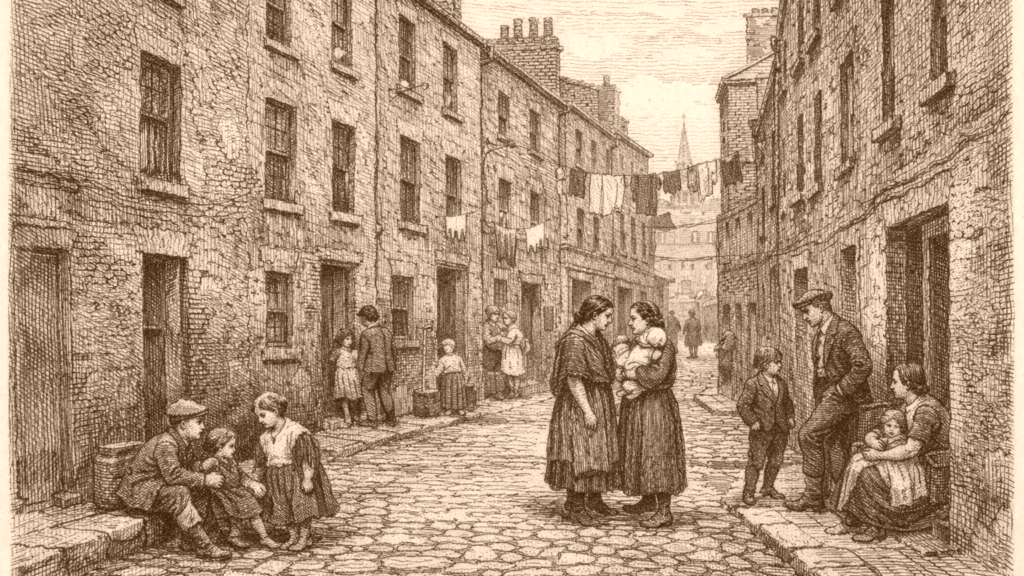
The housing inquiry material gives detailed descriptions of tenement life. One passage says that in tenement houses there could be no privacy and that children scarcely understood the meaning of home. Another passage lists the conditions on which the inquiry focused: sanitation and the daily circumstances of families living in crowded buildings. The evidence is not abstract; it presents tenement housing as lived space and as a subject of inspection and complaint.
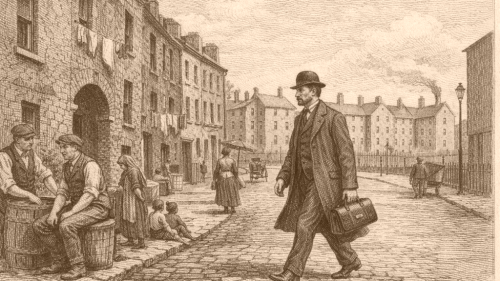
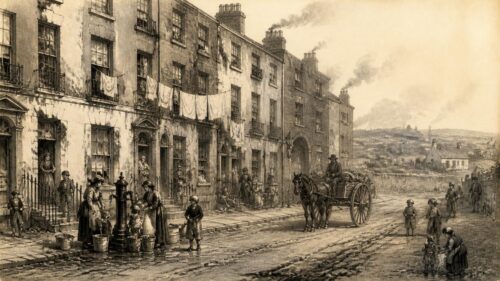
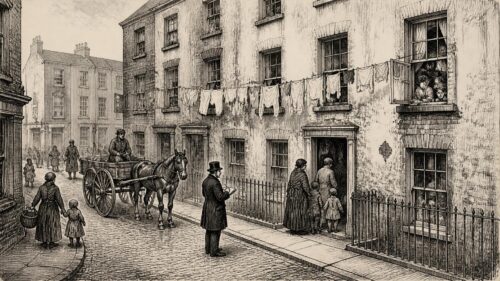
A journalist’s description, quoted in a later account, makes the material conditions more specific. The front door of many tenements was left open, stairwells became public space, chimneys smoked, windows were unsound, and floors were uneven or patched. The same passage distinguishes better rooms from the worst upper rooms, where the ill-paid and under-fed were said to crowd in. This is a descriptive contrast, not a census, but it is a striking one.
Official Inquiry
The 1914 housing commission material preserved through later republication is unusually explicit about inspection and repair. It states that some tenement property was classed as third-class property and therefore unfit for human habitation. It also records disagreement over whether rebates should have been granted on such buildings. The document’s strength lies in its detail: the condition of drains, yard space, cleanliness, and access to water-closets are all singled out as matters of concern.
The same report quantifies sanitary pressure in a way that is directly measurable. It states that, out of 5,322 tenement houses, many had closet ratios far below what the report considered adequate. It also notes that in some cases there were only three water-closets for eighty-one persons. Those figures do not by themselves explain the crisis, but they do show the scale of overcrowded sanitation documented by the inquiry.
Housing Policy
Later Dublin City Council material traces a longer policy arc. A local history of Inchicore says Richmond Barracks was converted to social housing in the 1920s in response to notorious inner-city tenements. The same history notes a mid-century effort to move families to suburban houses, and it records tenant purchase provisions in the Housing Acts of 1948, 1954, and 1956. These are specific policy milestones, not a continuous narrative of success.
That history also records later experimentation and retrenchment. It says the 1963 collapse of two Dublin tenements led to Ballymun’s large high-rise complex, that Keogh Square was demolished in the late 1960s, and that surrender grants introduced in 1978 helped tenants buy homes. The passage then moves into the 1980s and 2000s, when suburbanisation, neglect of the centre, and Public Private Partnerships shaped regeneration plans. The text presents these as sequential changes, not as uniform improvement.
Regeneration Scenes
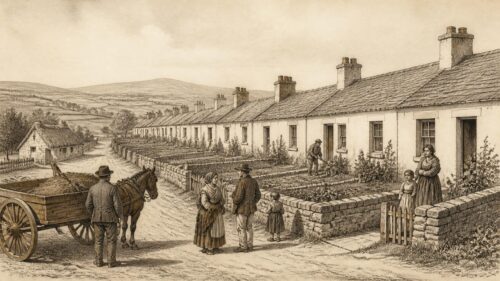
The same council history also warns against treating regeneration as only physical change. It says residents and community groups argued that social regeneration should be included as well. That is an explicit statement of disagreement over what renewal should mean. Because the passage names both the physical transformation of place and the demand for social renewal, it offers a useful guide to reading Dublin’s later housing record as more than bricks, flats, or planning lines.
Archival Memory
Dublin’s housing crisis is also preserved through the archives that make these records accessible. The National Library of Ireland describes its official publications collection as a resource running from the seventeenth century to the present, with digitised material and access to Irish government publications. Dublin City Council likewise presents heritage and archaeology resources, including mapped reports and complementary datasets, as publicly accessible research tools. These institutional descriptions matter because they explain how housing history survives as organised record.
Other repositories focus on specific housing material. The Irish Labour History Society identifies the Dublin Housing Committee Report as an inquiry into working-class housing conditions in 1913 and links it to a digitised version. Catholic Archives describes a separate report of the Dublin Corporation Housing Committee that included compensation awards to tenement dwellers and a revised scheme for workmen’s dwellings in Beresford Street and Church Street. Together these repositories preserve both policy and condition, though only within the limits of what these excerpts name.