
Energy Protest
At a Glance
Fuel Prices
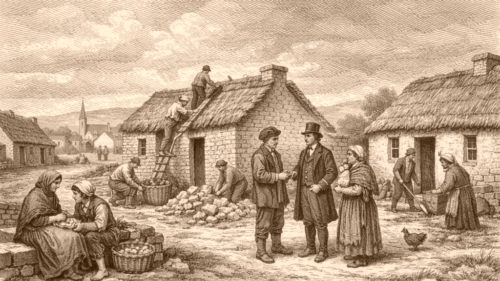
In the eighteenth century peat was a main fuel in Ireland. The Ireland 2050 timeline notes that most industrial energy use came from small water- and wind-powered mills, and that the earliest recorded windmill dates to 1281. With the introduction of steam engines, demand for coal grew, while Irish coal deposits were described as poor quality and the country became highly reliant on coal imports. [4]
The same timeline records that by 1824 there were three gasworks in Dublin: one operating from coal, one from fish oil, and another from turf. It also says that objections to underground pipes focused on noxious vapours and water contamination, but gas lighting still went ahead. The growth that followed was substantial: by 1881 there were 114 gasworks in Ireland, the majority of which relied on coal for fuel, and gas was predominantly used for lighting at that time. [4]
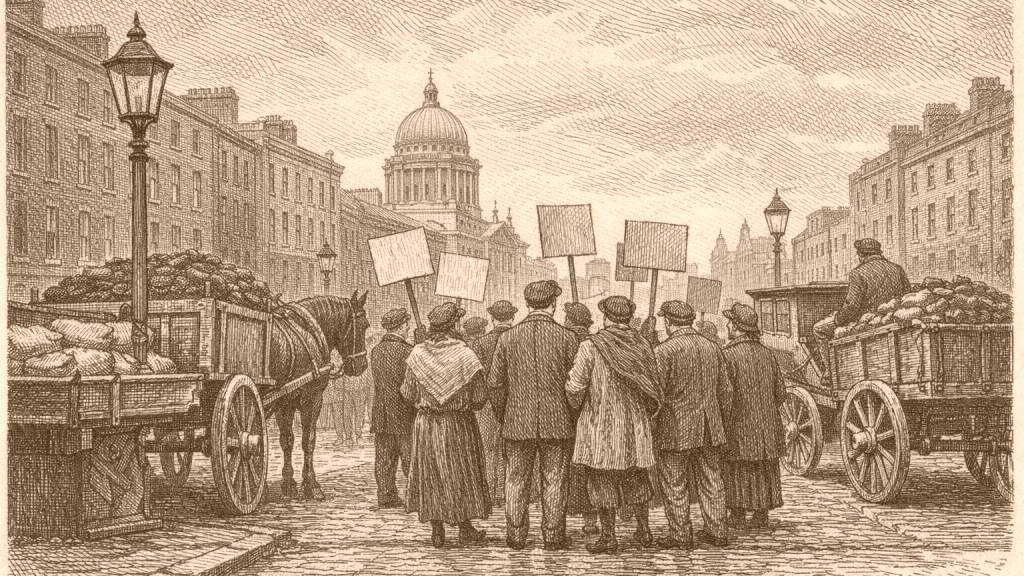
Labour Protest
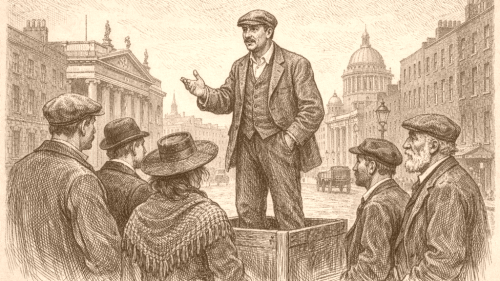
James Connolly described the Labour demonstration in Dublin on Sunday, 25 May 1913, as the largest seen there in a generation. He said it had been delayed, but made up in size and enthusiasm for the lateness of the celebration. For Connolly, its most striking feature was not its dimensions but its character. He emphasised that it was not under the patronage of any political party and was flatly and defiantly in opposition to them all. [6]
Connolly wrote that the working class of Dublin had made up its mind in favour of independent political action. He added that Dublin Labour remained sternly Nationalist, but that this did not change its political outlook. In his account, workers no longer wished to be made the sport of politicians whom they suspected of using Nationalist aspirations to cloak and protect capitalist outrages. He also said the rising vote in favour of Labour at Dublin municipal elections reflected that mood. [6]
Cost Pressure
The Postal Strike of 1922 began in the infancy of the Irish Free State and at the height of the Irish Civil War. The dispute was prompted by the Provisional Government’s threat to cut the cost-of-living bonus of civil servants. That bonus had been introduced by the British Government during the First World War because of the dramatic rise in the cost of living, and when prices kept rising after the war it was retained as a percentage of basic wages. [5]
The same account gives the Board of Trade figure for the increased cost of living as 130 percent above normal. It says the bonus added 130 percent to the first 35 shillings of civil servants’ wages and 60 percent to the remainder. For postal workers, the bonus was described as essential. [5]
State Policy
The 1975 Oireachtas committee report cites the Community objective of reducing the rate of growth of internal consumption by using energy rationally and economically without jeopardising social and economic growth. It also records the view that high dependence on imported energy sources, especially oil, from third countries would endanger the Community’s economic balance and social progress. [8]
In its comments on Ireland, the committee said there was an overreliance on external sources of energy, since uranium and to some extent non-community gas and coal were to substitute for oil. It added that even if nuclear energy were used as envisaged, its benefits would not be available to Ireland for a considerable time, and that a nuclear station would not produce energy there until 1983 at the earliest. [8]
Archival Memory
Ulster University’s history guide says its library holds primary source material in book form, on microform, and electronically, while original sources such as manuscripts are kept in Special Collections. The guide also lists holdings that include Irish political and radical newspapers of the twentieth century, British Cabinet papers, and Labour Party annual reports. Its description of the collection makes clear that primary material may survive in several formats, and that researchers may need to consult both published and unpublished records in different parts of the library system. [1]
CELT describes itself as the free digital humanities resource for Irish history, literature, and politics, and says it is Ireland’s longest running Humanities Computing project. It has a searchable online textbase of over 18 million words in over 1,600 contemporary and historical documents from many areas, including literature and the other arts. The National Library of Ireland says its Web Archive preserves selected Irish websites by taking regular snapshots so that their content and structure can still be accessed if the original website changes or disappears. [2] [7]
The Fenian Archive adds another layer of preservation. It says that images stay with the holding library or on a local file tree, and its collection list includes newspapers, released government files, and Irish annals. Taken together, these repositories show different approaches to documentary survival: physical holdings in special collections, digitised texts, web snapshots, and linked or listed materials. The records do not create one unified archive, but they do help preserve political, cultural, and administrative history in formats suited to different kinds of research. [3] [7]
Historical Limits
The material comes from different kinds of records. The Ireland 2050 timeline describes changing fuels, steam engines, coal imports, and the growth of gasworks. The Postal Strike of 1922 concerns a dispute over a cost-of-living bonus for civil servants. Connolly’s 1913 article discusses a Labour demonstration in Dublin and its political character. The 1975 Oireachtas report deals with Community energy policy and dependence on imported energy sources. [4] [5] [6] [8]
The sources also differ in genre and scope. The energy timeline is a broad chronological overview; the postal strike account is a narrative of one industrial dispute; Connolly’s piece is a polemical labour article; and the Oireachtas report uses committee language. Taken together, they do not form a single continuous history of fuel prices and protest. Instead, they show energy questions appearing in policy, supply, and labour contexts at different moments, each preserved in a separate type of record. [4] [5] [6] [8]
Source References
Hover over a number to see the source. Select it to open the source.

- [1] Primary Sources - History - Library Guides at Ulster University
- [2] CELT - Corpus of Electronic Texts | University College Cork
- [3] Home — Fenian Archive
- [4] Past | Ireland 2050
- [5] The Postal Strike of 1922 – The Irish Story
- [6] James Connolly: The Awakening of Ulster's Democracy (1913)
- [7] Web Archive | National Library of Ireland
- [8] Committee Reports::Report No. 04 - Energy Policy::12 February, 1975::Report
How do the retrieved Irish sources connect rising energy costs with episodes of organised protest and public dispute?