
Oliver Cromwell
At a Glance
Public Figure
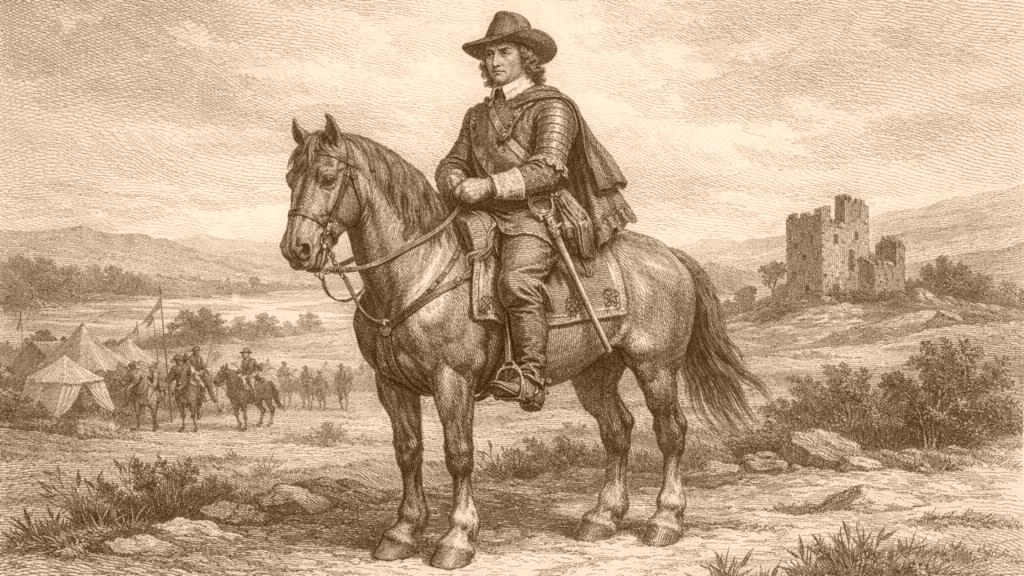
Archival notices list Oliver Cromwell, Lord Protector, in two separate holdings at Trinity College Dublin. One accession describes a letter of protection for Redmond Roch dated 1649; another describes military and financial instructions under Cromwell’s name. Taken together, these catalogue entries show only that his name appears in identified repository descriptions attached to specific record types. They do not add any further detail about the contents of the documents beyond the brief archival wording preserved in the notices. [1] [2]
Later discussion in History Ireland also identifies him as a central figure in the British and Irish political upheavals of the period. One review notes that Cromwell remains central to the history of Ireland and that his recorded words matter, while another describes him as a major figure in the English Revolution and in Irish affairs. These passages do not define him in one sentence, but they consistently present him as a man of state and war. [3] [4]
Lord Protector
The National Archives accession list gives the title “Oliver Cromwell, Lord Protector” and links it to “military and financial instructions” at Trinity College Dublin. That wording is brief, but it is enough to show how the repository labels the material: a named person, a formal title, and a description of the papers themselves. The entry does not explain the instructions in detail, nor does it need to be read as evidence for anything beyond the catalogue description preserved in the accession notice. [2]
A History Ireland review of the letters, writings, and speeches of Oliver Cromwell gives further context by describing documents from the years after Charles I’s execution and before the Protectorate was established. It says the volume includes Cromwell’s words from campaigns in Ireland and Scotland and from the period when he became lord protector in December 1653. The text therefore places his title inside a sequence of military and political developments. [3]
Irish Campaign
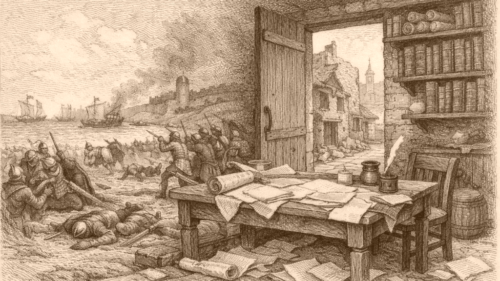
The Irish campaign is one of the strongest features in the later commentary. One review says the volume of Cromwell’s writings contains much detail on his nine-month campaign in Ireland, while another notes a compact account of his Irish campaigns of 1649 to 1650. The evidence here is descriptive rather than interpretive, but it clearly shows that Ireland was a major setting for his public career and for the records that survive about him. [3] [4]
The same review adds that the campaign began with Cromwell raising an army of 12,000 horse and foot and securing a large war chest. Another passage says the reconquest of Ireland was an essential step in securing parliamentarian victory over the king and in depriving Charles II of support from Ireland. These are explicit statements in the source text, though they are presented there as part of a reviewer’s summary of the edited writings. [3]
Wider Role
Cromwell is also placed within wider military and governmental activity beyond Ireland. The review of his letters and speeches says the volume covers his military campaign in Scotland and later matters including the Nominated Assembly, the first Anglo-Dutch war, and his engagement in European affairs. This is important because it shows that the surviving record and the later summary do not restrict him to one campaign; they present him as active across several theatres of power. [3]
Another review describes him as a figure with a more holistic life, including family matters, wealth, horse-breeding, patronage, and his ability to make friends and enemies. It also says the biography explores his ruthless opportunism and his close attention to logistics and supply chains. These are the reviewer’s characterizations, not neutral archival labels, yet they reinforce the picture of Cromwell as both politician and soldier rather than as a single-purpose military man. [4]
Recorded Words
The surviving writings associated with Cromwell are substantial in the reviewed edition. One notice says the three-volume work presents 1,077 separate items, including letters, speeches, conversations, declarations, and other writings. Another says the second volume reproduces 430 documents, with 39 in Cromwell’s hand. These figures are not biography in the narrow sense, but they show how extensively his voice is preserved in documentary form and why historians can study him through written record. [3]
The review also stresses editorial care in identifying manuscript and printed materials and in distinguishing items in Cromwell’s voice. That matters for any attempt to understand who he was, because the source is not simply a list of titles; it is a claim that a large documentary corpus can be tied back to him. The evidence here is about records, but it still reveals a statesman whose words circulated in official and private contexts. [3]
Historical Image
The image of Cromwell in later commentary is mixed and contested. One History Ireland piece says he has been remembered in Ireland as God’s executioner and the devil from over the sea, while also noting that he remains central to history. A different letter to the magazine says Cromwell has been used in the past to justify atrocities in the North of Ireland. These are modern judgments, not seventeenth-century facts, but they show the scale of his historical afterlife. [3] [5]
At the same time, the archive notices and reviews keep returning to concrete documentary forms: letters of protection, military and financial instructions, and the large edited corpus of his writings. That combination matters. The surviving material presents Cromwell as a titled ruler, a campaign leader, and a writer whose words were copied, edited, and discussed. The evidence does not make him simple; it makes him legible as a powerful man of the mid-seventeenth century. [1] [2] [3]
Source References
Hover over a number to see the source. Select it to open the source.

- [1] The National Archives | Search other Archives | Accessions to Repositories | Major Accessions to Public Record Office of Northern Ireland, 2010
- [2] The National Archives | Search other Archives | Accessions to Repositories | Major Accessions to Burns Monument Centre, 2011
- [3] THE LETTERS, WRITINGS, AND SPEECHES OF OLIVER CROMWELL - History Ireland
- [4] OLIVER CROMWELL: GOD’S WARRIOR AND THE ENGLISH REVOLUTION (2nd edn) - History Ireland
- [5] Cromwell and Ireland: new perspectives - History Ireland
How do the cited records and later historical discussions characterize Oliver Cromwell’s public role in the mid-seventeenth century?