
Children of Lir
At a Glance
Story Origins
The Children of Lir belongs to the Irish mythological cycle and is presented in the record here as a tale of transformation and penance. The available notices identify it as one of the Three Sorrows of Storytelling and as an Irish prose tale with verse laments. They also point to an early title listing in a 1526 catalogue and to an older manuscript witness in Edinburgh, showing that the story was already securely named before nineteenth-century editions made it widely accessible. [3] [4] [6]
The same material identifies the tale by several related Irish titles, while English editions render it as the Fate of the Children of Lir. One source names the work Oidhe Chloinne Lir and notes that the original title is in Irish. Another lists the printed and translated form used in the nineteenth century. These notices do not give a single fixed wording, but they do show a stable narrative identity across manuscript, editorial, and popular forms. [1] [3] [4]
Royal Choice
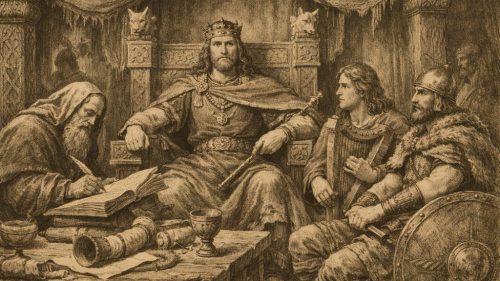
The tale opens with a meeting of the kings of Ireland to decide the high kingship. In the versions quoted here, the assembly chooses Bodb Derg, son of the Dagda, over Lir, who takes offence and leaves. One prose witness places this dispute after a battle, while another simply begins with the kings meeting. Both preserve the same basic pattern: an election, Lir’s anger, and an attempt to prevent open conflict by turning rivalry into kinship. [4] [5] [6]
That settlement takes the form of marriage. Bodb Derg offers one of his foster-daughters to Lir, and Lir chooses the eldest, Aobh or Ove depending on the version. The place-names vary slightly, but the sequence remains clear: the marriage is arranged, Lir is given a wife of high standing, and from that union four children are born. The surviving texts name the children as Fionnuala, Aodh, Fiachra, and Conn, or close spellings of those names. [4] [5] [6]
Jealousy Awakens
The story then turns on the second wife, Aoife or Oifa, who begins with affection for the children but becomes jealous of the attention they receive. In one version she broods for most of a year; in another, a dart of jealousy enters her. The evidence is consistent on the point that she is the children’s aunt and that her hostility grows from the father’s love for them, not from any quarrel among the children themselves. [4] [5] [6]
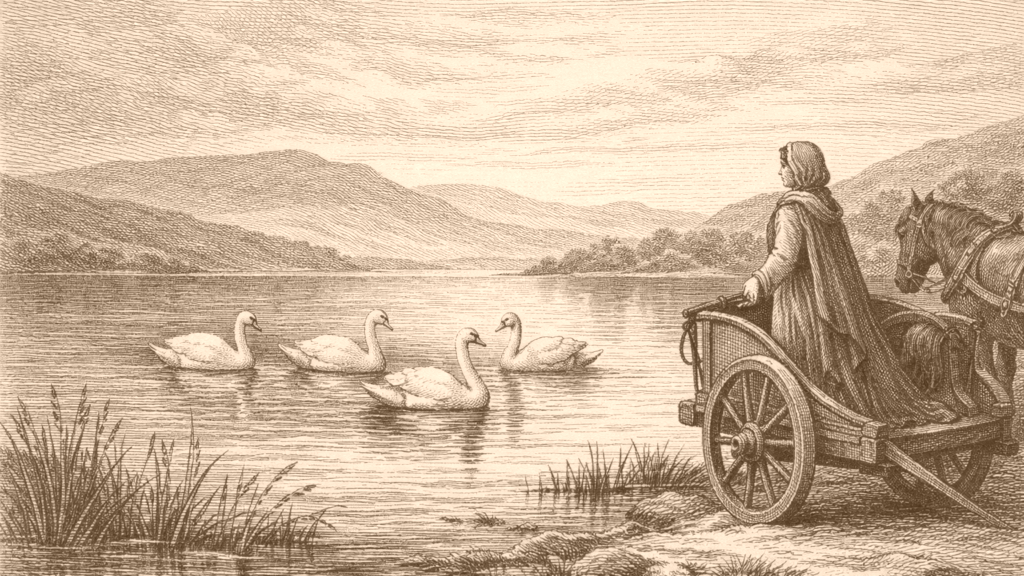
Her act of removal is also closely parallel in the witnesses. She takes the four children out in a chariot, either toward Bodb Derg’s hall or toward the lake, and the children are warned in advance in one version but not in another. When she tries to persuade attendants to kill them, they refuse. She then brings them to the water, has them bathe, and strikes them with a wand. The manuscripts and printed texts agree on the transformation into swans. [4] [5] [6]
Swan Exile
The spell lasts for nine hundred years in all of the major versions cited here. The exile is divided into three equal stages, though the named waters differ in wording: Lough Derravaragh or the Lake of the Oaks first, then the sea between Ireland and Scotland, and finally the western coast at places such as Inis Gluaire or Inis Gluaire. The consistency lies in the arithmetic of the curse and in the sequence of waters, not in exact spelling. [4] [5] [6]
The enchantment is not complete in every respect. Aoife allows the children to keep speech, reason, and the power to sing music of extraordinary sweetness. The narrative then follows their life as swans: they are watched by kings and people, their songs bring sleep to hearers, and their presence is treated as remarkable rather than ordinary. The sources do not describe a return to childhood; instead they stress endurance, lament, and the strange dignity of the birds’ voices. [4] [5] [6]
Christian Ending
The narrative closes when the long sentence is fulfilled and Christian figures enter the tale’s horizon. In one account the swans’ release is linked to the coming of Christianity in Ireland and the ringing of a bell; in another it depends on the marriage of a woman from the south to a man from the north. The evidence does not require these details to be reconciled, but it does show that the ending is framed as the exhaustion of a fixed term and a sacred moment. [4] [5]
After the transformation ends, the tale does not restore the children to youth. One modern summary notes that when the feathers fall away, the brothers appear as withered old men and their sister as a withered old woman; she asks for baptism, and all four die and are buried together. That ending is not given in full detail in every witness cited here, yet the material consistently points away from recovery and toward death, burial, and closure. [4] [6]
Textual Witnesses
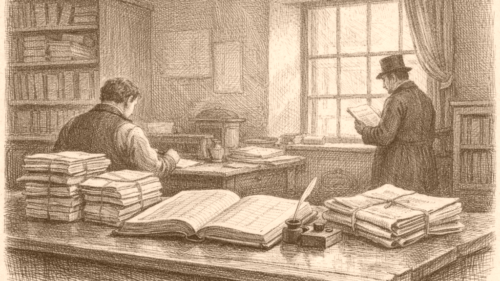
The surviving record shows a long editorial life. A source page lists manuscript copies in Edinburgh, Dublin, and London, and it names nineteenth-century editions and translations by Eugene O’Curry, Richard J. O’Duffy, and P. W. Joyce. Another page notes that the tale appears in a seventeenth-century manuscript and in an eighteenth-century manuscript, while the older bibliography points back to a manuscript description and to printings from 1863, 1879, and 1883. [1] [3]
The archive notices add a different kind of evidence: recorded collecting activity in the nineteenth century. One collection note says the title was written down in 1872 from a South Uist informant, with an accompanying explanation linking the verse to the grave of the Children of Lir at Larne in Ireland. Another note records a related poem and story from the same year. These items do not alter the tale itself, but they show how the name and story circulated beyond formal literary editions. [2]
Source References
Hover over a number to see the source. Select it to open the source.

How do the surviving manuscript witnesses and early printed versions present the main episodes and ending of the Children of Lir narrative?