
Irish Defence
At a Glance
Treaty Terms
The Irish Memorandum of November 1921 set defence among the matters of common concern within an associated relationship with the British Commonwealth. It stated that Ireland would not be less entitled in those matters than other component states represented in the League of Nations, and it linked consultation to concerted action. The same memorandum also said Ireland would provide for its own defence by sea, land, and air as resources allowed, while refusing any treaty or compact that would let a foreign power gain military or naval authority over Irish territory. [1]
The same document also shows that naval defence remained unsettled. It notes that varying British proposals had been put forward on naval defence and asks that the required facilities be precisely defined. It further proposes that Ireland should assume responsibility for coastal defence within a period not exceeding five years. Read together, these clauses show a negotiation in which the shape of defence obligations was still being defined rather than fixed in advance. [1]
Army Reform
The Department of Defence A-Series places these early policy questions inside the new state machinery. It states that after the Treaty a new Dáil Executive was formed in January 1922, with Richard Mulcahy as Minister for Defence, and that the Department of Defence later took over the administration and business of raising, training, organising, maintaining, equipping, managing, disciplining, regulating, and controlling the military defence forces according to law. The collection description also notes that the files reflect the emerging Irish Free State, the Civil War, and its aftermath. [4]
Those records also indicate that the military administration was concerned with expanding the National Army during the Civil War and reducing its size afterwards, while establishing the organisation needed for a properly functioning army or defence force. That description is administrative rather than celebratory. It points to a state moving from wartime expansion toward a more settled structure, with military and civilian files together documenting the practical work of building a defence system. [4]
Modernisation Board
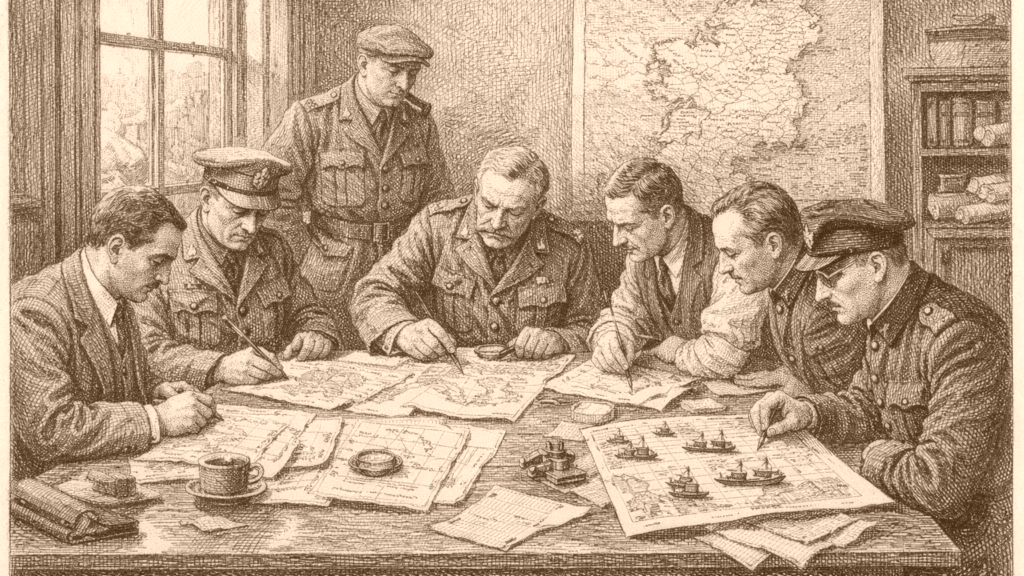
The Army Organisation Board collection shows the next stage of reform. It was created in May 1925 by Lieutenant General Peadar McMahon to examine necessary modifications in the organisation of the Defence Forces so that they could fulfil the functions of a modern army in relation to national defence. The board gathered evidence from commanders, senior staff officers, and technical officers, and it also studied the army organisations of several European countries and the United States. [3]
The same description says the board set out the function, structure, and establishments for the National Army, and that it emphasised the need for a clear defence policy to be created by the Irish Government of the time. Its surviving papers include final drafts of reports, appendices, minutes, and correspondence. In this file group, modernisation appears as a documented administrative project rather than a finished settlement, with evidence collection and policy formulation proceeding together. [3]
Archive Scope
The Military Archives describe themselves as the official place of deposit for records of the Irish Defence Forces, the Department of Defence, and the Army Pensions Board, and they say their brief reaches from the foundation of the Irish State to the present day. Their collections include revolutionary-period material, emergency-period records, and later defence-force holdings. That scope matters here because it shows that defence modernisation is preserved as a long administrative record, not as a single isolated episode. [2]
The archives also explain that they preserve original documentation to clarify what happened and to add nuance to conflicting reports, statements, administrative papers, and letters. Their home page lists several relevant collections, including the Department of Defence files, the Army Inquiry Committee Papers, and the Army Organisation Board. Together these descriptions show that the institutional record for Irish defence is broad, layered, and organised around administrative continuity. [2] [6] [3] [4]
Political Setting
The peace-negotiation correspondence of 1921 provides the political setting in which these defence clauses were framed. It shows David Lloyd George inviting Irish representatives to a London conference and Eamon de Valera replying that he wanted lasting peace but saw no avenue to it if Ireland’s essential unity was denied. The correspondence then turns to contacts with political minority representatives in Ireland, showing that the settlement process involved more than two parties and more than one constitutional arrangement. [5]
What these papers do not do is provide a complete theory of neutrality. Instead, they show a negotiated arrangement in which defence, peace, war, and naval questions were all being argued alongside sovereignty, fiscal autonomy, and the wider constitutional settlement. The documentary trail therefore supports a cautious reading: Irish defence modernisation developed within unresolved political conditions, and the administrative language of the later files reflects that unsettled origin. [1] [5] [3] [4]
Historical Reach
Taken together, the documents trace a line from constitutional negotiation to military administration and then to formal review of the armed forces. The 1921 memorandum outlines limits, obligations, and possible coastal defence arrangements; the Department of Defence files show the state assuming responsibility for military organisation; and the 1925 Army Organisation Board shows reformers studying comparable systems abroad while pressing for a clear defence policy at home. The pattern is one of adaptation rather than sudden transformation. [1] [4] [3]
The records are especially valuable because they keep policy, administration, and institutional memory in the same frame. One set of papers captures a diplomatic proposal; another records the machinery of a new department; a third preserves the work of a board searching for a modern army. That sequence does not by itself prove a fully formed doctrine of neutrality, but it does document the state’s effort to define defence on its own terms. [1] [2] [3] [4]
Source References
Hover over a number to see the source. Select it to open the source.

- [1] Irish Memorandum of November 22th, 1921
- [2] Military Archives | About the Military Archives
- [3] Military Archives | Army Organisation Board
- [4] Military Archives | Department of Defence A-Series
- [5] Official Correspondence relating to the Peace Negotiations June-September, 1921
- [6] Military Archives | Home
How did Irish political and military documents between 1921 and 1926 define defence responsibilities and drive the reorganisation of the new armed forces?