
Lifford Fortress
At a Glance
Lifford Place
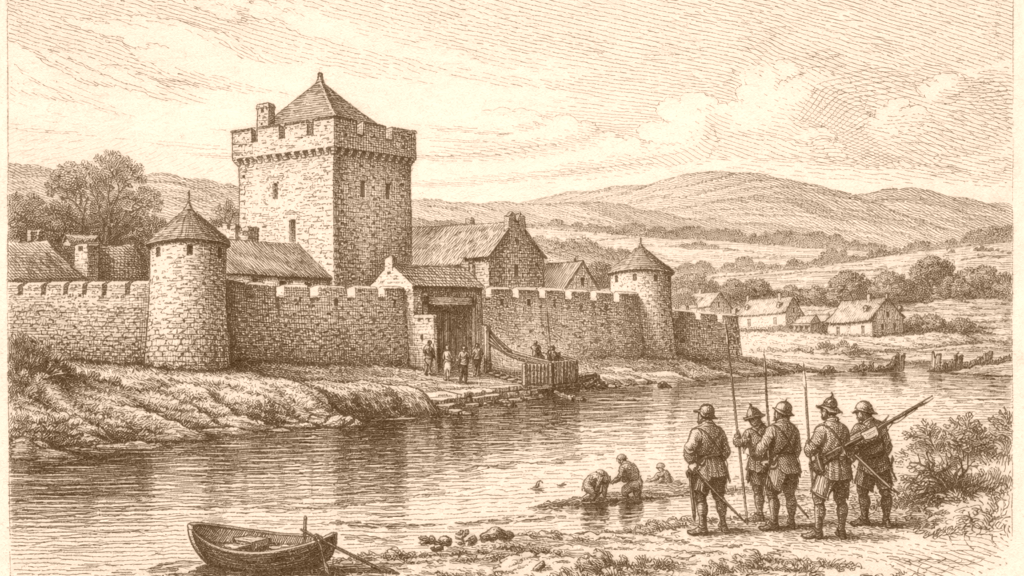
The evidence places Lifford in county Donegal, in the barony of Raphoe, where it was an assize town and parish on the west bank of the river Foyle. It had long been connected with the O'Donnells, and the place had once contained their strong castle. By the seventeenth century the old name had changed in use, but the site still remained a political and military focus because of its position and its earlier association with the family whose rival claimants were fighting for power. [1] [2]
In these excerpts, Lifford is not presented as a battlefield with a fixed formal name, but as a defended place that changed hands within wider conflict. The later topographical account says the castle had been destroyed before 1600, and that the town first grew under the protection of the English fortress that followed. This makes the place itself central to the aim of holding ground, rather than merely to an isolated encounter between armies. [1]
Garbh Alliance
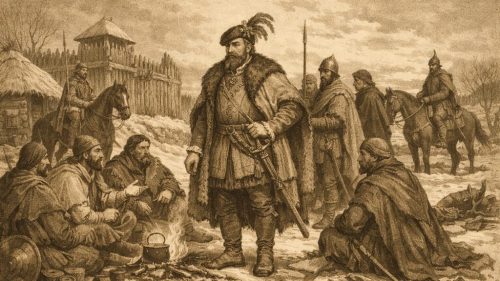
Niall Garbh O'Donnell emerges in the evidence as the key figure connected with the English seizure of Lifford in 1600. He had grievances against Hugh Roe O'Donnell and came into secret communication with Sir Henry Docwra after Docwra reached Derry in May 1600. The bargain described in the biographical account linked Niall's service against O'Donnell with the promise of a grant of Tyrconnell, showing that Lifford was part of a wider shifting alliance and not simply a local dispute. [2]
That same account says Niall had earlier been deprived of the castle of Lifford, which helps explain why the place mattered to him personally as well as strategically. After his agreement with the government, he is described as faithfully serving the colony at Derry. The evidence therefore points to an aim of regaining position through English support, while also helping the English secure a foothold against Hugh Roe O'Donnell in north-west Ulster. [2]
English Entry
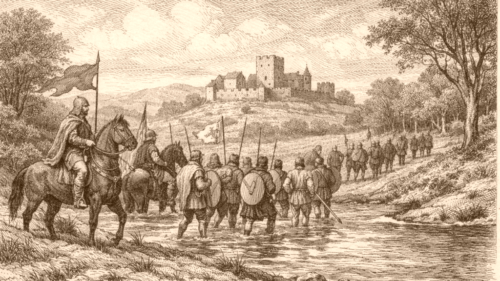
The clearest statement of action comes from the description of October 1600, when Niall Garbh O'Donnell brought 1,000 men from the English garrison at Derry to Lifford. The place, the account says, had only earth ramparts and a shallow ditch because the castle had already been destroyed. On the approach of the English, Hugh O'Donnell's garrison abandoned the site and camped nearby. These details show that the immediate aim was to occupy and hold the post, not to level it or simply pass through. [1] [2]
The same narrative reports that the English then fortified Lifford with stone walls. That transformation is important, because it marks the shift from a vulnerable position to a defended military base. A later section of the topographical account explicitly says the present town first arose under the protection of this English fortress. The aim visible in the evidence was therefore to convert Lifford into a durable English-held strongpoint on the Foyle. [1]
Battle Result
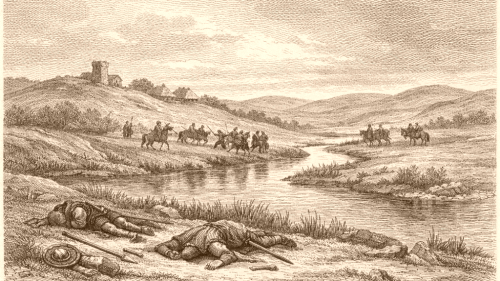
The fighting around Lifford did not end immediately after the occupation. After some weeks without action, Niall Garbh observed disorder in Hugh O'Donnell's camp and urged the English to attack. An obstinate battle followed, with heavy losses on both sides, after which the English withdrew to their fortifications. This suggests that the object was not only to enter Lifford, but to keep it by defensive strength after offensive attempts had run their course. [1]
The sources do not give a detailed tactical plan for the battle itself, nor do they offer a casualty count. What they do show is that the English post remained in being after the clash. The garrison did not abandon Lifford; instead, the site stayed fortified. In that limited but clear sense, the immediate aim at Lifford was successful control of a defended position rather than decisive destruction of the enemy force. [1]
Wider War
The Annals of the Four Masters place the year 1600 inside a broader campaign led by Hugh O'Neill. They describe an English decision to send officers and an army into Ulster, followed by O'Neill's hosting into the south and west, where he made submissions, caused waste, and formed alliances. This wider setting matters because Lifford was not isolated from the war in Ulster; it belonged to the changing contest for control across Ireland. [3]
The same annalistic account also shows O'Neill moving through Meath, Breifny, and other districts, taking submissions and ravaging territory. That material does not mention Lifford directly, but it demonstrates the scale of the conflict in which the town was involved. Against that background, holding Lifford would have had value as one of the English footholds in a war that stretched beyond a single fight or a single parish. [3]
Historical Answer
Taken together, the evidence supports a careful answer: the aim at Lifford in 1600 was to secure and hold the place for the English side, using it as a fortified post against Hugh O'Donnell and his followers. Niall Garbh O'Donnell brought men from Derry, the English occupied the weakly defended site, and it was then strengthened with stone walls. The goal visible in the sources is therefore control of a strategic strongpoint, not a separate war with its own independent declared purpose. [1] [2]
There is still uncertainty in the wording of the surviving material. None of these excerpts states a formal title for a 'Lifford war', and none gives a single authorial explanation of motive in modern terms. What can be said directly is narrower and firmer: Lifford was occupied, fortified, defended, and made into the basis of an English post. That is the clearest historical aim that the evidence itself reveals. [1] [2] [3]
Source References
Hover over a number to see the source. Select it to open the source.




What did the English and Niall Garbh O’Donnell seek to achieve at Lifford in 1600?