
Ireland Europe
At a Glance
Irish Texts
The electronic catalog of Irish texts lists annalistic and related historical works alongside legal, literary, and other categories. It names the Annals of Ulster, Annals of Tigernach, Annals of Inisfallen, the Annals of the Kingdom of Ireland, and several shorter annals. It also lists the Fragmentary Annals and related historical compilations. The result is a compact picture of Irish textual scholarship organized through identifiable editions rather than through a single chronicle. [1]
The same catalog also shows that these texts are presented through modern editorial projects connected with the Dublin Institute for Advanced Studies and the Irish Texts Society. That is a direct sign of institutional framing rather than a claim about the contents of the annals themselves. It places Irish historical writing in a scholarly environment that is not confined to one manuscript or one repository, but is organized through editions available for study and comparison. [1]
Manuscript Worlds
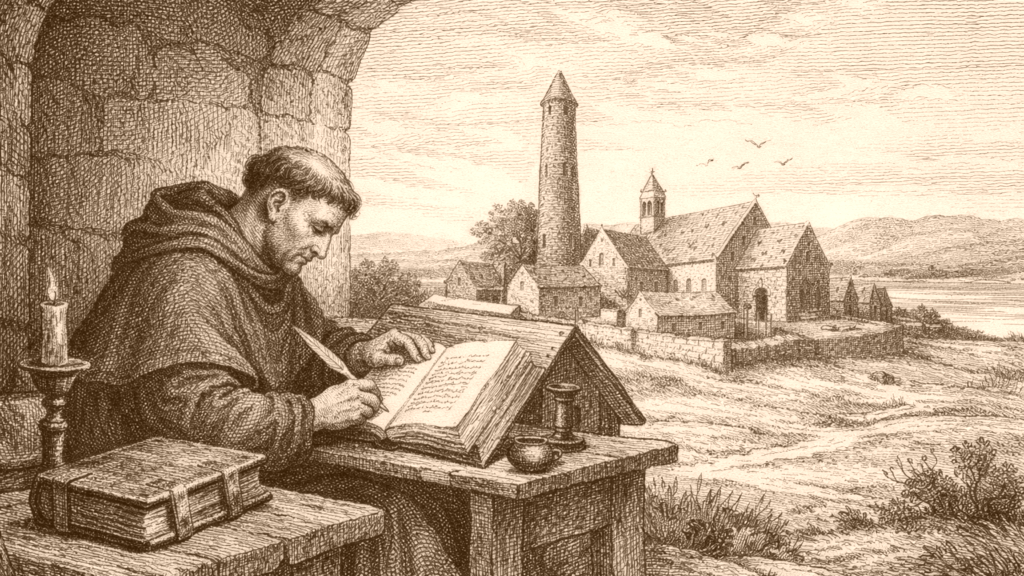
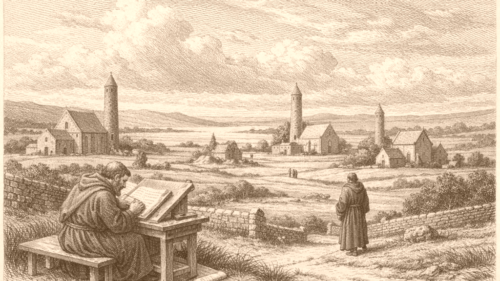
The Annals of Ulster survive in manuscript witnesses in Trinity College Dublin, the Bodleian Library in Oxford, and British Library manuscripts in London. The digital description notes lacunae in several stretches of the text and explains that some lost passages can be supplied from another manuscript. It therefore presents the annals as a textual tradition preserved through more than one codex, with gaps, supplements, and multiple scribal hands visible in the surviving witnesses. [3]
The Annals of Tigernach are described through manuscripts in Oxford, one of them from Clonmacnoise provenance and another from the Mac Fir Bhisigh school. The edition notes that one witness is an imperfect copy of a world chronicle and that a later text is divided into fragments spanning different date ranges. In this material, Ireland appears through a manuscript tradition that is geographically dispersed while still retaining named Irish provenance. [4]
Western Houses
The Annals of Inisfallen are tied to a Bodleian manuscript with a Munster origin and later association with Inisfallen. The description records a single hand for the earliest part, later scribes, and lacunae that interrupt the text. It also notes a seventeenth-century ownership history in which the manuscript reached Sir James Ware. This sequence links an Irish monastic text to Oxford and to later antiquarian collecting. [6]
The Fragmentary Annals survive in a Brussels manuscript and are described as the only known copy of the text. Their manuscript history passes through a lost transcription made in 1643 from another lost vellum manuscript. The available description also suggests a possible connection with Cluain Eidnech and with other historical material, but it presents that link as probability rather than certainty. The excerpt therefore keeps the evidence close to the surviving chain of transmission. [5]
Annal Entries
A sample entry in the Annals of Ulster records the year 795, the slaying of Bran Airdchenn, and the burning of Rechru by the heathens. The same entry set also mentions another killing and the death of an abbot. These brief notices show the annalistic style in direct form: compact records of named individuals, violent events, and monastic deaths, all placed under a specific year in the surviving text. [2]
Because the excerpt preserves only a few entries, it does not by itself supply a wider narrative of causes or consequences. What it does show is that the annals can record local rulers, clerics, and attacks attributed to heathens in the same compressed format. That limited sample is enough to demonstrate a direct textual contact between Irish record keeping and the wider world of raiding and political violence mentioned in the annalistic line. [2]
Editorial Networks
The editorial notices show that the annals are not preserved only in manuscript form but also in modern digital editions produced at University College Cork. The Annals of Ulster and the Annals of Tigernach are each described as electronic editions with named editors, proof corrections, and publication details. These notices identify the texts as items within a structured research environment that connects Irish materials with wider academic publication systems. [3] [4] [6]
The same descriptions also state that some editions are restricted for academic research and teaching, and they provide publication histories for printed and electronic versions. The evidence here is administrative rather than narrative, but it matters because it shows how Irish annalistic material now circulates through catalogues, edition records, and institutional access rules. That circulation extends beyond Ireland while remaining tied to Irish studies. [3] [4] [6]
Historical Reach
Taken together, the excerpts show Ireland appearing in several registers at once: as the subject of annalistic entries, as the origin of monastic and scholarly manuscripts, and as material preserved in repositories outside the island. Oxford, London, and Brussels appear as actual locations in the manuscript descriptions, while Dublin and Cork appear in the editorial history. The evidence therefore maps Ireland into a wider European documentary landscape without requiring any broader interpretation. [2] [3] [4] [5] [6] [1]
What remains visible, and what remains limited, is equally important. The excerpts do not offer a single unified account of Ireland and Europe, nor do they provide a continuous political history. They do, however, preserve direct evidence of Irish texts moving through multiple manuscript homes and modern editorial systems, while the annals themselves record events that include external attack, named rulers, and ecclesiastical deaths in terse chronological form. [2] [3] [4] [5] [6]
Source References
Hover over a number to see the source. Select it to open the source.




How do the cited medieval Irish annals and related manuscript descriptions place Ireland within a wider European manuscript and textual landscape?