Feimen Battle573 CE
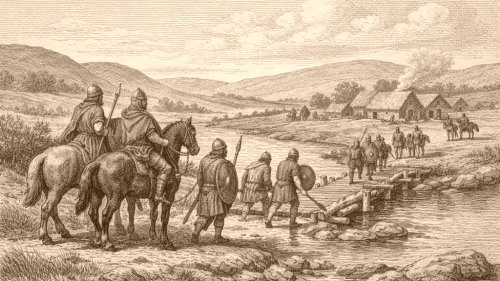
The annals preserve several notices associated with 573, but they do not all align in the same way. One set of records places the battle of Feimen in an entry headed AD 572, while another associates the same battle with a later annal year and different framing. The same year-group also includes notices for the battle of Tola and Fertola, the death of Conall son of Comgall, and related ecclesiastical deaths. This article compares the notices as written, distinguishes the records, and avoids moving any event to a modern year beyond what each annal explicitly states.
Dateline
Dating frame
The printed headings do not line up one-to-one with a modern 573 CE year. Ulster has U573.0 with “AD 572” and U574.0 with “AD 573”; Tigernach has Annal T573 and T574; Chronicon Scotorum has Annal CS573 and CS575. [1] [2] [4]
Within this cluster, the most prominent military notice is the battle of Feimen. Annals of Ulster places it in an entry headed U573.1, while Annals of Inisfallen gives a parallel notice under AI573.1 and Chronicon Scotorum also records the battle under CS573. These are separate records, and they should be treated as parallel witnesses to a single annal notice rather than as independent proof of a modern dated event. [1] [3] [4]
Feimen notice
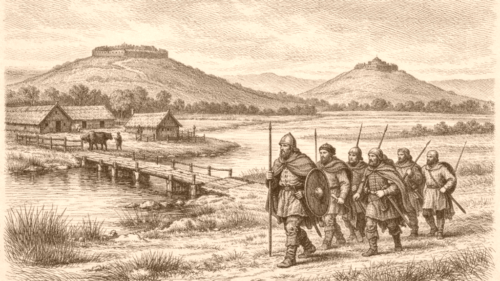
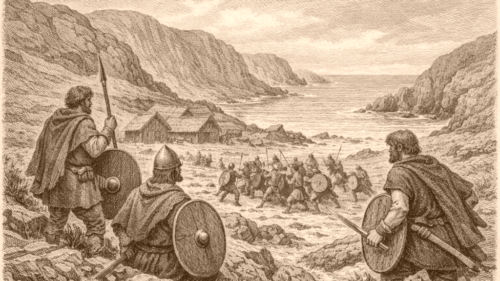
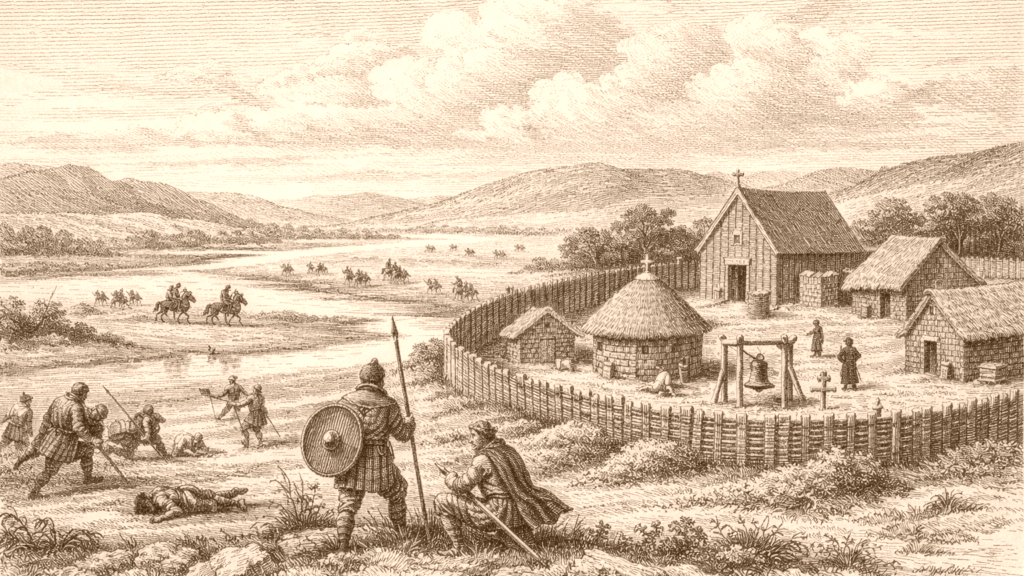
Annals of Ulster states that in the battle of Feimen Colmán Bec son of Diarmait was defeated, but escaped. The same entry is followed by alternative wording that shifts the battle elsewhere, showing that the Ulster text preserves more than one formulation in this place. Annals of Inisfallen likewise names the battle of Feimen and says that Colmán Bec was slain by the Munstermen, while also naming Cairpre son of Feidlimid son of Aengus as the victor. [1] [3]
Chronicon Scotorum records the battle of Feimen as won by Cormac son of Crimthann, king of Mumu, and says that Colmán Bec son of Diarmait was defeated but escaped. [4]
Other battles
Ulster places the battle of Tola and Fertola at U574.1 and adds a gloss identifying the places; Tigernach and Chronicon Scotorum also record the battle and say Fiachra son of Baetán was victor. Inisfallen records the battle of Tala and cross-references it to [AU 573, 574]. [1] [2] [3] [4]
The wording of these notices is uneven, but the observable pattern is consistent: the same battle-name cluster is repeated with variant names for the places and differing attributions of victory. No one text gives a single harmonized account for all of them. For the year-focus here, the main point is that the annals preserve battle notices in the 573 vicinity, not that they agree on one version of what happened. [1] [2] [3] [4]
Deaths recorded
In the Annals of Ulster under U574, Conall son of Comgall is recorded as dying in the sixteenth year of his reign, and the notice says that he had granted the island of Ia to Colum Cille. Tigernach records the death of Conall son of Comgall, king of Dál Riata, and says that he offered the island of Ia to Colmcill. Chronicon Scotorum likewise records the death of Conall son of Comgall, king of Dál Riata, and says that he granted the island of Ia to Colum Cille. [1] [2] [4]
Ulster records the repose of Brénainn of Biror at U572.6; Tigernach records Brénainn of Birr rested at T572.2; Inisfallen records Brénainn of Birra rested in Christ; Chronicon Scotorum records the death of Brénainn son of Brión at CS576 and the repose of Brénainn of Cluain Ferta at CS577.3. [1] [2] [3] [4]
Parallel records
The annals do not limit 573-linked notices to warfare. Inisfallen preserves a repose notice for Brénainn of Cluain Ferta in the same general year-band, and Chronicon Scotorum includes the repose of bishop Eitchen of Cluain Fata Baetáin Aba and the return of the Ulaid from Emain in the nearby sequence. These entries show that the year-group contains both ecclesiastical and secular material, but they do not by themselves establish a single connected narrative. [3] [4]
The records also show that later annal compilers sometimes added cross-references or alternative dating notes. Inisfallen explicitly brackets several entries with references to the Ulster and Tigernach traditions, while Ulster itself uses alternative formulations such as 'or here' and 'or in this year' within the same cluster. Those phrases are part of the evidence for how the notices are transmitted; they are not grounds for moving the event into a more definite modern year than the text itself states. [1] [3]
Year scope
Taken together, the notices around 573 show a year-band dominated by battle entries, deaths of kings and churchmen, and occasional alternative readings. The securely observable facts are the contents of the annal lines themselves: Feimen appears in more than one record, Tola and Fertola appear in more than one record, and the death of Conall son of Comgall appears alongside them. Beyond that, the sources do not give a single agreed chronological scheme for every item in the group. [1] [2] [4]
For a study centered on Ireland in 573 CE, the record is therefore best read as a comparison of annal notices rather than as a unified event narrative. The texts preserve overlapping but not identical accounts, and the main historical work is to keep those accounts separate, note where they coincide, and note where they differ. That discipline is especially important here because the annals themselves already signal uncertainty through variant wording and alternative placements. [1] [2] [3] [4]
Source References
Hover over a number to see the source. Select it to open the source.