Milltown
Milltown is identifiable in historical references as the former milling settlement in the south-west of Belfast, within the historic county of Antrim and the townland of Ballymurphy. A reliable gazetteer describes it as a former hamlet that became part of the urban area of south-west Belfast, explicitly assigning it to historic County Antrim and noting its location on the Ballymurphy Stream 1. The county assignment is therefore not merely modern administrative shorthand: the settlement is historically rooted in Antrim, even though later urban growth absorbed the area into Belfast’s built-up district 1. The place-name is supported by both local historical commentary and the Irish place-name authority.
Dateline
Settlement and county
Milltown is identifiable in historical references as the former milling settlement in the south-west of Belfast, within the historic county of Antrim and the townland of Ballymurphy. A reliable gazetteer describes it as a former hamlet that became part of the urban area of south-west Belfast, explicitly assigning it to historic County Antrim and noting its location on the Ballymurphy Stream 1.
The county assignment is therefore not merely modern administrative shorthand: the settlement is historically rooted in Antrim, even though later urban growth absorbed the area into Belfast’s built-up district 1.
Historical naming and Irish form
The place-name is supported by both local historical commentary and the Irish place-name authority. Belfast Street Names traces Milltown to a small rural settlement on the Falls Road, centred on milling and bleaching activity, and says the name appears on the first-edition Ordnance Survey map; it also cites an 1815 Belfast News-Letter notice for “Mill-Town House and Farm,” showing that the English form was already current in the early nineteenth century 2.
Logainm gives the Irish form as Baile an Mhuilinn, glossed as “town of the mill,” and records an Ordnance Survey namebook form from c. 1840 as baile an mhuillinn 3. This supports the view that “Milltown” is an English translation of an older Irish place-name rather than an unrelated modern label 3.
Historical development
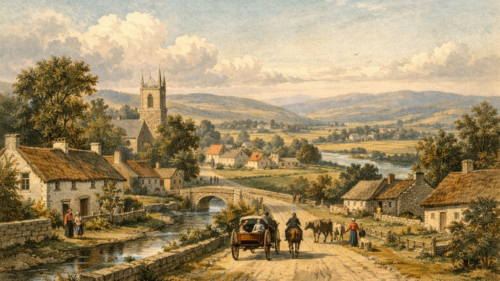
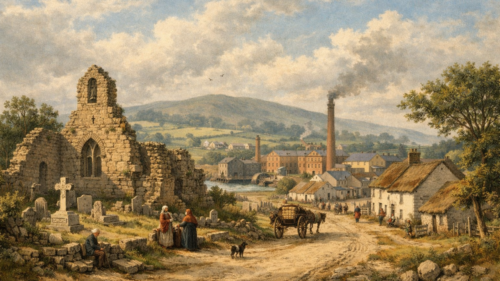
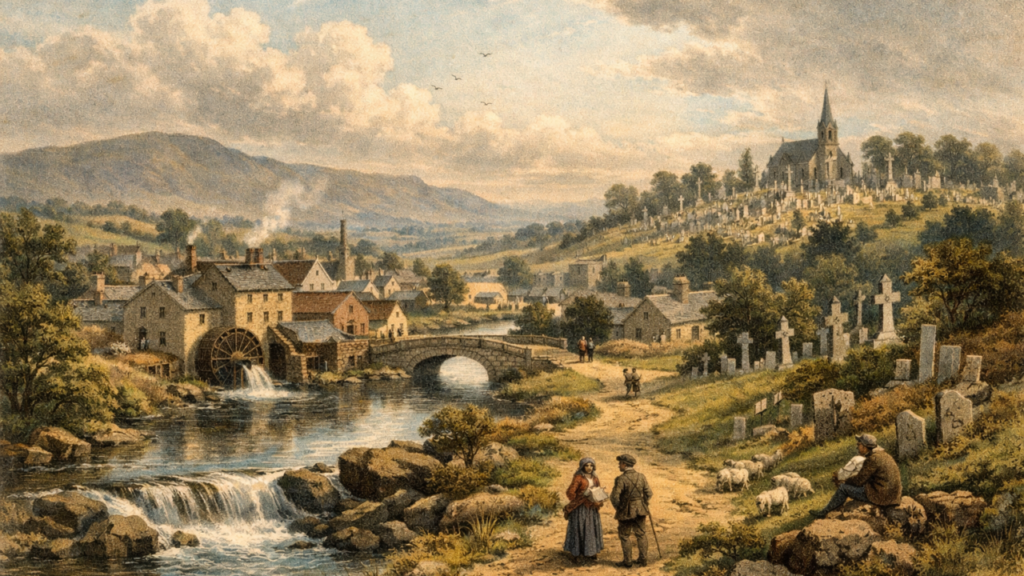
What survives in the record is a working landscape rather than a planned village. The settlement grew from milling and related industrial use along the Blackstaff system, and by the nineteenth century its name was attached to houses, farmland, and the road-side district on the Falls Road 2. The later establishment of Milltown Cemetery on the site in 1869 helped preserve the name after the original rural settlement had largely disappeared beneath urban expansion 12.
The documentary forms therefore show a consistent sequence: Irish Baile an Mhuilinn, anglicised and translated as “Milltown,” then fixed in nineteenth-century Ordnance Survey and local newspaper usage 23. That combination of evidence securely establishes the settlement, its historic county, and its spelling history 123.