Roman Samian Ware293 CE
Roman Samian ware is documented as a red-gloss pottery type mass-produced from the first century BC to the third century AD, a span that includes 293 CE. In Ireland, museum evidence links such pottery to Roman contact through trade and to finds from excavations at Lagore Crannog, while also noting that Ireland was never conquered by the Romans.
Dateline
Date range
The museum description dates Samian ware to the first century BC through the third century AD. That range demonstrably includes 293 CE, but the source does not assign that exact year to a specific find or event. For the archive year, the safest reading is therefore contextual rather than annalistic: 293 CE falls within the documented life span of the pottery type, not within a separately dated Irish occurrence. [1]
Irish context
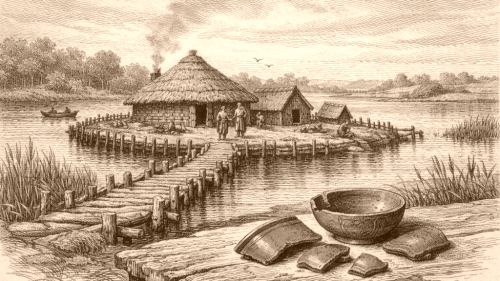
The same source says that Ireland never was conquered by the Romans, yet trade between Ireland and the Roman world was common. It also describes Roman artefacts from many Irish sites and identifies three Samian ware sherds from Lagore Crannog, County Meath, excavated between 1934 and 1936. The evidence therefore places Roman Samian ware in Ireland as part of a broader pattern of contact and circulation rather than conquest. [1]
Limits noted
The Lagore sherds are described as possibly having reached Ireland in the post-Roman period, and one piece may have been reused as a pendant. That observation is important, because it shows that not every Samian find in Ireland can be tied securely to a Roman-century deposition date. For 293 CE, the evidence supports a general chronological framework and an Irish context of exchange, but not a precise local event. [1]
Source References
Hover over a number to see the source. Select it to open the source.