Iron Age Ireland285 CE
Archaeological summaries place Iron Age Ireland within a broad span that overlaps 285 CE. The evidence here points to long-lived traditions of metalwork, horse equipment, and interaction with the Roman world, while also showing that some projects examine material from the first centuries AD rather than a single year.
Dateline
Period Context
The documentary and museum material places Iron Age Ireland within a broad chronological frame that includes 285 CE. One guide describes the Iron Age as spanning roughly 500 BCE to 400 CE, while a museum record for an Iron Age horse-bit places early Iron Age use in Ireland around the second century AD. Together, these passages show that 285 CE falls within the later part of the period discussed here, but they do not isolate a single event for that year. [2] [3]
Material Culture
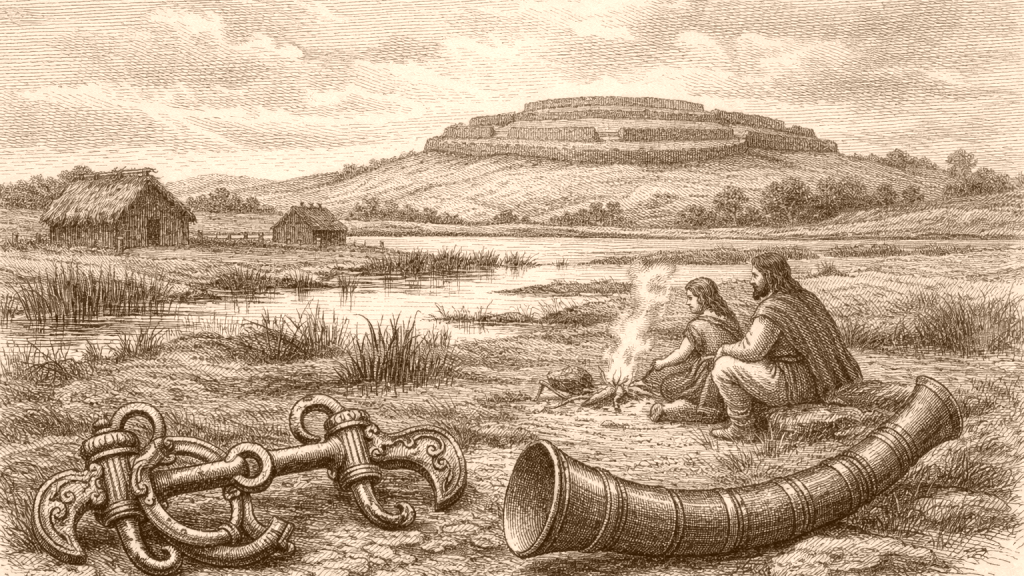
The strongest evidence for this era is material culture rather than narrative history. The horse-bit from Streamstown is described as a bronze harness element decorated in the curvilinear style associated with early Celtic art, and the museum account says that more than 130 bronze horse-bits from Iron Age Ireland are known. A separate museum entry for the Loughnashade Horn identifies it as an important Iron Age bronze object from a bog find near Emain Macha. These objects show that metalwork and horse equipment were prominent features of the period that included 285 CE. [3] [4]
Roman Contact
A project on late Iron Age and Roman Ireland states that it examined evidence for the first five centuries AD and focused on interactions between Ireland and the Roman world, especially Roman Britain. It also reports isotope analysis of burials dated to the first seven centuries AD and notes that some individuals studied may have migrated from Roman Britain or, in one case, from Central or Eastern Europe. This does not identify a specific occurrence in 285 CE, but it does establish the wider cross-cultural setting in which that year belongs. [1]
Source References
Hover over a number to see the source. Select it to open the source.