Roman Contacts288 CE
Ireland in 288 CE belongs to a wider late Iron Age and early historic setting in which archaeologists examine contact between Ireland and the Roman world, especially Roman Britain. The strongest available evidence places that contact within the first five centuries AD, while noting that a direct Roman invasion was not considered a realistic option and that trade, kinship links, and subsidies are the main proposed mechanisms.
Dateline
Historical Context
Ireland in 288 CE falls within a broad period of Roman-Irish contact rather than a single documented event for that year. The relevant archaeological project defined its scope as the first five centuries AD, and its discussion of Ireland and the Roman world extends across that span. In that wider setting, the evidence emphasizes contact with Roman Britain and asks how Roman artefactual material reached Ireland. [2] [1]
Contact Evidence
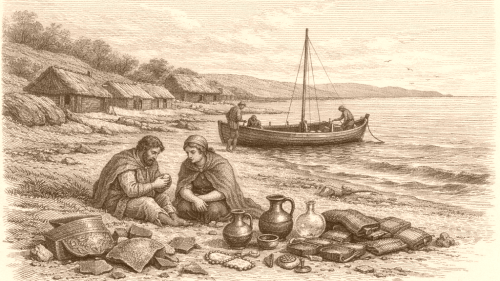
For this period, the clearest interpretation is that a Roman invasion of Ireland was not regarded as realistic, mainly because Roman conquest of Scotland had not been completed. Instead, the evidence points to other channels: trade with Roman merchants, continuing kinship links with western Britain, and financial subsidies from Rome used to help maintain peace on the northern frontier. That means 288 CE should be understood as part of a contact zone, not as the date of a securely attested Irish-Roman campaign or conquest. [1]
Source References
Hover over a number to see the source. Select it to open the source.