Editorial Pressure
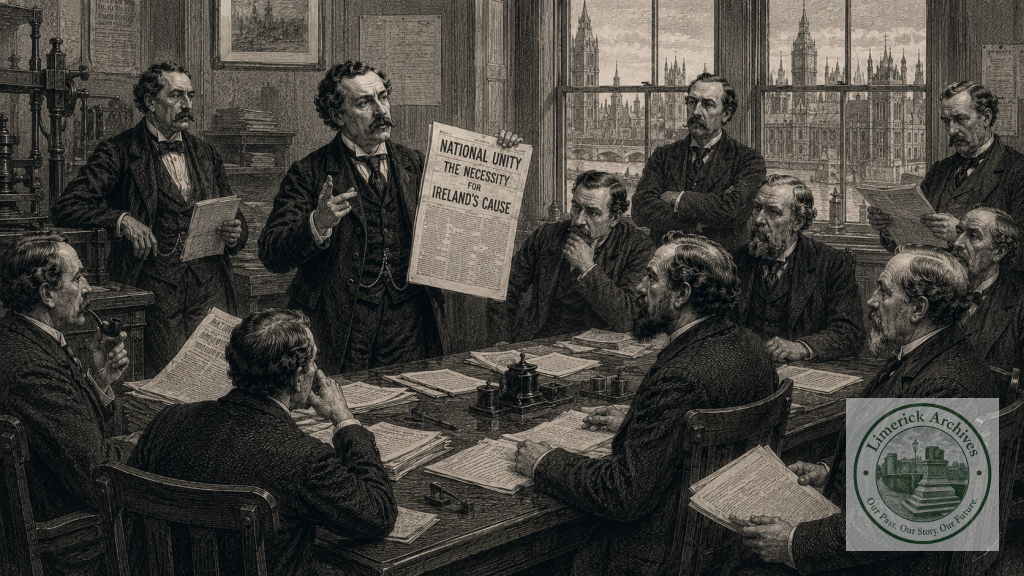
Nationalist newspapers increasingly presented reunion as a political necessity if Ireland was to recover influence at Westminster. Nearly ten years of division had left the parliamentary movement broken into Parnellite, Dillonite and Healyite groupings, each claiming to represent the national cause while weakening the collective strength of Irish MPs. Editorial argument did not always conceal sympathy for particular leaders, but a common warning became difficult to ignore: a divided party could neither discipline its members nor exploit opportunities created by close divisions in the House of Commons. Unity was therefore described less as reconciliation between personalities than as an instrument of national effectiveness.
The Freeman’s Journal occupied an especially important position because it had long been associated with constitutional nationalism and had become aligned with the anti-Parnellite majority after the split. Its treatment of reunion was complicated by Thomas Sexton’s influence and the continuing rivalry between John Dillon and Timothy Healy, yet the newspaper remained a major forum in which the movement’s weakness was examined. Other nationalist titles, including William O’Brien’s Irish People and the Mayo News, reflected the growing strength of the United Irish League. Their coverage helped turn parliamentary reunion from a private negotiation among MPs into a public test of political responsibility.
The argument rested upon Westminster arithmetic. Irish nationalist MPs could exert pressure only when they acted together, voted under discipline and negotiated as a recognisable parliamentary force. Continued factional rivalry allowed British governments and opposition leaders to discount demands for Home Rule, land reform and administrative change. Newspaper readers were repeatedly reminded that public meetings and constituency organisation would have limited value if the men elected to Parliament remained divided. Reunion promised a single leadership, coordinated voting and greater bargaining power, though editors differed over whether the restored party should be controlled by its MPs, the United Irish League or organised nationalist opinion throughout Ireland.
For readers in Limerick, the question was directly connected to representation for the city and county at Westminster. Limerick City, East Limerick and West Limerick each returned nationalist members, but their effectiveness depended upon cooperation with colleagues from across Ireland. Land purchase, tenant security, labourers’ housing, local government and Home Rule could not be advanced by isolated representatives acting through competing factions. National newspapers carried these debates into local homes, reading rooms, railway stations and political branches. The surviving evidence does not justify attributing one uniform opinion to every Limerick reader, but the practical case for united parliamentary action was readily understood.
Press advocacy helped create the atmosphere in which the factions met in Committee Room 15 on 30 January 1900 and formally restored a united Irish Parliamentary Party. John Redmond’s election as chairman gave the movement a recognised public leader, while John Dillon, Timothy Healy, William O’Brien and their followers entered an organisation whose unity remained dependent upon compromise. Newspapers could celebrate the recovery of parliamentary strength, but they could not remove the mistrust accumulated since 1890. Reunion nevertheless allowed nationalist Ireland to approach the coming general election with coordinated candidates and a stronger claim to speak at Westminster through one disciplined parliamentary body.
- Freeman’s Journal, 6 May 1899.
- Freeman’s Journal, 20 May 1899.
- Freeman’s Journal, 3 August 1899.
- Freeman’s Journal, 8 August 1899.
- Mayo News, 27 January 1900.
- The Times, 31 January 1900.
- Mayo News, 3 February 1900.
- W. H. Brayden to William O’Brien, 5 February 1900, William O’Brien Papers, University College Cork, AKA.74.
- Philip Bull, “The United Irish League and the Reunion of the Irish Parliamentary Party, 1898–1900,” Irish Historical Studies, vol. 26, no. 101, May 1988, pp. 51–78.
- F. S. L. Lyons, The Irish Parliamentary Party, 1890–1910, London: Faber and Faber, 1951, pp. 79–89.