Unity Resolutions(c.1890s)

Local political organisations passed resolutions supporting a united Irish parliamentary representation as dissatisfaction deepened with the factional divisions inherited from the fall of Charles Stewart Parnell. United Irish League branches, nationalist associations and constituency bodies increasingly treated reunion as a public obligation rather than a private matter for rival leaders. Their resolutions urged parliamentarians to restore cooperation, accept common discipline and present Ireland’s claims through one organised party at Westminster. Such declarations did not possess formal authority over every MP, but they demonstrated that continued separation risked alienating local supporters whose votes, subscriptions and organisational labour sustained constitutional nationalism.
The campaign gathered force during 1899 as William O’Brien’s United Irish League expanded beyond its western base. Its organisers connected agrarian demands with the reconstruction of national political representation, arguing that land reform and Home Rule required coordinated parliamentary pressure. Meetings gave local activists an opportunity to condemn factional quarrels and instruct representatives to place unity above personal allegiance. Contemporary newspapers recorded repeated public appeals for reconciliation, while correspondence among nationalist leaders reveals their awareness that organised opinion was becoming difficult to disregard. The resolutions helped convert reunion from an abstract hope into a practical test of whether MPs remained answerable to their constituencies.
Local declarations also carried an electoral warning. The approaching general election raised questions about candidates, campaign funds and the possibility that divided nationalist groups might oppose one another in constituencies otherwise secure from unionist competition. A resolution favouring united representation could therefore signal that electors expected one agreed candidate and disciplined voting at Westminster. Established MPs understood that the United Irish League might support challengers where sitting members resisted reunion. The language of harmony consequently concealed a struggle over political authority: local organisations demanded unity, but they also asserted their right to influence who represented the nationalist cause and upon what conditions.
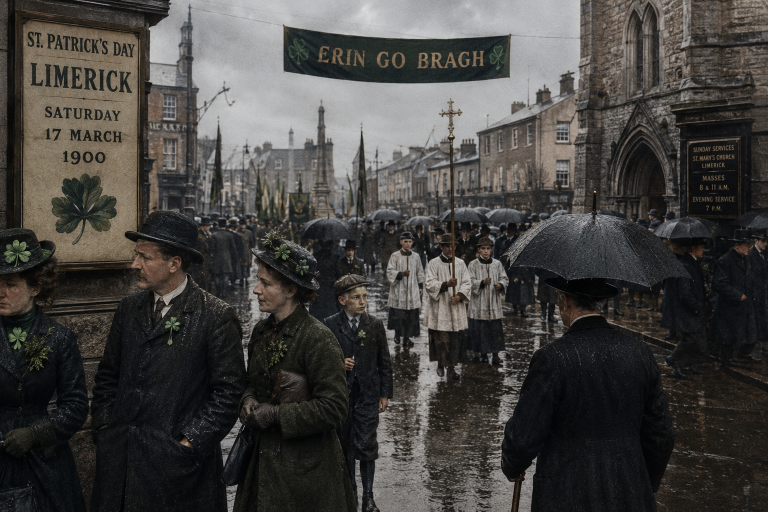
The issue had clear relevance in Limerick, where the first elections under the Local Government (Ireland) Act of 1898 had widened participation in county, urban and rural administration. The surviving evidence does not justify attributing a particular reunion resolution to every Limerick organisation, yet local nationalists operated within the same expanding culture of meetings, resolutions and representative politics. The city and county returned nationalist MPs whose effectiveness depended upon cooperation with colleagues from elsewhere in Ireland. Land purchase, labourers’ housing, public works, local finance and Home Rule all strengthened the practical argument that Limerick interests required a coordinated parliamentary body rather than competing factions.
The accumulating pressure contributed to the formal reunion of the parliamentary sections in January 1900. John Redmond became chairman of the restored Irish Parliamentary Party, while John Dillon, Timothy Healy, William O’Brien and their followers entered a common organisation without abandoning every disagreement. Local resolutions had not settled questions of leadership, finance or control of the United Irish League, but they had helped establish the political cost of continued division. Reunion consequently reflected more than negotiation among prominent men. It also represented the influence of branches, constituency workers and local electors who insisted that Ireland’s representation at Westminster should act collectively if it expected to retain national confidence.
Primary Sources
- Freeman’s Journal, 18 April 1899.
- Freeman’s Journal, 6 May 1899.
- Freeman’s Journal, 20 May 1899.
- Freeman’s Journal, 22 May 1899.
- Freeman’s Journal, 3 August 1899.
- Freeman’s Journal, 8 August 1899.
- Mayo News, 21 January 1899.
- Mayo News, 15 April 1899.
- Mayo News, 27 January 1900.
- The Times, 17 January 1900.
- The Times, 31 January 1900.
- Philip Bull, “The United Irish League and the Reunion of the Irish Parliamentary Party, 1898–1900,” Irish Historical Studies, vol. 26, no. 101, May 1988, pp. 51–78.
- F. S. L. Lyons, The Irish Parliamentary Party, 1890–1910, London: Faber and Faber, 1951, pp. 75–89.
- Local Government (Ireland) Act 1898, 61 & 62 Vict., c. 37.