
Factional Shadows(c.1890s)
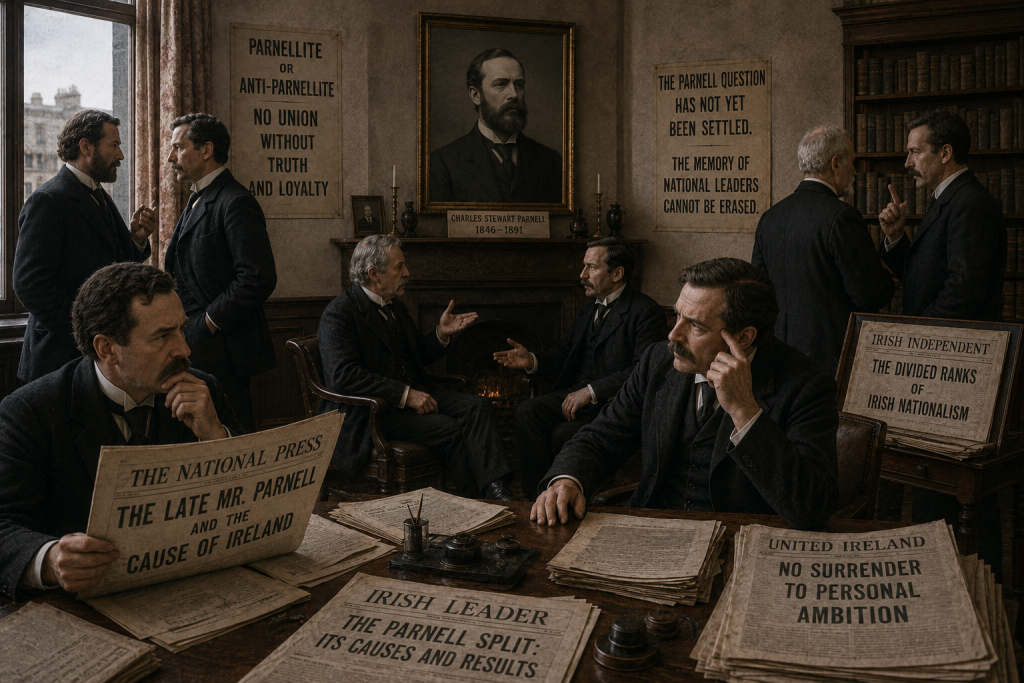
The legacy of the Parnell split continued to shape personal rivalries within Irish nationalism nearly a decade after the parliamentary rupture of December 1890. Charles Stewart Parnell’s refusal to surrender the party leadership during the crisis created by the O’Shea divorce case divided former colleagues into Parnellite and anti-Parnellite camps. Political disagreement quickly became entangled with questions of loyalty, honour and betrayal. Parnell’s death in October 1891 removed the central figure but did not settle the quarrel. Memories of who had defended him, abandoned him or challenged his authority remained powerful within parliamentary groups, newspapers, constituency organisations and personal relationships.
John Redmond inherited leadership of the Parnellite minority and presented himself as the guardian of Parnell’s political tradition. John Dillon became one of the strongest figures among the anti-Parnellites, while Timothy Healy, although an opponent of Parnell during the crisis, increasingly pursued an independent course and quarrelled bitterly with former allies. William O’Brien moved between these competing personalities while attempting to rebuild organisation through the United Irish League. Their disputes concerned Home Rule, land reform, party discipline, candidate selection and political strategy, but the language and emotional force of the arguments repeatedly returned to the unresolved wounds of the split.
The United Irish League, founded in 1898, placed new pressure upon leaders whose personal hostility had weakened nationalist representation at Westminster. O’Brien’s organisation mobilised tenant farmers, local activists and constituency branches around agrarian reform and political reunion. Sitting MPs were increasingly expected to place collective action above inherited factional loyalties. Yet reunion negotiations exposed the difficulty of separating policy from personality. Redmond feared domination by the anti-Parnellite majority, Dillon sought dependable parliamentary discipline, and Healy resisted arrangements that might diminish his independence. The League could bring rival leaders towards agreement, but it could not compel them to forget the accusations exchanged during the previous decade.
In Limerick, the consequences of national division were felt through elections, newspapers, political organisations and the work of parliamentary representatives. The surviving evidence does not justify describing one uniform local reaction, but voters in the city and county had practical reasons to resent factional weakness. Land reform, labourers’ housing, local administration and Home Rule required coordinated pressure upon the government. The widening of elected local government under the 1898 legislation also encouraged expectations of greater political accountability. Nationalist representatives who remained absorbed in personal quarrels risked appearing increasingly detached from Limerick electors whose immediate concerns depended upon effective organisation rather than loyalty to old parliamentary camps.
The formal reunion of the Irish Parliamentary Party in January 1900 placed Redmond at the head of a reconstructed organisation, but it did not recreate the personal authority once exercised by Parnell. Redmond had to balance Dillon’s influence, O’Brien’s popular organisation and Healy’s independent strength. Old suspicions continued to affect decisions concerning funds, constituencies, leadership and relations with the United Irish League. The settlement therefore restored outward parliamentary unity without removing the rivalries beneath it. Irish nationalism entered the new century with a recognised chairman and a common party structure, yet the emotional and political inheritance of the Parnell split remained embedded within its leadership.
Primary Sources
- Frank Callanan, The Parnell Split, 1890–91, Cork: Cork University Press, 1992.
- F. S. L. Lyons, The Irish Parliamentary Party, 1890–1910, London: Faber and Faber, 1951.
- F. S. L. Lyons, John Dillon: A Biography, London: Routledge and Kegan Paul, 1968.
- T. M. Healy, Letters and Leaders of My Day, 2 vols, London: Thornton Butterworth, 1928.
- William O’Brien, An Olive Branch in Ireland and Its History, London: Macmillan, 1910.
- John Redmond Papers, National Library of Ireland, Collection List No. 118.
- John Dillon Papers, Trinity College Dublin Manuscripts, IE TCD MSS 6455–6909.
- Philip Bull, “The United Irish League and the Reunion of the Irish Parliamentary Party, 1898–1900,” Irish Historical Studies, vol. 26, no. 101, May 1988, pp. 51–78.