Archived: 18 November 2026
Abstract
Year noticesAnnals of Inisfallen AI529.1 records the finding of the body of Antony the monk and its translation to Alexandria. In Annals of Ulster, U531.1, under printed AD 530, says the body of Anthony the monk was discovered by divine revelation and brought to Alexandria and buried in the church of St John the Baptist; U532.1, under printed AD 531, records Dionysius's Paschal Cycles.Other Irish annal works preserve different material under 531. The Annals of the Four Masters date the battle of Claenloch in Cinel Aedh to the Age of Christ 531, and the Chronicon Scotorum dates Muircertach Mac Earca’s
Read Article
Archived: 18 November 2026
Abstract
Edmund Burke was born in Dublin, Ireland, then part of the British Empire. He was the son of a prosperous attorney, and after an early education at home he became a boarder at the school run by Abraham Shackleton, a Quaker from Yorkshire, at Ballitore.Early FormationBurke received his university education at Trinity College, Dublin. He then went to the Middle Temple in London in order to qualify for the Bar. His earliest writings included A Vindication of Natural Society and A Philosophical Enquiry into the Origin of our Ideas of the Sublime and Beautiful. From 1758, at least until 1765,
Read Article
Archived: 18 November 2026
Abstract
Annal EntriesIn the surviving excerpts, 532 CE is not filled by a single large narrative. Chronicon Scotorum gives Tuathal Maelgarb an eleven-year reign and records the dormition of Mochta, disciple of Patrick, on the sixteenth day before the Kalends of September. The Annals of Tigernach likewise preserve a brief notice for Tuathal Maelgarb and another for Mochta, keeping the record compact rather than expansive.Battle ClusterThe Annals of Ulster preserve a different kind of notice for their 532 entry: a cluster of battles, including Ebhlinn, Mag Ailbe, Aidhne, Almuin, and Cenn Eich, followed by a ravaging of Clíu, all presented as
Read Article
Archived: 18 November 2026
Abstract
George Berkeley was born near Kilkenny, Ireland, in 1685. He attended Kilkenny College and entered Trinity College, Dublin, at the age of 15. Early WorksBerkeley’s first important published work was An Essay Towards a New Theory of Vision, which appeared in 1709. He followed it with A Treatise concerning the Principles of Human Knowledge in 1710, then Passive Obedience in 1712, a work that discusses the foundations of morality. In 1713 he published Three Dialogues between Hylas and Philonous.Church OfficesWhile remaining connected with Trinity College until 1724, Berkeley also spent time abroad and composed De Motu in 1720 during a
Read Article
Archived: 18 November 2026
Abstract
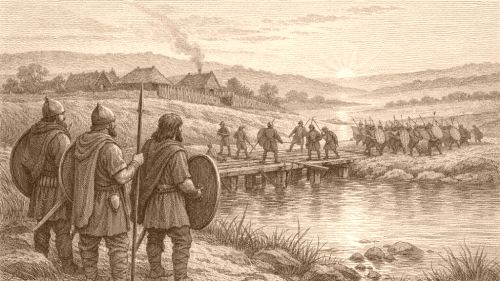
Annal NoticesIn the annalistic material that can be linked to 533, the clearest notice is a battle at Luachair Mór or Luachair-mór edir-da-Inbher, won by Tuathal Maelgarb over the Ciannachta. Tigernach and Chronicon Scotorum preserve that notice in closely matching forms, and both make Tuathal the victor. The Annals of Inisfallen do not expand the event in the excerpted passage, but they do cross-reference a battle of Luachair, showing that the name belonged to a remembered battle notice in the wider annalistic tradition.Dating UncertaintyThe surviving excerpts also show why this year must be treated cautiously. The Annals of Ulster material
Read Article
Archived: 18 November 2026
Abstract
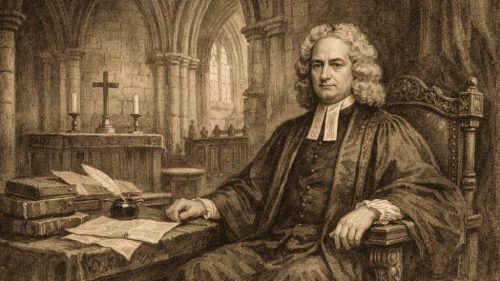
Jonathan Swift was born in Dublin in 1667. His father, a lawyer, died before Swift’s birth, and his childhood was partly spent in the care of a nurse. He boarded at Kilkenny College between the ages of six and fourteen.Education YearsIn 1682, Swift entered Trinity College Dublin, then Ireland’s only university. There he studied Latin and Greek, added Hebrew, and deepened his knowledge of Aristotelian philosophy. After four years, he graduated with the degree of B.A. ex speciali gratia. He left Trinity College in 1686.Early WritingSwift’s first known composition was a Pindaric ode published in 1691. He also wrote The
Read Article
Archived: 18 November 2026
Abstract
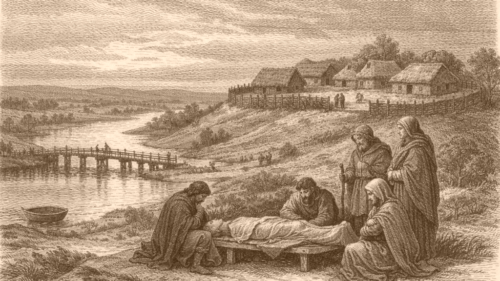
Annal entriesThe Annals of Ulster preserve under U534.0 a notice of the drowning of Muirchertach Mac Erca at Cleitech above the Boyne, together with the repose of Ailbe of Imlech Ibuir and a notice on Pope Boniface. The Annals of Tigernach preserve a notice of the drowning of Muircheartach son of Erc at Cletty above the Boyne and a separate notice for Ailbe of Imlich Iubair.Other annals show that 534 is not a single, uniform dossier. The Annals of the Four Masters place the death of Saint Mochta in 534, while the Chronicon Scotorum puts Ailill, abbot of Armagh, under
Read Article
Archived: 18 November 2026
Abstract
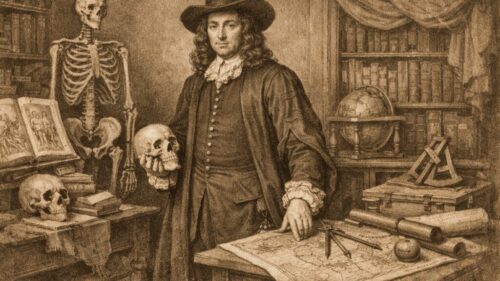
William Petty was born in Romsey, Hampshire, on 16 May 1623, the son of Anthony Petty, a clothier of the town. He was educated at the grammar school of his native place, and at the age of fifteen was sent to the university of Caen in Normandy. He later returned to England and entered the navy, though the capacity in which he served is not stated in the surviving account.Medical StudiesPetty then turned to medicine and studied successively at Leyden, Utrecht, Amsterdam, and Paris. He went to Oxford in 1648 and became deputy or assistant to Dr Thomas Clayton, the
Read Article
Archived: 18 November 2026
Abstract
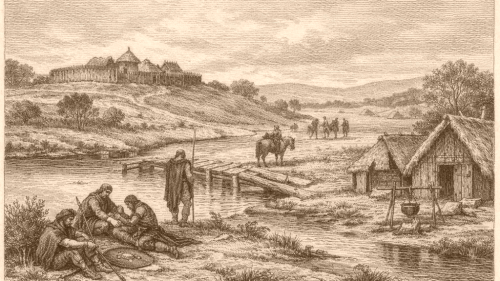
Annal EntriesFor 535, the surviving annals do not give a single dominant Irish event. The Annals of Ulster place the year under its calendar heading and record a failure of bread, the death of Ailill bishop of Armagh, and a note that the drowning of Muirchertach Mac Erca was reported differently by others. The same annal entry also includes a notice about Pope Mercurius. In the Annals of Tigernach, the year is marked by the death of Pope Mercurius, the battle of Great Luachair, and the reign-length notice for Tuathal Maelgarb; the Annals of the Four Masters likewise give 535
Read Article
Archived: 18 November 2026
Abstract
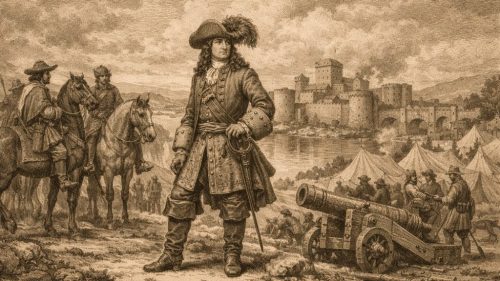
Patrick Sarsfield was born at Lucan about the middle of the seventeenth century. He bore a commission in the English Life Guards, fought under Monmouth on the Continent, and was severely wounded at Sedgemoor. After that he retired with James II to France, then accompanied him to Ireland in March 1689, where he ranked as a brigadier-general.Irish ServiceAfter the death of his elder brother William, he succeeded to the family estates. He also married Honora Burke, daughter of the 7th Earl of Clanricard. He sat in James II’s Irish Parliament for the County of Dublin. After Mountcashel’s defeat before Enniskillen,
Read Article
