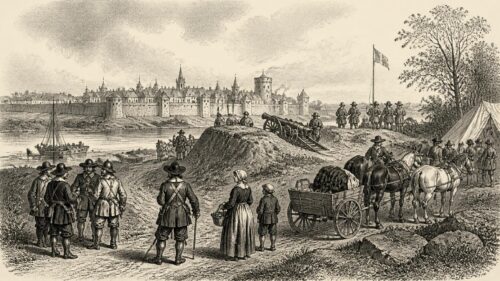
Archived: 14 October 2026
Abstract
In 1649, the second Ormond peace united Confederate Catholics and royalists against the English Commonwealth, but exclusion of Owen Roe O’Neill exposed deep divisions. Ormond’s defeat by Michael Jones at Rathmines on 2 August secured Dublin for parliament, enabling Oliver Cromwell’s landing with the New Model Army and naval support. At Drogheda in September and Wexford in October, stormings produced exceptional killings, including civilians and clergy, and devastated resistance and trade. O’Neill’s death further weakened opposition. Cromwell failed to take Waterford before winter, but the year transformed the war, creating conditions for the later Cromwellian conquest and settlement in Ireland.
Read Article
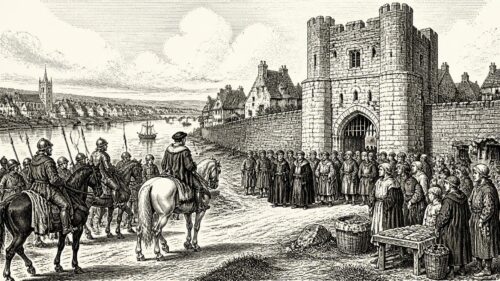
Archived: 19 October 2026
Abstract
In 1494 Henry VII sent Sir Edward Poynings to Ireland to strengthen Tudor control, counter Yorkist support and reduce reliance on Gerald FitzGerald, earl of Kildare. Landing in October, Poynings led an Ulster expedition, securing submissions from O’Hanlon and Magennis, but relations with Kildare deteriorated. His Drogheda parliament, opened in December and continuing into 1495, began legislation, including the measure later called Poynings’ Law, restricting Irish parliamentary initiative. Elsewhere, regional lordships remained autonomous: dynastic killings, sieges around Sligo, conflicts in Fermanagh and Cavan, raiding and hostage-taking continued. Church, trade and daily life were shaped by warfare, contested authority and insecurity.
Read Article
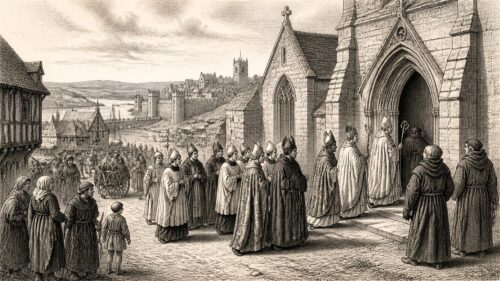
Archived: 19 October 2026
Abstract
In 1486 Ireland remained politically fragmented, with Kildare dominating the English lordship around Dublin while Gaelic and Anglo-Irish powers contested local authority. Ulster saw raids, killings, captures and burnings among Maguire, MacMahon, Ó Néill and allied groups, including the capture of a castle at Belfast. Connacht experienced disputed kingship, lordship successions and a significant battle involving Aodh Ruadh Ó Domhnaill and Mac William. Archbishop Octavian de Palatio convened a northern synod at Drogheda, while Roland FitzEustace founded an Observant Franciscan friary near Kilcullen. Abundant apples contrasted with severe salt scarcity and high horse prices, linking conflict, markets and everyday life.
Read Article




