

Rathmines, Drogheda And Wexford1649 CE
In 1649, the second Ormond peace united Confederate Catholics and royalists against the English Commonwealth, but exclusion of Owen Roe O’Neill exposed deep divisions. Ormond’s defeat by Michael Jones at Rathmines on 2 August secured Dublin for parliament, enabling Oliver Cromwell’s landing with the New Model Army and naval support. At Drogheda in September and Wexford in October, stormings produced exceptional killings, including civilians and clergy, and devastated resistance and trade. O’Neill’s death further weakened opposition. Cromwell failed to take Waterford before winter, but the year transformed the war, creating conditions for the later Cromwellian conquest and settlement in Ireland.
Dateline
For Ireland, 1649 was a year of collapse, invasion and irreversible fear. It began with political manoeuvring among forces that had already spent seven years fighting one another; it ended with the east coast pierced by a highly organised parliamentary army and two towns, Drogheda and Wexford, marked by exceptional slaughter. The events were part of the wider Wars of the Three Kingdoms, but their consequences were distinctly Irish. They exposed the fragility of the Catholic Confederacy’s political project, destroyed hopes that a royalist alliance might secure a tolerable settlement, and opened the most destructive phase of the Cromwellian conquest.
A Coalition With Fault Lines
In January, the Confederate Catholics and the royalist lord lieutenant, James Butler, marquess of Ormond, concluded what is generally called the second Ormond peace. It allied the Confederacy with supporters of the Stuart monarchy against the English parliament. The agreement followed years in which Irish Catholic leaders had built a functioning wartime administration at Kilkenny: it had assemblies, councils, taxation, diplomacy and armies, but was divided by disagreements about religion, land, foreign aid and the degree of trust that could be placed in the king’s representatives.
The execution of Charles I in London on 30 January changed the stakes. To many Irish royalists, Anglican clergy and Scottish Presbyterians, regicide made resistance to the English Commonwealth a matter of political legitimacy and religious principle. Ormond sought to assemble a broad Catholic–Protestant army for Charles II. Its commanders included Murrough O’Brien, earl of Inchiquin, a Protestant with a formidable Munster following, and Catholic aristocrats such as Viscount Taaffe and the earl of Castlehaven. Yet this was less a settled national alliance than a coalition of expediency.
Its greatest absence was Owen Roe O’Neill, commander of the Ulster Irish army. O’Neill had opposed the accommodation with Ormond and had instead maintained contacts with parliamentarian commanders. His position was rooted in both military calculation and politics: he wanted security for Catholic worship and the restoration of dispossessed Ulster Irish interests, aims that did not sit easily with old English Catholic landowners or Protestant royalists. The Confederate–royalist cause therefore entered its decisive year divided even before it met the Commonwealth’s expeditionary force.
Dublin Saved At Rathmines
Ormond’s immediate objective was Dublin. The capital, held for parliament by Colonel Michael Jones, was the principal bridgehead between Ireland and England and the obvious landing place for any large English army. Royalist forces had taken several outlying positions during the summer and pressed towards the city, but their advance was slow, hampered by shortages of money, food and dependable troops. In a country exhausted by continuous campaigning, maintaining an army was a practical as well as a political problem: men had to be paid or fed, horses supplied, ammunition moved and local communities compelled or persuaded to provide quarters and provisions.
On 2 August, Jones launched a sudden attack at Rathmines, south of Dublin. Ormond’s combined army was routed. The defeat cost the royalists experienced officers, artillery, stores and the chance to force Dublin’s surrender before reinforcements arrived from England. It was a decisive military reversal, not simply a lost field battle. The coalition still possessed towns, garrisons and substantial regional support, but it no longer had the strength to prevent a parliamentarian landing at Dublin.
Oliver Cromwell arrived in Dublin on 15 August as lord lieutenant and commander of a New Model Army expedition. His force brought veteran infantry and cavalry, siege artillery, finance and an effective naval connection across the Irish Sea. Sea power mattered greatly. Parliamentarian vessels protected transports, conveyed heavy guns and supplies along the coast, and helped deny royalist and privateering vessels freedom of movement. Cromwell’s campaign would be shaped by ports, rivers and roads as much as by battles in open country.
The Storming Of Drogheda
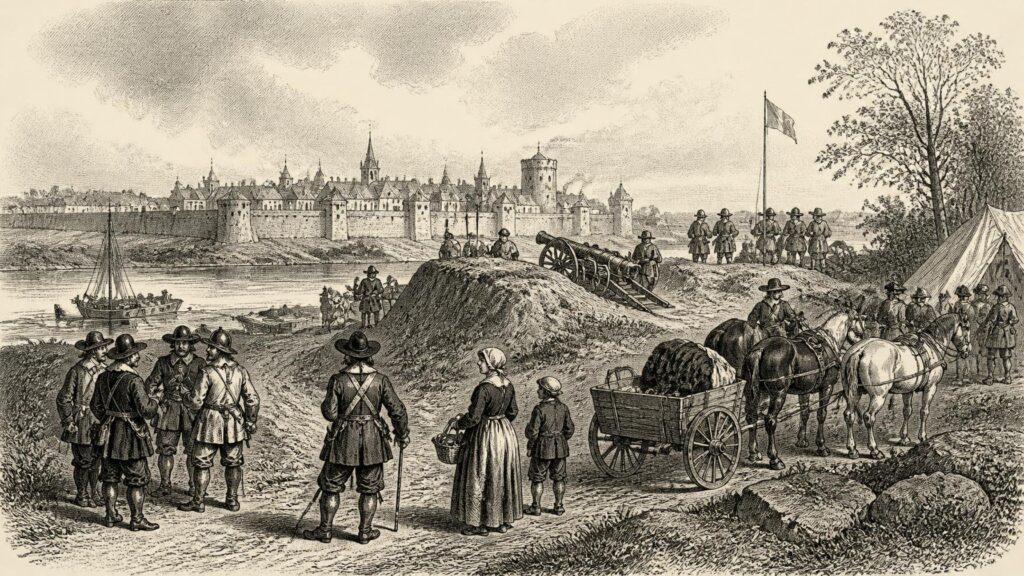
Cromwell moved north against Drogheda, a strategically important walled town on the Boyne and a gateway towards Ulster. Its governor, Sir Arthur Aston, refused to surrender. After bombardment created practicable breaches, parliamentarian troops stormed the town on 11 September. What followed was not an ordinary negotiated capitulation. The garrison was hunted down after the assault, and killings extended beyond armed defenders to Catholic clergy and civilians.
The exact death toll cannot responsibly be fixed. Cromwell’s own letter to Speaker William Lenthall represented the action as the killing of enemy soldiers after a refused summons; later accounts and modern scholarship demonstrate that the victims also included non-combatants. Estimates commonly place the military dead at around 3,000, while the civilian total remains uncertain. The crucial fact is not an unattainable precise figure but the character of the event: the taking of Drogheda involved mass killing on a scale that contemporaries immediately recognised as extraordinary.
Cromwell justified the assault in providential and deterrent language, presenting severity as a means of avoiding future bloodshed. That rationale was inseparable from his army’s view of Irish Catholic rebellion, memories and allegations surrounding the violence of 1641, and the strategic desire to make resistance appear hopeless. Whatever its intended military effect, Drogheda spread terror through garrisons and civilian communities. It also became a defining episode in Irish historical memory because it joined military conquest to confessional hostility and the vulnerability of an urban population trapped behind walls.
Wexford And The Sea Road South
After securing positions in the north-east, Cromwell marched down the coast. The route allowed the army to draw on naval transport for provisions and siege equipment. This was especially important in an impoverished war zone, where an army living solely off the countryside would worsen hunger, displacement and resentment. Parliamentarian operations also targeted places associated with maritime resistance. Wexford was a major harbour and a centre of privateering against English parliamentary shipping; taking it promised both military and commercial advantage.
Cromwell appeared before Wexford early in October. Correspondence between him and Colonel David Sinnott, the governor, shows that surrender was being discussed. The negotiations were slow and confused, while military pressure mounted around the town and its defences. On 11 October parliamentarian troops entered after a breach in the castle defences. The town was then sacked while terms were still unresolved. More than 2,000 people, including many defenders and civilians, may have been killed, although—as at Drogheda—the evidence does not permit a wholly secure total.
Wexford’s destruction had consequences beyond the immediate deaths. Houses, stores and shipping were damaged or burned; a busy port was devastated; and a population already living amid war lost property, shelter and security. The seizure of the harbour also weakened the royalist–Confederate capacity to use the south-east coast for privateering, supply and overseas communication. Nearby New Ross surrendered on 19 October, illustrating the coercive power created by Drogheda and Wexford, though other places would continue to resist fiercely.
Faith, Allegiance And Daily Survival
Religion ran through the conflict, but the lines were not simply ethnic or denominational. Ormond’s alliance brought Catholic Confederates and Protestant royalists together; parliament’s Irish supporters included Protestants of different traditions; and O’Neill’s Ulster army had pursued its own Catholic and territorial programme. Nevertheless, Cromwell’s campaign made the Catholic Church a conspicuous target. At Drogheda, Catholic clergy and religious were among those killed. Later in the autumn, Cromwell made clear in negotiations at New Ross that he distinguished between inward conscience and public celebration of the Mass: private belief might be beyond a magistrate’s reach, but public Catholic worship would not be permitted where he held power.
For most people, politics was experienced through its material consequences. Soldiers demanded food, horses, carts, lodging and labour. Town gates, bridges, mills, storehouses and river crossings acquired sudden importance. Families fled approaching armies or waited anxiously behind fortifications; farmers faced the loss of crops and livestock; merchants and sailors saw coastal trade disrupted by warships and privateers. A proclamation issued for Cromwell’s army during the campaign ordered soldiers not to rob, abuse or commit violence against country people not actually in arms. Its very existence shows that pillage and coercion were recognised dangers. It did not erase the devastation already inflicted, nor guarantee safety in a war fought through sieges and moving garrisons.
O’Neill’s Last Weeks
As the parliamentary advance transformed the military balance, Ormond and Owen Roe O’Neill moved towards agreement. Terms were reached late in October, too late to repair the alliance’s strategic weaknesses. O’Neill was already seriously ill. Travelling southwards with the intention of aiding the resistance, he stopped at Cloughoughter Castle in County Cavan, the stronghold of Miles O’Reilly, and died there on 6 November.
His death removed the most capable Irish Catholic field commander from the war at precisely the moment when unified leadership was most necessary. It should not be treated as a simple explanation for later defeat: the Commonwealth army’s resources, naval support, discipline and possession of Dublin were formidable advantages. But O’Neill’s loss deprived the opposition of an experienced general who had built an army in Ulster and who retained a political constituency distinct from Ormond’s. Rumours of poisoning circulated, but the evidence does not establish murder; his poor health after prolonged campaigning is the firmer historical ground.
Winter Without Resolution
By late November Cromwell had reached Waterford, another strongly Catholic and strategically valuable port. This time the advance did not produce a swift success. Weather, sickness, supply difficulties and resistance constrained the besieging force, and Cromwell withdrew in early December to winter quarters at Youghal. The check is important. Ireland had not been conquered in 1649. Waterford, Limerick, Galway, Kilkenny and extensive rural districts remained outside parliamentarian control, while Ulster and Munster each retained complicated local alignments.
Yet the year had remade the war. Rathmines had saved Dublin for parliament; Cromwell’s arrival had supplied a powerful army and fleet; Drogheda and Wexford had demonstrated a willingness to employ extreme violence after storming; and O’Neill’s death had further weakened an already fractured resistance. The later confiscations, transplantation policies and demographic losses often associated with the Cromwellian settlement still lay in the future and should not be read back as completed facts in 1649. What can be said with certainty is that, by the close of the year, the political and military conditions that would make those later transformations possible had been violently created.
Primary Sources
- Cromwell, Oliver
- Butler, James
- O'Neill, Owen Roe (Ó Néill, Eoghan Rua)
- Jones, Michael
- Monck, George
- Taaffe, Theobald
- Tuchet, James
- Trevor, Marcus
- Worth, Edward
- CELT Project: A Chronology of Ireland
- Cromwell to Speaker Lenthall, 17 September 1649
- Cromwell Letter to William Lenthall
- Oliver Cromwell’s Letters and Speeches: with Elucidations, Vol. I, Part I
- Correspondence Between Cromwell and Col. D. Sinnott, Governor of Wexford, Oct. 1649
- Extract from a Letter Giving an Account of the Death of Owen Roe O'Neill and the Campaign in Ireland
- The Cromwellian Conquest, 1649–53
- The Navy and the Cromwellian Conquest of Ireland, 1649–53
- Conquest and Land in Cromwellian Ireland, 1649–1652
- War and Population, 1649–52
- State of Emergency: The English Subjection of Early Modern Ireland
- The Letters, Writings, and Speeches of Oliver Cromwell
- ‘Pirates in Our Channel’: The Cromwellian Navy in Ireland, 1649–53
- Siege in Ireland 1641–53: Blood and Stone
- Cromwell in Waterford
- Oliver Cromwell and the Siege of Waterford in 1649
- Irish History Online: 1649