Poynings at Drogheda1494 CE
In 1494 Henry VII sent Sir Edward Poynings to Ireland to strengthen Tudor control, counter Yorkist support and reduce reliance on Gerald FitzGerald, earl of Kildare. Landing in October, Poynings led an Ulster expedition, securing submissions from O’Hanlon and Magennis, but relations with Kildare deteriorated. His Drogheda parliament, opened in December and continuing into 1495, began legislation, including the measure later called Poynings’ Law, restricting Irish parliamentary initiative. Elsewhere, regional lordships remained autonomous: dynastic killings, sieges around Sligo, conflicts in Fermanagh and Cavan, raiding and hostage-taking continued. Church, trade and daily life were shaped by warfare, contested authority and insecurity.

Dateline
In 1494, Ireland became a crucial theatre in Henry VII’s struggle to secure the Tudor monarchy. The king’s authority as lord of Ireland was strongest in and around Dublin, yet even there it depended on the cooperation of great local magnates, above all Gerald FitzGerald, eighth earl of Kildare. Beyond that zone, often later called the Pale, Gaelic lordships and Gaelicised Anglo-Irish powers made war, negotiated settlements and exercised lordship on their own terms. The year’s record therefore combines a new English-led intervention at Drogheda with local conflicts from Sligo to Fermanagh and Cavan. It was not a moment when one administration suddenly commanded the whole island. Rather, 1494 exposed how much political authority in Ireland remained divided, negotiated and regional.
A New Deputy Arrives
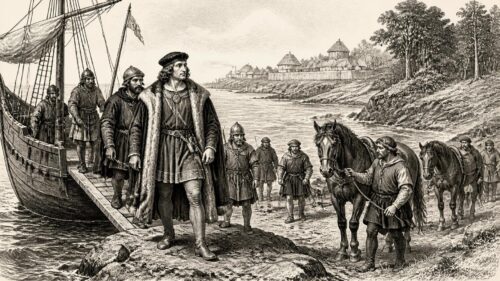
The most consequential firmly dated event was the arrival of Sir Edward Poynings, Henry VII’s new lord deputy, on 13 October. He landed at Howth with an English force and a body of administrators. His appointment was an unusually direct attempt to alter the workings of the lordship of Ireland. The immediate background was the continuing danger of Yorkist pretenders to Henry’s throne, especially Perkin Warbeck, who had found supporters in Ireland earlier in the decade. Henry had reason to distrust the political world dominated by Kildare: the earl and many other leading figures had previously backed the Yorkist claimant Lambert Simnel.
Poynings was sent not simply to punish past disloyalty. His instructions, as later evidence makes clear, joined military, political and financial aims: to secure the Dublin-centred lordship, curb support for Warbeck, make dealings with Gaelic rulers more manageable, and improve an administration whose ordinary income could not meet its needs. This was a formidable programme. The crown could dispatch soldiers, officials and legal expertise across the Irish Sea, but it could not govern effectively without local networks of landholding, service, intelligence and transport. Kildare, recently the dominant deputy governor, possessed precisely those networks.
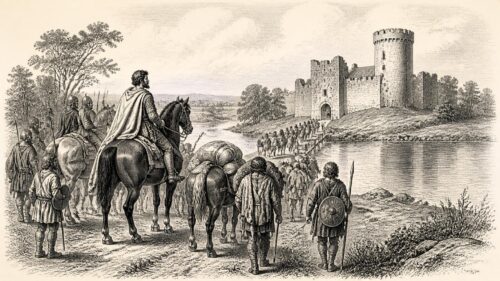
At first, cooperation was possible. In November Poynings went on expedition into Ulster with Kildare and Sir James Ormond, a royal ally and rival to the earl. O’Hanlon and Magennis made submissions to the deputy’s authority. Such submissions should not be mistaken for permanent annexations. They were political acts made in a setting where a lord’s presence with an army, the giving of pledges, and the prospect of future retaliation could all influence a decision. Yet the expedition showed that the new deputy could temporarily assemble a coalition extending beyond the immediate reach of Dublin.
It also revealed the limits of that coalition. Poynings soon suspected Kildare of communicating privately with Gaelic leaders before they submitted. Whether or not every suspicion was justified, the disagreement mattered because the deputy’s wider plans required Kildare’s cooperation. By the close of 1494, the two men were moving from an uneasy partnership towards an open political breach. Kildare’s eventual arrest belongs to February 1495, and should not be read back into this year; in 1494 the essential development was the arrival of a deputy determined to reduce the dependence of government upon him.
The Drogheda Parliament
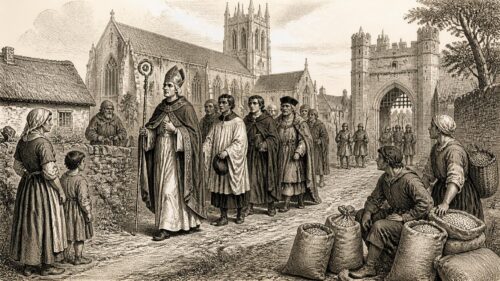
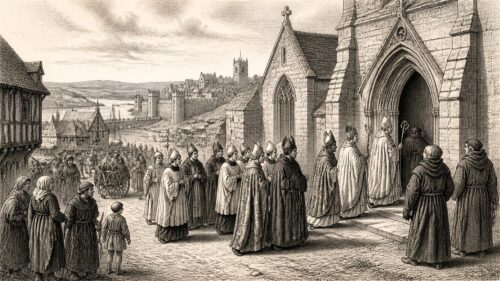
On 1 December, Poynings assembled a parliament at Drogheda. The choice of town was practical as well as political. Drogheda was a major walled settlement on the north-eastern approaches to Dublin, linked by trade and travel to the Irish Sea world, and an established meeting-place for lordship government. Parliament brought together the political community recognised by that government: bishops, abbots, magnates, knights and representatives of towns. It did not represent all inhabitants of Ireland, nor did its jurisdiction extend evenly across the island.
The sessions which began in December continued into February 1495. That chronology is important. The legislation commonly grouped as the acts of Poynings’ parliament belongs to the parliamentary process of 1494–95; it is unsafe to treat every famous statute as completed on the opening day, or even within the calendar year 1494. What can firmly be placed in December is the convening of the parliament and the beginning of an extensive legislative programme.
Its measures addressed the practical anxieties of a frontier lordship. They included renewed restrictions on the adoption of Gaelic customs by those deemed English in Ireland, provisions affecting royal officials and castle constables, financial measures, and efforts to regulate private warfare. The statutes also preserve an early official reference to an “English pale”, in connection with proposed defensive ditches. The language was telling. It imagined a territory that required enclosure and discipline, not a kingdom securely administered from its centre.
The parliament is best remembered for the measure later called Poynings’ Law: the requirement that proposed Irish parliamentary legislation should first receive approval under the great seal of England before it could be introduced in an Irish parliament. Its long constitutional significance should not obscure its immediate setting. It was designed in part to prevent an Irish parliament from becoming a vehicle for a Yorkist challenge to Henry VII. In the short term it was an instrument of Tudor security; over the following centuries it became a major restraint on Irish parliamentary initiative. The law’s later fame should therefore be distinguished from the more immediate uncertainty of December 1494, when the deputy was still trying to make royal authority work on the ground.
Wars Beyond the Lordship
While Drogheda prepared for parliamentary business, the annals recorded a very different political landscape elsewhere. In north Connacht, Domnall Ó Conchobair, lord of Sligo and territory extending from the mountains to the sea, was killed on a Friday night before the feast of St Patrick. He died in a night attack at the bawn of Bunfinne castle, struck down by sons of a rival Ó Conchobair branch. The entry conveys both the importance of fortified places and the intensely dynastic character of power: lordship could be contested through sudden raids as well as set battles.
The struggle around Sligo continued. At the end of summer and beginning of harvest, Aodh Ruadh Ó Domhnaill, Red Hugh O’Donnell of Tír Chonaill, lay before Sligo castle. Men fighting with him included a Scottish leader, Domnall of Arran, an indication of the military links joining Ulster, the Hebrides and western Scotland. The siege cost lives on both sides. The annal names O’Donnell adherents killed by the castle’s defenders, while it separately records the death at Sligo castle of William Mac William de Burgh during the summer. These notices do not provide a full campaign narrative, but they show Sligo as a contested gateway between north-west Ulster and Connacht.
Conflict was equally visible in the north Midlands. After Easter, Tuathal Ó Néill and thirteen companions were killed along with Murchadh Ó Lorcáin by rival forces. Near May Day, Toirdelbach Mag Samradhain was killed by an arrow, and the annalist even preserved the name and status of the kern who shot it: Edmund Mac Sitriuc. In June, Feidhlimidh Mag Samradhain was captured amid an internal family dispute involving Maguire allies and was released in July. Such entries underline that political life was not divided neatly between an “English” east and a “Gaelic” west. Kinship disputes, hostage-taking, cattle-raiding and armed retainers shaped security and authority throughout Gaelic Ireland.
One annalistic notice records a defeat inflicted by Aodh Mag Mathghamhna and John Ó Raghallaigh upon “the Foreigners”, with sixty leading men killed and others taken as captives or hostages. The identification of that force is not explained in the surviving entry, so it would be rash to assign the encounter to a particular named army. Its language nevertheless demonstrates the annals’ own political vocabulary: “Foreigners” denoted people associated with the Anglo-Irish world, rather than a simple modern ethnic category. Hostages, whether seized in battle or exchanged by agreement, remained central to the enforcement of relationships between lordships.
Authority, Faith and Daily Pressures
Religion was inseparable from these political arrangements. Churches, monasteries and cathedral chapters held land, received protection or suffered in war, while clerics appeared within the institutional world of parliament. The opening legislation at Drogheda included concern for ecclesiastical liberties and for particular church interests. Yet the evidence for 1494 is much stronger on political and military affairs than on ordinary devotional practice. It cannot responsibly yield a detailed picture of parish life in this specific year. What it does show is a Christian society in which saints’ days structured time, churches were important local institutions, and lay lordship constantly intersected with ecclesiastical rights and property.
Everyday life was also exposed to the consequences of rivalry. The annals’ references to a pursuit after prey, night incursions, sieges, killings and captives point to the disruption borne by households close to contested routes and castles. Livestock was wealth, food and a means of sustaining followers; raiding it was therefore both economic coercion and political theatre. In towns such as Drogheda, trade across the Irish Sea linked merchants and craftsmen to England and beyond, while nearby rural districts supplied food, hides, wool and other goods. But warfare, uncertain authority and the fiscal needs of government could readily disturb those connections.
By year’s end, Poynings had established a parliament and displayed royal force in Ulster, but he had not transformed Ireland. Kildare remained indispensable even as he became suspect; Gaelic rulers continued to make and unmake local power; and the threat of Yorkist intrigue still shaped Tudor policy. The significance of 1494 lies less in a completed conquest than in the beginning of a constitutional and administrative experiment. Drogheda’s parliament opened a process whose repercussions would endure, while the annals insist that Ireland’s history that year was also being made in castles, cattle-raids, kin conflicts and regional wars far beyond its walls.
Primary Sources
- The Annals of Ulster: Year U1494
- The Annals of Ulster
- Annala Rioghachta Eireann: Annals of the Kingdom of Ireland by the Four Masters
- Translated Texts at CELT
- Poynings, Sir Edward
- FitzGerald, Gerald (Gearóid Mór)
- Butler, James (‘Sir James Ormond’; ‘Black James’)
- Butler, Piers (‘Piers Ruadh’)
- Butler, Edmund
- Poynings' law
- Public General Acts of 1494
- Statute Law Revision Act 2007
- Statute Law Revision Act 2007 (Oireachtas PDF)
- Documents Relating to Perkin Warbeck, with Remarks on His History
- Merchants and Mariners in Medieval Ireland
- Climate, Disease and Society in Late-Medieval Ireland
- Crisis and Survival in Late Medieval Ireland
- Ireland's Trade with England in the Later Middle Ages
- Ireland in the Middle Ages
- Crisis in the Medieval Irish Economy