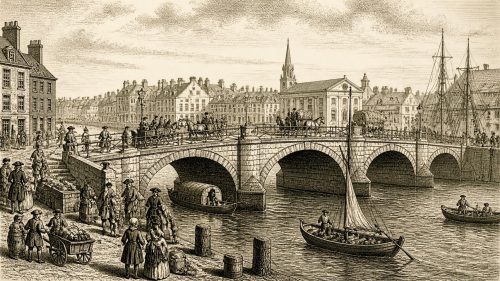
Archived: 12 October 2026
Abstract
In 1755, Ireland remained a Protestant-controlled kingdom constrained by Britain, with Catholics and Presbyterians excluded from political rights. William Cavendish became lord lieutenant as parliament resumed under a narrow electorate. Dublin’s Essex Bridge opened, improving movement across the Liffey, while Luke Gardiner’s death marked his influence on planned urban development. Banking failures exposed fragile commercial credit, despite linen’s importance. Thomas Omer began Shannon navigation works, seeking inland connectivity. Russborough House displayed landed wealth; Moravian activity illustrated religious diversity; and the Irish Artillery Company reflected tensions. Lisbon’s earthquake and tsunami disturbed Irish coasts, damaging Galway’s Spanish Arch and demonstrating Atlantic connections.
Read Article

Archived: 12 October 2026
Abstract
In 1753, Ireland’s exchequer surplus provoked a constitutional crisis when the Dublin Commons, led by Speaker Henry Boyle, rejected a debt bill returned from Britain with Crown control over expenditure. The dispute affirmed Commons resistance to executive interference but exposed the limits of parliament under Poynings’ Law, Protestant ascendancy and Westminster’s claimed supremacy; bargaining continued for years. In Dublin, the failing Essex Bridge was dismantled and replacement foundations begun, disrupting traffic while signalling Georgian engineering ambition. Authorities also addressed coal prices, begging, street cleaning and Kildare unrest. George Berkeley died in Oxford, ending an episcopate marked by practical improvement schemes.
Read Article
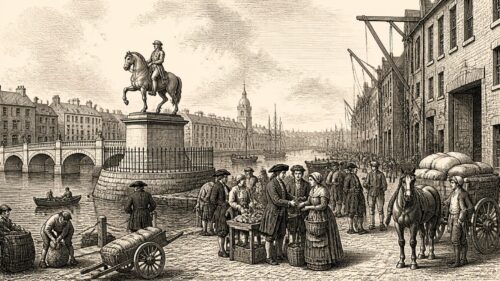
Archived: 13 October 2026
Abstract
In 1722 George I authorised English ironmaster William Wood to mint up to 360 tons of copper halfpence and farthings for Ireland, initiating a controversy over currency, trade and political authority. Issued in London without Irish parliamentary consultation, the fourteen-year patent alarmed critics amid Ireland’s restricted autonomy following the 1720 Declaratory Act, although Swift’s attacks and parliamentary condemnation came later. Ireland’s rural economy, unequal imperial trade and unreliable small change formed its background. Executive government, policing proclamations and penal restrictions demonstrated state power. Dublin simultaneously celebrated Hanoverian rule with George I’s statue, while print culture widened constitutional unease more widely.
Read Article
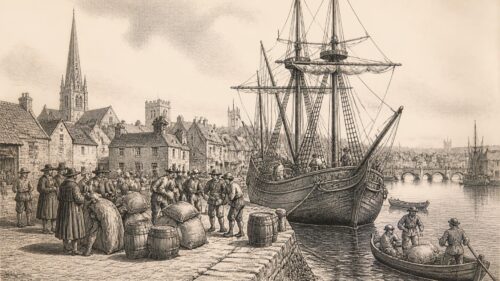
Archived: 14 October 2026
Abstract
In 1676, under Lord Lieutenant Essex, Ireland’s administration addressed fragile revenue, quit rents, transplantees’ land claims in Connacht and Clare, and unlawful county charges, reflecting unresolved consequences of Cromwellian confiscation. Patronage shaped officeholding, while rewards for Patrick Fleming and Redmond O’Hanlon exposed limited control in Ulster. Dublin changed through Humphrey Jervis’s Essex Bridge, promoting north-side development and commerce. The ship Katherine carried Irish Protestant-organised relief to war-stricken New England, including allied Indigenous recipients. Meanwhile, Francis O’Molloy’s Irish-language Catholic catechism, printed in Rome, demonstrated continental religious networks. These events reveal Ireland as contested, rebuilt and connected across Atlantic and European worlds.
Read Article




