
Katherine’s Dublin Cargo1676 CE
In 1676, under Lord Lieutenant Essex, Ireland’s administration addressed fragile revenue, quit rents, transplantees’ land claims in Connacht and Clare, and unlawful county charges, reflecting unresolved consequences of Cromwellian confiscation. Patronage shaped officeholding, while rewards for Patrick Fleming and Redmond O’Hanlon exposed limited control in Ulster. Dublin changed through Humphrey Jervis’s Essex Bridge, promoting north-side development and commerce. The ship Katherine carried Irish Protestant-organised relief to war-stricken New England, including allied Indigenous recipients. Meanwhile, Francis O’Molloy’s Irish-language Catholic catechism, printed in Rome, demonstrated continental religious networks. These events reveal Ireland as contested, rebuilt and connected across Atlantic and European worlds.
Dateline
In 1676 Ireland was not marked by a single dramatic battle or constitutional rupture. Its importance lies instead in a set of revealing movements: administrative orders from Dublin Castle, unresolved claims to land in Connacht and Clare, renewed efforts against outlaws in Ulster, the reshaping of Dublin’s streets and river crossing, and two very different connections with the wider world. In August a ship left Dublin with relief for distressed people in New England; during the same year, an Irish Franciscan in Rome published a substantial Irish-language catechism. Together, these developments show an island still living with the consequences of war and confiscation, yet connected by shipping, religion, print and government to an Atlantic and European world.
Essex Returns to Government
Charles II was king, and Arthur Capel, earl of Essex, was lord lieutenant of Ireland. Essex had first taken office in 1672, but after a period in England he returned to Ireland in May 1676. His restoration administration was preoccupied less with parliamentary politics than with the difficult mechanics of authority: revenue, land titles, local charges, security and the management of competing interests among officeholders, Protestant landowners and the large Catholic population.
The surviving official record gives a particularly clear impression of government by proclamation. On 26 May the commissions of Sir Charles Meredyth and others as chief commissioners and governors of the king’s revenue in Ireland were declared void. That apparently technical act mattered. Customs, excise, rents and other receipts sustained the civil establishment, garrisons and courts, while disputes over who controlled revenue could quickly become disputes over patronage and power. Essex’s correspondence from this period also records anxiety over excise contractors unable to advance the money they had promised. The state’s authority was real, but its financial machinery could be fragile.
On 26 June proclamations addressed quit rents and appointed a commissioner to hear the claims of transplantees to Connacht and County Clare; a further proclamation on 30 June dealt with the conduct of those hearings. Quit rents were continuing payments owed to the Crown from landholders. The claims of transplantees reached back to the Cromwellian land settlement, when many Catholic proprietors had been dispossessed and others were moved westwards, while soldiers, adventurers and Protestant purchasers gained land. The Restoration settlement had altered some outcomes, but it had not erased the tangled titles, expectations and grievances created by the wars of the 1640s and 1650s.
Land, Charges and Local Power
The June business should not be mistaken for a final solution to Ireland’s land question. Rather, it demonstrates that the consequences of conquest still reached into the daily administration of farms, estates and townlands in 1676. A claimant’s success or failure could affect tenancy, rents, inheritance and local status. Survey material produced after the Cromwellian conquest had reduced land to mapped, measured and valued units, but maps did not settle every right. In Connacht and Clare especially, where transplantation had been central to the Commonwealth’s policy, official hearings kept old dislocation alive in legal form.
Another proclamation, issued on 23 August, opposed the raising of money on counties through illegal grand-jury presentments. Grand juries performed important county functions, including approving expenditure for roads, bridges, prisons and other local needs. The intervention indicates official concern that local financial burdens could be imposed improperly or without authority. For ordinary inhabitants, government was experienced not only through distant decrees but through levies, rents, quartering, transport obligations and the decisions of magistrates and juries. Essex’s administration was attempting to assert oversight in precisely these places where central policy met local interest.
Honour and office also mattered. On 31 July George Lane, a long-serving secretary of state in Ireland and secretary for war, was created Viscount Lanesborough. The peerage was part of a bargain: Lane surrendered the secretaryship for war in return for a pension and elevation. His advancement illustrates the personal character of Restoration government. Offices were sources of income and influence; their rearrangement could reward service, quiet a dispute or make a powerful official less troublesome. Yet Lane’s promotion reportedly prompted complaints of favouritism, a reminder that courtly reward was never politically neutral.
Outlaws on the Ulster Roads
Security was another persistent concern. On 23 August the government offered a reward for the capture of Patrick Fleming, and on 16 October it issued a further proclamation for the taking of Fleming and Redmond O’Hanlon. O’Hanlon, active around south Ulster, was described by the authorities as a tory: a term used for armed robbers and outlaws, though such figures could also exploit local loyalties, intelligence networks and difficult terrain. He had already been proclaimed in 1674 and would remain at large for years.
The proclamations do not prove that all Ulster was lawless, nor should O’Hanlon’s later folkloric reputation be projected uncritically back onto 1676. They do show, however, that the government regarded armed predation as serious enough to require public rewards. The woods, hills and roads around Slieve Gullion and the Fews offered concealment and routes between Armagh, Down and the borderlands. For carriers, cattle owners, travellers and small communities, insecurity could mean stolen animals, interrupted trade and pressure to provide information or provisions. The contrast between Dublin Castle’s proclamations and the difficulty of enforcing them at a distance was a defining feature of the year.
A Bridge and a Changing City
Dublin, meanwhile, was being physically reoriented. In 1676 Humphrey Jervis developed the first Essex Bridge on the site of today’s Grattan Bridge, named for the lord lieutenant. The crossing linked Jervis’s developing north-side property interests, including the emerging Capel Street area, with the south side of the Liffey and the route towards Dublin Castle. It was more than an engineering convenience. A bridge changed the movement of people, carts, livestock and goods; it encouraged adjoining streets, building plots and commercial traffic to acquire greater importance.
The development belonged to a wider later-seventeenth-century expansion of Dublin beyond its medieval core. Merchants, brewers, maltsters, craftsmen, officials and labourers inhabited a city whose riverside, quays and suburbs were increasingly significant. The first Essex Bridge was narrow and troublesome by later standards, and it did not survive in its original form. Nevertheless, its creation in 1676 captures a genuine change: the capital was becoming a more connected commercial town, while private enterprise, municipal interests and viceregal prestige could combine in the remaking of urban space.
Relief Across the Atlantic
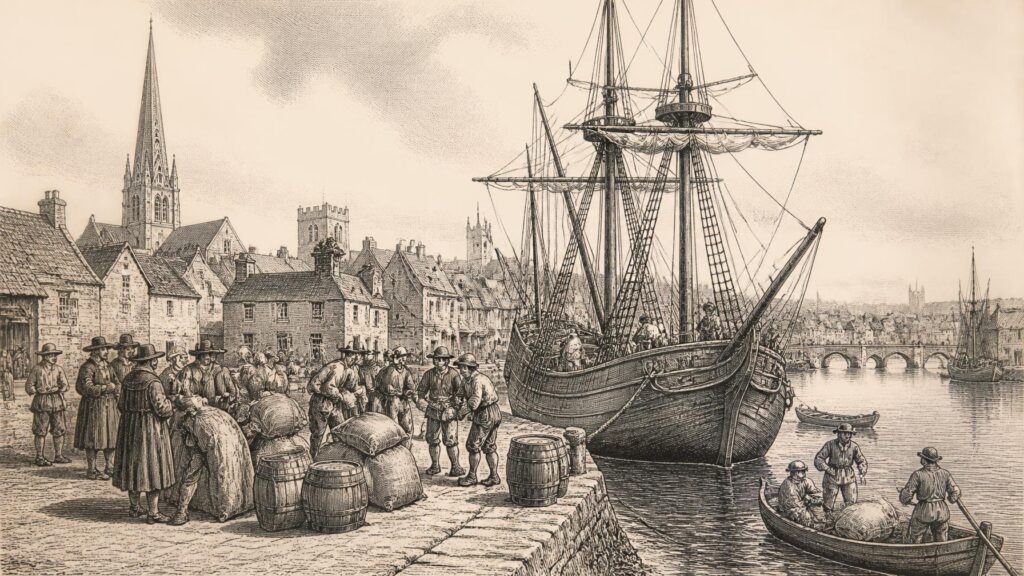
On 28 August, the hired ship Katherine sailed from Dublin for Boston carrying what became known as the Irish Donation of 1676. The cargo was intended for people impoverished by the recent war in New England commonly called King Philip’s War. The relief was raised among Christians in Ireland, with the Dublin-based independent Protestant minister Nathaniel Mather associated with the effort. Its eventual recipients were to include not only English colonists but Indigenous people allied to the English who had been reduced to distress by the conflict.
This was a modest episode in the scale of Atlantic commerce, but a striking one. Ireland is often viewed in this period chiefly through dispossession, religious division and subordination to English policy. The Katherine shows another dimension: people in Dublin could mobilise provisions and credit for a distant emergency, employ a ship, and direct aid across an ocean. The consignment was commercial as well as charitable in method. Goods had to be transported, freight paid, merchandise sold and proceeds distributed. Its voyage therefore depended on the same maritime connections that carried Irish produce, imports, letters, passengers and news.
The donation also cautions against treating seventeenth-century religious identities as simple national categories. Its organisers and many contributors came from a Protestant milieu in Dublin, while the recipients were in Puritan New England; yet the instructions reportedly insisted that godly people differing on baptism should not be excluded, and that allied Indigenous people in need should be remembered. The gift did not dissolve the harsh hierarchies of the Atlantic world, but it did create an unusually tangible Irish connection to its violence and displacement.
An Irish Book from Rome
In the same year, Froinsias Ó Maolmhuaidh, known in English as Francis O’Molloy, published Lucerna Fidelium, or Lóchrann na gCreidmheach, in Rome. It was an Irish-language Catholic catechism produced under the authority of the Congregation of Propaganda Fide. The book was the first work in Irish issued by that Roman press and used the distinctive “Rome Irish” typeface for the first time. Its publication was firmly connected to a request made in 1670 by Irish clergy for a catechism in Irish.
Its appearance abroad is central to its meaning. Catholic religious organisation in Ireland operated under legal and political constraint, while Irish Franciscan learning depended heavily on continental colleges and networks. Ó Maolmhuaidh, an Offaly-born Franciscan based at St Isidore’s in Rome, assembled teaching intended for missions in Ireland and Scotland and perhaps for Irish soldiers serving in European armies. The catechism’s Irish text made religious instruction available in the language spoken by many of those it sought to reach. It is evidence not of an isolated Gaelic culture, but of Irish scholarship using Roman institutions, continental printing and inherited Irish literary resources.
Thus 1676 joined local pressures to international connections. In Connacht and Clare, families pursued claims born of confiscation and transplantation. In Ulster, rewards advertised the limits of state control. In Dublin, a bridge and a departing relief ship made the Liffey and the Atlantic conduits of change. In Rome, an Irish Catholic book entered print. The year’s surviving record is administrative and fragmentary, but its fragments reveal a country being governed, rebuilt, contested and imaginatively connected far beyond its shores.
Primary Sources
- Statute Law Revision Act 2015, Schedule 2
- Capel, Arthur
- O'Hanlon, Redmond
- Lane, George
- Selections from the Correspondence of Arthur Capel, Earl of Essex, 1675–1677
- Lucerna Fidelium
- Lucerna Fidelium–Lochrann na gCreidmheach, Roma, (1676)
- Grattan Bridge, Dublin 7, Dublin
- Jervis Centre, Jervis Street, Dublin 1, Dublin
- Book of Survey and Distribution, Volume I: County Roscommon
- The Down Survey of Ireland Project
- Civil and Down Surveys
- The Civil Survey (1654–6)
- Dublin in the 1680s
- Ireland and the Emerging English Atlantic Empire in the Seventeenth Century
- Making Ireland English: the Irish Aristocracy in the Seventeenth Century
- The Irish in Boston
- The History of Sudbury, Massachusetts, 1638–1889
- The History of Concord, Massachusetts
- Whereas the farmers of His Majesties revenue … have complained to us …