Archived: 13 October 2026
Abstract
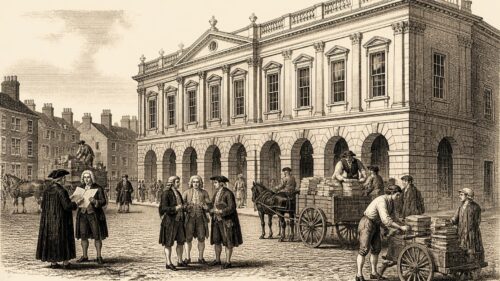
In 1732, Irish institutions revealed tensions within a Protestant-governed, predominantly Catholic society. Hugh Boulter’s Lords’ inquiry counted extensive Catholic clergy, worship, schools and religious houses, prompting renewed enforcement of penal laws, while also exposing uneven local practice. Parliament reduced the maximum interest rate to six per cent, reflecting an expanding but unequal commercial economy. Trinity College Dublin’s Burgh-designed Library was completed, symbolising privileged Protestant learning. George Grierson became king’s printer, but Constantia Grierson’s death diminished Dublin letters. In Paris, Begley and MacCurtin published the first comprehensive English–Irish dictionary. Dublin also published Berkeley’s Christian defence, Alciphron, illustrating religious and intellectual debate.
Read Article

Archived: 13 October 2026
Abstract
In 1731, Dublin witnessed institutional developments that illuminated eighteenth-century Ireland’s unequal political and social order. Thomas Prior, Samuel Madden and fellow Protestant elites founded the Dublin Society to promote agriculture, manufactures and useful knowledge, creating a forum for economic improvement. In October, the Irish parliament first met in Edward Lovett Pearce’s Parliament House on College Green, a grand but constitutionally constrained home for a legislature representing Protestants alone. Its session considered regulation and transport, including roads. Meanwhile, the Lords’ hostile inquiry into popery documented enduring Catholic worship, clergy, schools and religious communities, exposing the narrow social base of Protestant rule.
Read Article
Archived: 13 October 2026
Abstract
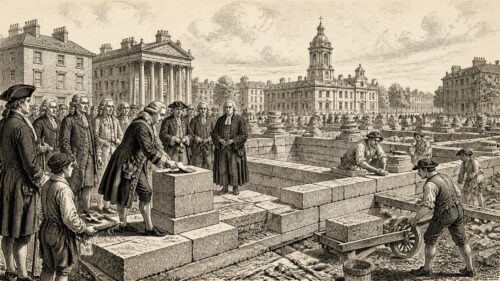
In 1729, Ireland displayed striking contrasts between elite ambition, commercial regulation and widespread hardship. Dublin’s new Parliament House began at College Green, while Castletown House was completed, both symbolising Protestant landed power despite Catholic exclusion from politics. Continuing scarcity after failed harvests left poorer households vulnerable to hunger, begging and displacement; Dublin expanded workhouse provision, combining relief with discipline. Jonathan Swift’s A Modest Proposal transformed these conditions into devastating satire. The Ballast Offices Act sought to improve provincial ports and maritime trade. Deaths of William Conolly, Archbishop William King and poet Aogán Ó Rathaille marked political, ecclesiastical and cultural transitions.
Read Article

Archived: 13 October 2026
Abstract
In 1728, Irish legislation disfranchised Roman Catholics, excluding the Catholic majority from parliamentary elections and legal employment while reinforcing Protestant Ascendancy within a constitutionally dependent kingdom. Parliament also contemplated replacing dilapidated Chichester House. A severe harvest failure intensified the 1727–29 subsistence crisis, raising grain prices and exposing tenants, labourers and smallholders to hunger despite local charitable relief. Efforts to promote tillage reflected tensions between grazing exports and food security. Emigration from Belfast to America signalled economic pressure. Brooking’s Dublin map portrayed civic confidence amid poverty. Esther Johnson’s death, Swift’s political writing, and Matthew Dubourg’s appointment marked cultural life that year.
Read Article
Archived: 13 October 2026
Abstract
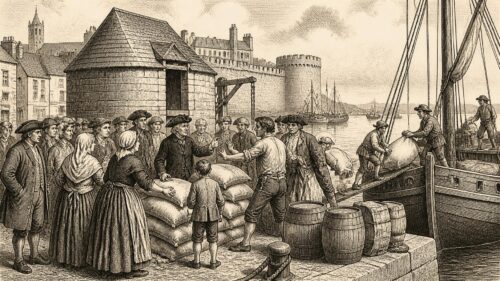
In 1727, Ireland experienced political continuity alongside acute social insecurity. George II succeeded George I, and a new Irish parliament assembled under a Protestant establishment managed through Dublin and London. Qualified Catholic freeholders still voted in the election, although legislation passed in 1728 subsequently disfranchised them. Harvest weakness and dear grain provoked resistance at Youghal and elsewhere to exports and interregional shipments, exposing conflict between commerce and subsistence. Linen exports did not ensure welfare. Swift criticised structural poverty, while Dublin’s workhouse expanded foundling provision amid uncertainty over dates. The year revealed unequal access to political rights, food, care and markets.
Read Article

Archived: 13 October 2026
Abstract
In 1726, Ireland’s constrained Protestant polity, governed within British authority, regulated religious and private life while excluding Catholics from power. Lord Lieutenant Carteret and Archbishop Boulter represented competing Dublin and London priorities. Jonathan Swift’s anonymously published Gulliver’s Travels, shaped by Irish political experience, achieved immediate success as wide-ranging satire. The previous day, Caleb Threlkeld published the first Irish flora, cataloguing Dublin-area plants in Latin, English and Irish and linking observation, medicine and vernacular knowledge. Linen exports demonstrated commercial integration, yet rural society remained vulnerable. A failed harvest and rising prices inaugurated late-1720s scarcity, revealing prosperity’s uneven distribution across the kingdom.
Read Article

Archived: 13 October 2026
Abstract
In 1724, opposition to William Wood’s London-authorised copper coinage transformed a dispute over halfpence into a national argument about economic trust, political consent and Irish interests. Jonathan Swift’s anonymous Drapier’s Letters, printed by John Harding, encouraged householders, merchants and bankers to refuse the coins, despite official assurances of their quality. Dublin declarations, grand jury support and Harding’s prosecution threats demonstrated print’s political power, while Lord Lieutenant Carteret confronted mounting resistance. The patent remained valid until 1725, but could not circulate effectively. The year also saw Hugh Boulter’s primacy, the Neal brothers’ landmark Irish tune collection, and a total solar eclipse.
Read Article




