Catholic Disfranchisement1728 CE
In 1728, Irish legislation disfranchised Roman Catholics, excluding the Catholic majority from parliamentary elections and legal employment while reinforcing Protestant Ascendancy within a constitutionally dependent kingdom. Parliament also contemplated replacing dilapidated Chichester House. A severe harvest failure intensified the 1727–29 subsistence crisis, raising grain prices and exposing tenants, labourers and smallholders to hunger despite local charitable relief. Efforts to promote tillage reflected tensions between grazing exports and food security. Emigration from Belfast to America signalled economic pressure. Brooking’s Dublin map portrayed civic confidence amid poverty. Esther Johnson’s death, Swift’s political writing, and Matthew Dubourg’s appointment marked cultural life that year.
Dateline
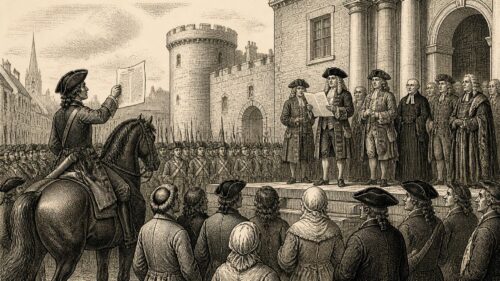
In 1728, Ireland’s political order became more openly exclusive. On 6 May, at the close of a session of the Irish parliament that had begun in November 1727, royal assent was given to legislation that barred Roman Catholics from voting at parliamentary elections. Often called the Disenfranchising Act, it was one element in the penal-law system, but it carried a particular constitutional force: Catholics were now formally shut out of the electorate as well as excluded from parliament and many offices. The measure did not create the Protestant Ascendancy; that settlement had been secured through conquest, confiscation, oaths and earlier statutes. It did, however, remove a residual political right from the overwhelming Catholic majority and made the confessional basis of public power still plainer.
Legislation and Dependence
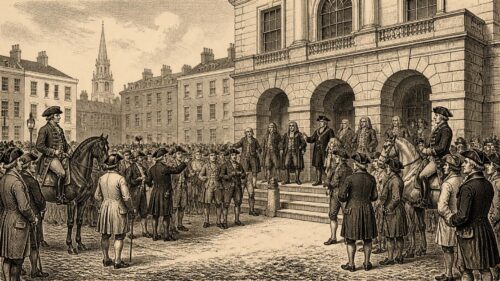
The parliament which enacted the measure sat in Dublin, but it was not a sovereign legislature in the modern sense. The British parliament’s Declaratory Act of 1720 had asserted its authority to make laws binding Ireland, while the older Poynings’ Law machinery restricted the initiation of Irish bills. The Irish House of Commons nonetheless mattered greatly in domestic administration: it voted supplies, passed local legislation and represented the interests of the Protestant landowning and office-holding elite. Catholic disfranchisement therefore narrowed the political nation within an already constrained kingdom. It also meant that disputes over rents, tithes, trade and local government would be debated in an assembly from which most of those affected by them were legally absent.
The statute was accompanied by another revealing act of the same 6 May settlement. Parliament regulated admission to legal employments and sought to prevent Catholics from practising as solicitors, explicitly presenting the purpose as the strengthening of “the Protestant Interest”. This was more than rhetoric. Law, elections and local office were routes to influence, income and social standing. Restricting access to them helped preserve the dominance of the established Church of Ireland and the Protestant governing class, even as Catholics continued to make up most of the population in many regions. The legal language also reminds us that the penal laws were not a single unchanging code; they were repeatedly adjusted, tightened and interpreted through particular political circumstances.
There was a quieter but significant sign of elite confidence in Dublin. On 10 January a parliamentary committee reported that Chichester House, where parliament met, had become dangerously dilapidated and that a new house was necessary. The report did not yet mean that the famous Parliament House on College Green existed: its foundation stone was laid only in February 1729, under the calendar then used in Britain and Ireland. But the 1728 decision began a project that would give the Ascendancy legislature a grand new architectural setting.
Bad Grain and Dear Food
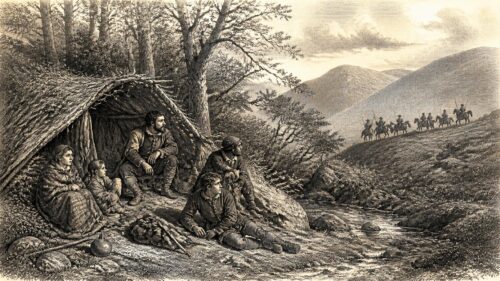
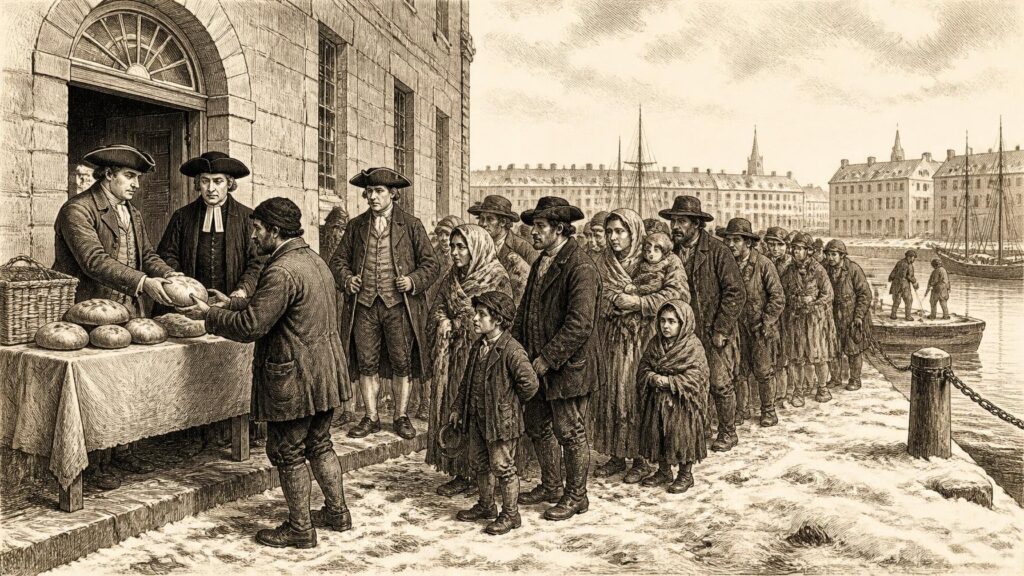
The most immediate anxiety of 1728 was subsistence. Ireland was passing through the smaller but serious famine crisis of 1727–29. Evidence from Archbishop Hugh Boulter’s correspondence and later economic research indicates that the 1728 harvest failure was especially grave. Grain did not yield well, prices rose, and the threat lay not merely in an empty market but in the precarious resources of labourers, cottiers and small farmers. A household with little cash, few reserves and rent or tithe demands could be pushed into catastrophe by a single bad season. Contemporary observers often framed the problem in terms of corn, but hunger was also a crisis of wages, credit, access to land and the ability to buy food.
The Dublin administration reacted during the year. A proclamation issued late in December against practices that enhanced food prices referred to the bad previous harvest. Boulter feared that very large numbers might perish before the next harvest; this was a warning, not a reliable count of deaths, and it should not be turned into one. Relief in this period remained piecemeal, depending on charitable subscriptions, churchmen, local authorities and institutional kitchens rather than any national poor-law system. Retrospective accounts record public feeding in Dublin during the 1728–29 crisis, including assistance associated with the workhouse and Trinity College. Such measures could save lives in particular places, but they could not remove the structural vulnerability exposed by the failed harvest.
Pasture, Tillage and Pressure on Tenants
Scarcity sharpened a longstanding argument about Irish agriculture. Cattle, beef, hides and provisions were important to an export economy increasingly centred on ports such as Cork, Dublin, Limerick and Waterford. Pasture suited much of Ireland’s wet grassland and could be profitable for landlords and larger graziers. Yet it employed far fewer people than tillage and could leave districts with limited local grain production. In 1728 Boulter supported, and parliament approved, a measure intended to encourage tillage. His concern was practical as well as ideological: he described journeys through areas in which cornfields were remarkably scarce. The statute could urge cultivation, but it could not by itself settle the tension between export-oriented grazing and the food security of a growing rural population.
That tension was experienced unevenly. Protestant estate owners and merchants could benefit from rents and livestock commerce; tenants faced the risks of rent increases, bad weather and tithe payments to the established church. Catholics bore the added disabilities of the penal code, while Ulster Presbyterians, though Protestant, also objected to supporting a church they did not attend. It would be misleading to describe all Irish farmers as equally destitute, or all grazing as a simple cause of famine. Nevertheless, the harvest crisis made visible how a rural economy that could export provisions still left many households dangerously exposed when grain supplies failed.
Ulster’s Atlantic Outlet
Emigration offered one response to those pressures. Boulter’s correspondence records that seven ships left Belfast for America with about 1,000 passengers in 1728. The figure is an illuminating contemporary report, not a total for all departures from Ulster or Ireland. Still, it shows that movement across the Atlantic was already an established option for some Presbyterian families and others connected to the northern ports. High rents, tithes, insecure livelihoods and the prospects offered by colonial land and communities all formed part of the background. The departure of so many people concerned administrators, who saw emigration both as a loss of Protestant population and as evidence of economic strain.
Dublin Mapped
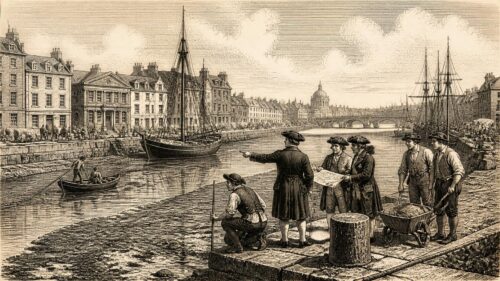
Charles Brooking’s map and northern prospect of Dublin, published in 1728, provide an unusually vivid contemporary frame for the capital. The work displayed parishes, liberties, major public buildings, guild arms and the city’s relationship with the Liffey. It showed Dublin as an administrative, commercial and institutional centre: Dublin Castle, the Custom House, barracks, markets, hospitals, Trinity College, the Royal Hospital and the Linen Hall all appeared in its designed urban panorama. It also captured the port before reclamation behind the North and South Walls, a reminder that the shoreline and working waterfront were still being remade.
Brooking’s polished image should not be mistaken for a social survey. It foregrounded authority, commerce and civic improvement, rather than crowded rooms, insecure employment or hunger. Yet its inclusion of the Poor House among the city’s landmarks hints at the institutional world through which urban poverty was managed. Dublin was expanding, drawing servants, artisans, labourers, traders, clergy and gentry into a city whose splendour and hardship stood close together. During the food crisis, the capacity to purchase bread or obtain charitable meals mattered at least as much as the impressive buildings along the river and in the central streets.
Loss, Music and Letters
On 28 January Esther Johnson, known to Jonathan Swift as “Stella”, died in Dublin. Her long, intimate friendship with the dean of St Patrick’s Cathedral had shaped one of the most famous personal records of early eighteenth-century Ireland, Swift’s Journal to Stella. The nature of their relationship has attracted centuries of speculation, including an unproven story of marriage; what is secure is that Johnson was a significant, independent figure within Swift’s Dublin world and that her death affected him deeply. Swift wrote a memorial character of her, while the city’s literary circles continued to include writers such as Patrick Delany, who left Trinity College Dublin in 1728 to become chancellor of Christ Church Cathedral.
Swift’s A Short View of the State of Ireland, printed in 1727–8, belongs closely to this moment of scarcity and political frustration. It was a polemical work, not an impartial statistical report, but its attack on commercial restrictions, absentee interest and rural misery expressed anxieties that the food crisis made harder to ignore. In music, Matthew Dubourg was appointed early in 1728 master and composer of the Irish state music, the kingdom’s most prestigious musical office. His appointment connected Dublin Castle’s ceremonial life with the wider London and European musical world. Tradition also places Oliver Goldsmith’s birth in 1728, conventionally on 10 November at Pallas in County Longford, though both the year and place have been disputed; it is best treated as a probable rather than uncontested datum.
Thus 1728 was not defined by one dramatic battlefield or rebellion. Its importance lay in the convergence of law and livelihood. Catholic political participation was legally extinguished; the elite legislature prepared to build itself a monumental home; a poor harvest exposed the fragility beneath agricultural exports; and ships from Belfast carried people towards an Atlantic future. The year’s official acts proclaimed Protestant authority, while its hunger, migration and writing revealed the insecure society over which that authority ruled.

Primary Sources
- Letters Written By His Excellency Hugh Boulter, D.D., Lord Primate of All Ireland, &c., to Several Ministers of State in England, and Some Others
- Famine in Ireland, 1300–1900
- The Demographic History of Ireland, 1740–1850
- The Political Economy of Famine in Ireland, 1690–1800
- Scarcity and Poor Relief in Eighteenth-Century Ireland: The Subsistence Crisis of 1782–4
- The Provision Trade
- Emigration to Colonial America
- Irish Emigration and the Tenure of Land in Ireland, Chapter II Appendix
- Free Movement of People? Responses to Emigration from Ireland, 1718–30
- Constitutional Differences
- Acts and Statutes Made in a Parliament Begun at Dublin, the Twenty Eighth Day of November, 1727
- Statute Law Revision Act 2015
- The Penal Laws: Origins, Purpose, Enforcement and Impact
- A Map of the City and Suburbs of Dublin and Also the Archbishop and Earl of Meath’s Liberties, 1728
- Lord Chancellor Lord Wyndham
- Eighteenth-Century Dublin
- A Short View of the State of Ireland: TEI Header
- Jonathan Swift Archive: An Introduction to A Short View of the State of Ireland
- Johnson, Esther
- Dubourg, Matthew
- Goldsmith, Oliver
- Delany, Patrick