Archived: 18 September 2026
Abstract
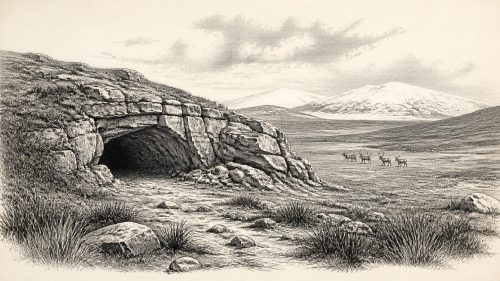
31,328 BCE is a label for a fluctuating later MIS 3 environment, not a recorded Irish event. Ireland experienced cold conditions as ice expanded before the Last Glacial Maximum, while southern habitats at times supported mammoth, giant deer, reindeer, bears, hyaenas and cold-adapted fauna. Castlepook Cave, County Cork, preserves mixed deposits spanning periods, making it valuable but limited. A reindeer femur bearing a possible stone-tool cut mark may indicate Ireland’s earliest human activity, though it lacks context and associated artefacts. Human presence may have been intermittent. No evidence supports settlements, polities, trade or population continuity; environmental change dominates the period.
Read Article

Archived: 17 September 2026
Abstract
Circa 31,365 BCE, Ireland lay within the climatically unstable Late Pleistocene, before the Last Glacial Maximum. Dates are approximate, reflecting calibrated radiocarbon uncertainties and disturbed cave deposits. Derryvree sediments show locally ice-free treeless tundra, wetlands and harsh periglacial conditions. Castlepook Cave yielded mammoth, reindeer, giant deer and carnivore remains, indicating intermittent animal access to open landscapes. A deeply incised reindeer femur may record stone-tool butchery, potentially Ireland’s earliest human trace, but cannot prove settlement. No securely associated tools, hearths, dwellings or burials survive. The evidence instead portrays a fragmented archive of changing ice, sea levels, habitats and possible human visits.
Read Article

Archived: 17 September 2026
Abstract
Around 31,485 BCE, Ireland lay within the climatically unstable Middle Midlandian/MIS 3, not a historically datable year. Evidence from Derryvree indicates wet, open tundra environments before later ice advances, while Crag Cave speleothems show intermittent milder, above-freezing conditions. Castlepook Cave preserves a long, mixed faunal record, including mammoth, reindeer, giant deer, bear and hyena, demonstrating periodically accessible, productive open landscapes before the Last Glacial Maximum. A reindeer femur, about 33,000 years old, bears a possible stone-tool cut mark and may signal brief Upper Palaeolithic human presence. However, disturbed deposits and absent associated artefacts preclude claims for permanent settlement or society.
Read Article

Archived: 16 September 2026
Abstract
31,575 BCE is a label for a late-Pleistocene interval, not a datable Irish event. Derryvree, County Fermanagh, preserves wetland deposits dated broadly to 36,900–31,700 cal BP, indicating treeless, cold, plant-rich terrain between glacial advances. Castlepook Cave, County Cork, contains MIS 3 remains of mammoth, reindeer, giant deer, predators and Arctic fauna, accumulated over time rather than contemporaneously. A cut-marked reindeer femur may indicate human butchery, but cannot establish settlement, chronology or continuous occupation. Lower seas may have aided movement, yet routes remain unknown. Ice expansion reshaped Ireland and destroyed sites, leaving evidence of habitats, animal movement and possible human presence.
Read Article

Archived: 14 September 2026
Abstract
Around 33,700 years before present, during the volatile later Marine Isotope Stage 3, Ireland contained open tundra, grassland, wetlands and changing ice margins. Castlepook Cave near Doneraile, County Cork, yielded over 2,000 bones, documenting reindeer, mammoth, giant deer, bears, hyaenas and other Ice-Age fauna. A reindeer femur, dated to roughly 33,000 years ago, bears an incision possibly made by a stone tool during butchery. This may represent Ireland’s earliest human activity, but remains contested. The bone neither proves permanent settlement nor identifies routes of arrival. Glacial erosion and disturbed cave deposits limit certainty, requiring further dating, microscopy and associated artefacts.
Read Article




