
Castlepook’s Palaeolithic Claim31485 BCE
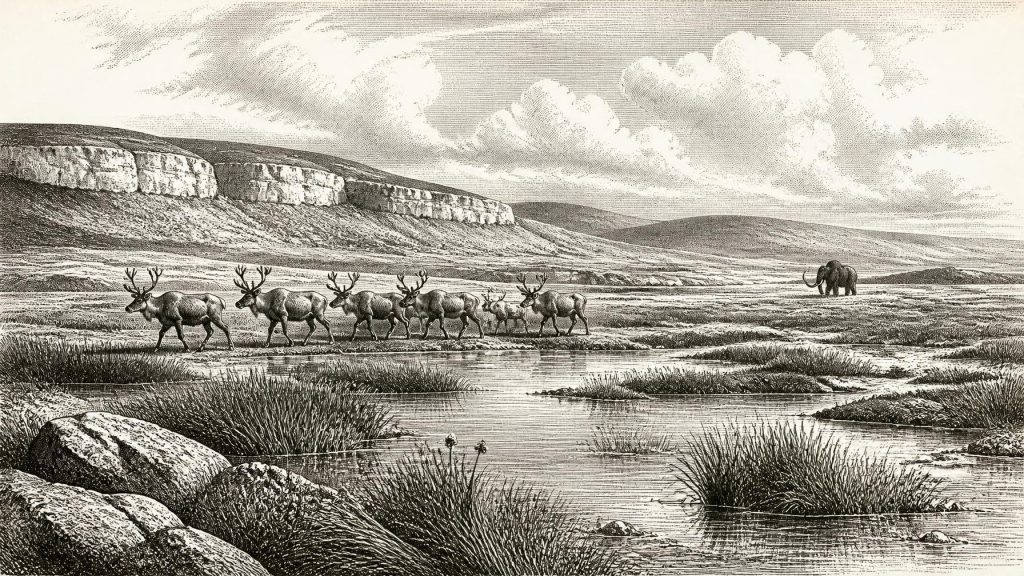
Around 31,485 BCE, Ireland lay within the climatically unstable Middle Midlandian/MIS 3, not a historically datable year. Evidence from Derryvree indicates wet, open tundra environments before later ice advances, while Crag Cave speleothems show intermittent milder, above-freezing conditions. Castlepook Cave preserves a long, mixed faunal record, including mammoth, reindeer, giant deer, bear and hyena, demonstrating periodically accessible, productive open landscapes before the Last Glacial Maximum. A reindeer femur, about 33,000 years old, bears a possible stone-tool cut mark and may signal brief Upper Palaeolithic human presence. However, disturbed deposits and absent associated artefacts preclude claims for permanent settlement or society.
Dateline
The label 31,485 BCE cannot denote an eventful year in Ireland in the way that a later historical date can. No calendar, named community, ruler, settlement or written record survives from this depth of time. Archaeologists instead work with radiocarbon determinations, calibrated ranges, cave deposits, animal remains, landforms and environmental proxies. In calendar terms, this label lies roughly 33,400 years before AD 1950, within the later part of Marine Isotope Stage 3 (MIS 3), a climatically volatile phase of the Last Glacial period. The responsible subject is therefore not a supposed Irish “year”, but the changing possibilities for life, animals and perhaps very occasional human visitors in Ireland during the broad interval around it.
A Date Without Annual Precision
Modern calendar precision is unavailable. Even a very good radiocarbon result represents a probability range, not an anniversary; calibration converts radiocarbon years into ranges of calendar years using independently dated records of past atmospheric carbon. The margins become wider and more consequential beyond 30,000 years ago. Older Irish cave discoveries were also excavated before modern expectations of fine stratigraphic recording, systematic sieving and contamination control. A bone’s age may be measured, but that does not automatically establish the date at which it entered a cave, nor the age of every object recovered nearby.
The period is usually called the Middle Midlandian in Irish Quaternary terminology and belongs to MIS 3 in the wider global framework. It preceded the Last Glacial Maximum, when the British–Irish Ice Sheet reached far greater extent, broadly between about 26,000 and 20,000 years ago. Around 31,485 BCE, Ireland was not the later green and wooded island familiar from the Holocene. Yet neither should it be imagined as a single, timeless white wilderness. The climate repeatedly altered between colder stadials and relatively milder interstadials over centuries and millennia. What survives records brief windows in a restless Ice Age landscape.
Wet Ground Beneath a Drumlin
The strongest direct environmental evidence relevant to this broad age comes from Derryvree near Maguiresbridge in County Fermanagh. Roadworks there exposed organic silts and fine sands trapped between two separate tills within a drumlin. The deposit produced the radiocarbon determination Birm-166, 30,500 radiocarbon years BP, with substantial uncertainty. It should not be equated mechanically with 31,485 BCE, but it is evidence for an Irish Middle Midlandian interval broadly relevant to the same late-MIS-3 world. Its position beneath a later ice deposit is equally important: a living landscape existed before the subsequent advance covered, compressed and preserved it.
Plant, insect and other biological evidence from Derryvree indicates open tundra vegetation and a periglacial regime. Sedges, mosses and aquatic plants point to wet ground, shallow water and freshwater margins; the surrounding terrain supported low, treeless vegetation rather than closed forest. Such a setting could include exposed mineral ground, seasonally waterlogged hollows and sheltered places where plants flourished briefly. It was a varied small-scale environment, not simply bare ice. But the deposit represents one locality and one environmental episode. It cannot prove that every part of Ireland shared precisely the same conditions at precisely the same moment.
South-west Ireland offers a complementary climatic archive. Uranium-thorium dating of calcite formations in Crag Cave, County Kerry, shows that liquid water periodically passed through the shallow cave during the last glacial period. Because such speleothem growth requires mean annual temperatures above freezing, the record supports repeated episodes of amelioration. In later MIS 3 those growth pulses broadly coincide, within dating uncertainty, with Greenland interstadials. This does not turn Ireland into a warm place, nor does it date a particular day in 31,485 BCE. It demonstrates that the island’s climate could change sharply and that wetter, somewhat less severe intervals mattered to its plants, animals and any people attempting to enter it.
The Castlepook Faunal World
Castlepook Cave, also known as Mammoth Cave, near Doneraile in north County Cork, provides the most vivid evidence for the animal communities of pre-Last-Glacial-Maximum Ireland. Its narrow limestone galleries and chambers yielded more than 2,000 bones during excavations undertaken mainly between 1904 and 1918. The collection includes woolly mammoth, giant deer, reindeer, brown bear and spotted hyaena, with later cold-stage material including Arctic fox, wolf and lemmings. Individual bones span a long period rather than a single occupation: Geological Survey Ireland summarises dates from roughly 45,700 to 19,950 BP. Castlepook is thus a repository created over many millennia, not a frozen snapshot of one season.
Its most telling lesson is ecological. Reindeer and mammoth required productive open-country habitats; giant deer needed substantial forage; large carnivores and scavengers depended on prey, carrion and routes through the landscape. Spotted hyaenas were especially significant. Their presence helps explain why carcass parts accumulated in cave chambers: carnivores can transport, gnaw and disperse bone, while water and later disturbance can further rearrange deposits. A hyena skull from Castlepook, now in the National Museum of Ireland, is tangible evidence that the cave was used within a predator-and-scavenger landscape rather than as a human home by default.
Recent redating has made the caution more, rather than less, necessary. Improved ultrafiltration of bone collagen showed that some Castlepook dates obtained in the 1990s were thousands of radiocarbon years too young. The reassessment places important elements of the southern Irish fauna more firmly in MIS 3 and suggests that giant deer and spotted hyaena may have disappeared locally before the Last Glacial Maximum, around 40,000 calibrated years BP. The result confirms that the island was accessible to substantial mammal populations before the great ice expansion. It also warns against building neat narratives on untested early dates.
A Reindeer Bone and a Human Question
The most provocative evidence near this article’s chronological horizon is a reindeer femur from Castlepook. It bears a single deep mark interpreted by zoologist Ruth Carden as having been made by a sharp stone tool during the processing of fresh bone. Radiocarbon work reported the bone as approximately 33,000 years old. If the interpretation and association are sustained, it would indicate that people reached Ireland during the Upper Palaeolithic, vastly earlier than the long-established evidence for post-glacial settlement. It would be evidence of a brief human action upon an animal, not evidence for a permanent population, village or named hunting people.
The distinction matters. No securely associated stone tools, hearth, dwelling, burial, clothing, art or stratified hunting floor of this age has been recovered in Ireland. A cut-marked limb cannot establish whether hunters killed the reindeer, found it already dead, removed a small quantity of meat or tendon, or processed it elsewhere before carnivores carried the discarded bone into the cave. Nor can a lone mark disclose language, kinship, ritual or identity. Castlepook’s early excavation history and its mixed, water-disturbed deposits make independent microscopic study, fresh dating and carefully excavated new deposits essential. The bone makes an important Palaeolithic claim; it does not yet furnish a complete Palaeolithic society.
This is why the later, directly dated evidence from Alice and Gwendoline Cave in County Clare remains a useful benchmark. A butchered brown-bear patella dated to about 12,810–12,590 calibrated BP is widely treated as secure terminal-Pleistocene evidence of human activity, while some scholars continue to debate what even that find can say about sustained colonisation. If such caution is appropriate for a younger and more tightly dated specimen, it is indispensable for Castlepook’s much older reindeer femur.
What Cannot Be Reconstructed
Political affairs, diplomacy and organised warfare cannot responsibly be described for Ireland around this date. There is no evidence for chiefs, territories, alliances, fortifications or conflict between human groups. Religion, art and learning are likewise invisible in the Irish record for this period: no shrine, image, engraving, grave or musical instrument can be assigned to it. The impressive cave names at Castlepook—such as Hyenahall and Elephant Hall—are modern descriptive names, not traces of Ice Age institutions.
Nor is there evidence for agriculture, herding, pottery, metalworking, settled houses, exchange networks or regular trade. If people visited, the cautious model is of extremely small, mobile Upper Palaeolithic groups operating in a wider north-west European world, perhaps following animals or exploiting seasonal opportunities. Lower sea levels changed the shape of surrounding coasts and exposed parts of continental shelves, but they do not by themselves prove a simple, continuous land bridge or a dependable route into Ireland. Animal dispersal demonstrates access at some times; it does not specify the route, frequency or human use of it.
The history illuminated by 31,485 BCE is consequently a history of thresholds. Ireland supported, at intervals, open-country ecosystems rich enough for reindeer, mammoth, giant deer and powerful scavengers. Freshwater sediments in Fermanagh and cave calcite in Kerry reveal that cold conditions were variable rather than uniform. Castlepook in Cork preserves the island’s best faunal archive for the time before the Last Glacial Maximum—and one contested sign that people may have entered that world. The essential fact is not a fictional annual episode, but a landscape repeatedly made habitable, traversed by animals and perhaps touched once by human hands before ice and time erased almost everything else.
Primary Sources
- A Middle Midlandian Freshwater Series at Derryvree, Maguiresbridge, County Fermanagh, Northern Ireland
- The Late Quaternary History of East-Central Ireland
- Episodic Speleothem Deposition Tracks the Terrestrial Impact of Millennial-Scale Last Glacial Climate Variability in SW Ireland
- A Reconsideration of the Radiocarbon Dating of the Marine Isotope Stage 3 Fauna from Southern Ireland
- The Irish Quaternary Fauna Project
- Castlepook Cave
- Spotted Hyena Skull
- Heritage Artefacts of County Cork
- New Insights on the Fauna of Ireland’s Younger Dryas and Early Holocene from Alice & Gwendoline Cave
- First Evidence of a Late Upper Palaeolithic Human Presence in Ireland
- Growth and Retreat of the Last British–Irish Ice Sheet, 31,000 to 15,000 Years Ago: the BRITICE-CHRONO Reconstruction
- Dynamic Cycles, Ice Streams and Their Impact on the Extent, Chronology and Deglaciation of the British–Irish Ice Sheet
- Maximum Extent and Dynamic Behaviour of the Last British–Irish Ice Sheet West of Ireland
- Stratigraphic and Palaeo-Geomorphological Evidence for the Glacial-Deglacial History of the Last British-Irish Ice Sheet in the North-Western Irish Sea
- Dimensions and Chronology of the Last Ice Sheet in Western Ireland
- Trimlines, Blockfields and the Vertical Extent of the Last Ice Sheet in Southern Ireland
- Last Glacial Maximum Cirque Glaciation in Ireland and Implications for Reconstructions of the Irish Ice Sheet
- Could Brown Bears (Ursus arctos) Have Survived in Ireland During the Last Glacial Maximum?
- Archaeological Excavations at Killuragh Cave, Co. Limerick: A Persistent Place in the Landscape from the Early Mesolithic to the Late Bronze Age
- Learn About: The Ice Age