The Awbeg Palaeolithic Horizon31328 BCE
31,328 BCE is a label for a fluctuating later MIS 3 environment, not a recorded Irish event. Ireland experienced cold conditions as ice expanded before the Last Glacial Maximum, while southern habitats at times supported mammoth, giant deer, reindeer, bears, hyaenas and cold-adapted fauna. Castlepook Cave, County Cork, preserves mixed deposits spanning periods, making it valuable but limited. A reindeer femur bearing a possible stone-tool cut mark may indicate Ireland’s earliest human activity, though it lacks context and associated artefacts. Human presence may have been intermittent. No evidence supports settlements, polities, trade or population continuity; environmental change dominates the period.
Dateline
31,328 BCE is a modern chronological label, not a year that anybody in Ireland could have named or recorded. No indigenous written calendar, settlement sequence or event history can be resolved to that precision. Expressed in the terminology used by Quaternary researchers, the point falls roughly 33,277 calibrated years before present, “present” conventionally meaning 1950. Even that conversion must not suggest a dated moment: radiocarbon results are calibrated into probability ranges, and different records have different degrees of precision. The responsible subject is therefore Ireland in the later part of Marine Isotope Stage 3 (MIS 3), a climatically volatile phase of the Last Glacial Cycle, rather than an imagined occurrence in one numbered year.
For Ireland, this is a threshold in deep time. It predates the fullest expansion of the last British–Irish Ice Sheet, but it belongs to the period in which ice masses were growing rapidly across the northern Atlantic archipelago. It also lies close to the broad age attributed in public heritage interpretation to a reindeer femur from Castlepook Cave near Doneraile, County Cork, bearing a mark proposed as the result of stone-tool butchery. That object makes this date unusually important for Irish prehistory. Yet it is a clue, not a chronicle: it cannot establish a village, a named people, a continuous population or a year-specific hunt.
Dating a Changing Ice-Age Ireland
MIS 3, conventionally dated from about 57,000 to 29,000 years ago, was not a single uniform “Ice Age weather” regime. Greenland ice-core records show repeated abrupt shifts between colder stadials and comparatively milder interstadials. Ireland’s temperature, snowfall, vegetation, coastlines and animal habitats would have altered in response, sometimes far faster than the broad millennial date ranges available for its fossils. Stalagmites, cave sediments, animal bone, pollen, insect remains and offshore landforms each register different aspects of this changing world. None can identify the weather, season or precise shoreline of 31,328 BCE.
The island’s later glacial history is better constrained than its conditions at this exact point. The BRITICE-CHRONO reconstruction models a substantial Irish ice cap by about 31,000 years ago, centred across the northern uplands from the Derryveagh Mountains towards the Sperrins, with separate ice fields and glaciers in several mountain regions. By about 30,000 years ago, ice had expanded and coalesced markedly across the wider British–Irish region. These reconstructions are evidence-led but remain reconstructions: their authors stress that the evidence for ice-sheet growth is less secure than evidence for retreat. They should not be turned into a map claiming that every part of modern Ireland was under ice in 31,328 BCE.
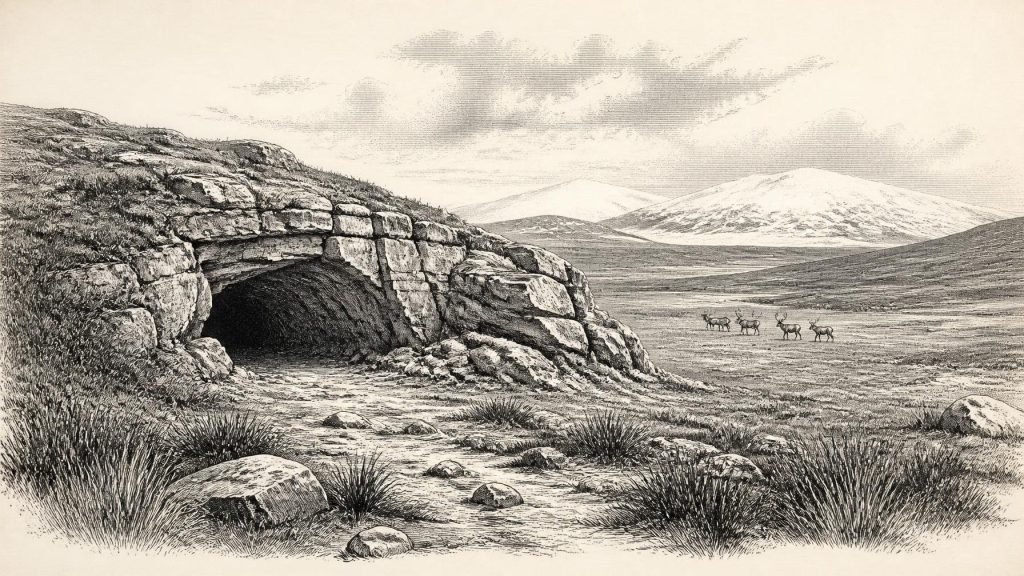
Southern Ireland was especially complex. At Castlepook, in the limestone country of the Awbeg Valley north of the Blackwater, cave passages preserved a long and mixed repository of animal remains. Geological Survey Ireland describes it as Ireland’s richest known vertebrate-fossil site for the interval leading towards the Last Glacial Maximum. Direct dates from individual bones span a very long part of the Middle and Late Pleistocene, while water movement, carnivore activity, early excavation and later disturbance have mixed material from different episodes. Castlepook is consequently powerful evidence that suitable habitats existed in southern Ireland during portions of MIS 3; it is not a sealed time capsule for a single generation.
The Cave Record and Its Limits
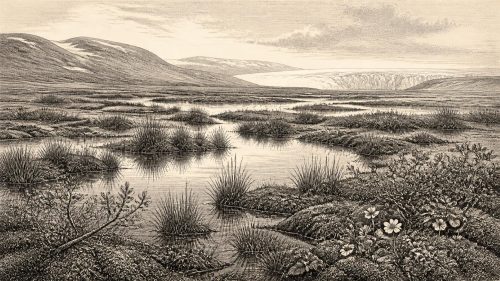
The Castlepook assemblage illuminates an austere but biologically varied landscape. It includes woolly mammoth, giant deer, reindeer, brown bear and spotted hyaena; later cold-stage material includes Arctic fox, wolf, Norwegian lemming and collared lemming. Such animals indicate that, at different times, parts of Ireland supported open, cold environments linked ecologically to north-western Europe. Reindeer and lemmings point towards tundra-like or steppe-tundra conditions, while mammoth, giant deer and large carnivores imply extensive grazing landscapes and food chains. This was not the later wooded Ireland familiar from popular imagination.
It would nevertheless be wrong to assemble every listed species into one illustrated scene dated precisely to 31,328 BCE. Some remains derive from different cave chambers, depositional processes and radiocarbon ranges. Re-dating with improved collagen purification has altered the chronology of several southern Irish specimens, sometimes making them thousands of radiocarbon years older than earlier results suggested. The lesson is methodological as much as zoological: a fossil is direct evidence for an animal, at a dated range, but its place in a cave may reflect scavenging, denning, flooding or collapse rather than ordinary life at that spot.
Spotted hyaenas make this warning particularly vivid. Castlepook appears to have been used by hyaenas, and carnivores can drag carcass parts into caves, chew bones and redistribute material. The cave therefore records both the living landscape outside and the behaviour of animals using subterranean shelter. A mammoth or reindeer bone in a gallery is not automatically proof that the animal died there; nor is it automatic proof that people occupied the cave. The cave’s early twentieth-century excavators recovered a great quantity of bone, but their methods preceded modern expectations for stratigraphic recording, sediment sampling and spatial analysis. Much of the original context is irrecoverable.
A Possible Human Trace
Against that background, the Castlepook reindeer femur deserves careful, qualified attention. County Cork heritage material identifies it as a Palaeolithic object of about 31,000 BC and presents a deep incision as a cut or chop mark made on fresh bone by a sharp stone implement. If that microscopic and zooarchaeological interpretation is sustained, it would indicate that a person processed a reindeer carcass in Ireland during MIS 3. It would be the earliest presently proposed evidence of human activity on the island, much earlier than the securely dated terminal-Pleistocene evidence at Alice and Gwendoline Cave in County Clare, where a butchered brown-bear patella dates to roughly 12,810–12,590 calibrated years before present.
The conditional wording matters. The Castlepook femur provides no associated stone tools, hearth, dwelling floor, human bone, art, burial or securely excavated occupation layer. Its radiocarbon age dates the animal’s death, not necessarily the instant when the mark was made. The mark may be consistent with butchery, but confirmation requires detailed comparison with stone-tool damage, tooth marks, trampling, excavation damage and natural breakage, ideally accompanied by fresh finds from undisturbed deposits. A 2022 excavation sought surviving Pleistocene sediments in the cave, demonstrating both the importance of the locality and the difficulty of recovering intact contexts after earlier digging.
Thus the strongest conclusion is narrow but consequential: people may have reached Ireland, perhaps intermittently, by this broad period. Lower sea level changed the geography of the Irish Sea basin, and before post-glacial sea-level rise Ireland was not yet the permanently isolated island it became by around 16,000 calibrated years before present. Connections across exposed land, shallow seas or ice-fringed terrain may have enabled animals and people to move westward. But the route, frequency and direction of any human movement remain unknown. A single modified bone does not demonstrate a migration stream, an ancestral population, or an Irish branch of a known continental Upper Palaeolithic culture.
No Polities, No Proven Society
There is no evidence from Ireland around this date for political institutions, rulers, territories, diplomacy, warfare, religion, formal learning, trade networks or permanent settlement. These are not merely subjects on which the record is thin: they are categories for which there is presently no Irish evidence at this depth of time. It would be misleading to infer tribal boundaries from a reindeer bone, to describe hunting parties as a local “society”, or to project later Celtic, medieval or modern identities into the Pleistocene.
If humans were present, comparative evidence from Upper Palaeolithic Europe makes small, mobile groups of hunter-gatherers a plausible possibility, reliant on knowledge of animals, stone, fuel, shelter and dangerous seasonal conditions. But that is an interpretation drawn from elsewhere, not a demonstrated description of life in Ireland. No Irish lithic assemblage of this age has yet been securely tied to Castlepook or another excavated context. Nor can trade be established: movement of people and fauna across a lowered-sea-level landscape is not evidence for exchange. The reindeer, mammoth and hyaena remains illuminate ecology more securely than human economy.
Landscape Before the Maximum
The most important development around this notional date was environmental, not political. Ireland stood in a changing northern frontier where open habitats could, at certain times and in certain regions, sustain large herbivores and predators, while expanding glaciers increasingly reshaped drainage, soils, coasts and the prospects for survival. Ice sheets later scoured and buried wide areas, helping to explain why the archaeological record is so sparse. Caves, sheltered fissures and museum collections have therefore become disproportionately valuable archives.
Castlepook’s significance lies in that imbalance between a vast vanished landscape and a small surviving body of evidence. Its fauna shows that Ireland was part of wider Pleistocene ecological systems; its possible cut-marked femur raises the prospect that humans also entered those systems. Neither point supports a neat origin story. The evidence instead presents an Ireland of mobile ice, exposed ground, cold-adapted animals and intermittent opportunity. Around 31,328 BCE, the historical task is not to invent a lost Irish event, but to recognise how much of the island’s earliest human and environmental past remains waiting beneath disturbed cave sediment, glacial deposits and the sea.
Primary Sources
- Growth and retreat of the last British–Irish Ice Sheet, 31,000 to 15,000 years ago: the BRITICE-CHRONO reconstruction
- BRITICE-CHRONO maps and GIS data of the last British-Irish Ice Sheet 31 to 15 ka
- A reconsideration of the radiocarbon dating of the Marine Isotope Stage 3 fauna from southern Ireland
- The Irish Quaternary Fauna Project
- Phylogeographic, ancient DNA, fossil and morphometric analyses reveal ancient and modern introductions of a large mammal: The complex case of red deer (Cervus elaphus) in Ireland
- First evidence of a Late Upper Palaeolithic human presence in Ireland
- New insights on the fauna of Ireland's Younger Dryas and Early Holocene from Alice & Gwendoline Cave
- Castlepook Cave, County Geological Site Report
- 2022:564 – Castlepook Cave, Castlepook South, Cork
- Heritage Artefacts of County Cork
- Mammoth Cave
- The IntCal20 Northern Hemisphere Radiocarbon Age Calibration Curve (0–55 cal kBP)
- The marine δ18O record overestimates continental ice volume during Marine Isotope Stage 3
- Anthropogenic changes to the Holocene nitrogen cycle in Ireland
- The Last Scottish Ice Sheet
- Landform modification by palaeo-ice streams in east-central Ireland
- Late Pleistocene sediments, landforms and events in Scotland: a review of the terrestrial stratigraphic record
- Archaeological excavations at Killuragh Cave, Co. Limerick: a persistent place in the landscape from the Early Mesolithic to the Late Bronze Age
- Archaeological Survey
- Geological time, the transformation of Earth, and what rocks can tell us about climate change