
Archived: 26 September 2026
Abstract
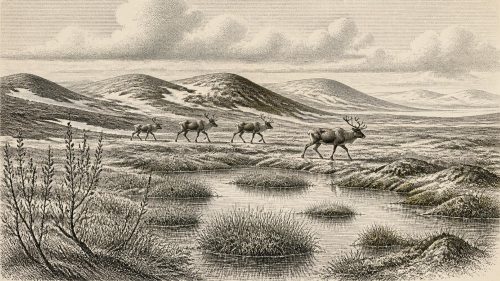
30,670 BCE is a label within a broad Late Pleistocene environmental horizon, not a datable Irish event. At Derryvree, County Fermanagh, freshwater sediments between glacial tills indicate locally ice-free, cold tundra conditions, with wetland plants and insects, before later glaciation. Castlepook Cave, County Cork, yielded diverse fauna, including mammoth, reindeer, giant deer and predators, demonstrating an open, cold environment, though mixed cave deposits cannot provide a snapshot. A marked reindeer femur may record stone-tool butchery around 31,000 BCE, but remains unconfirmed and cannot prove settlement. Secure evidence for humans in Ireland is later, while political and social history remain unknown.
Read Article
Archived: 21 September 2026
Abstract
30,916 BCE is an approximation within a broad, uncertain MIS 3 chronology, not a recoverable Irish year. Derryvree, County Fermanagh, preserves freshwater sediments between glacial tills, indicating cold, open tundra-like wetlands during fluctuating regional ice conditions. Castlepook Cave, County Cork, contains time-averaged remains of reindeer, mammoth, hyaena and mammals, demonstrating changing ecological opportunities rather than a uniform fauna. An incised reindeer femur may record human butchery around 31,000 BCE, but its old documented context prevents conclusions about settlement or society. No evidence supports claims about politics, belief or culture. The records instead reveal environmental change before the Last Glacial Maximum.
Read Article
Archived: 19 September 2026
Abstract
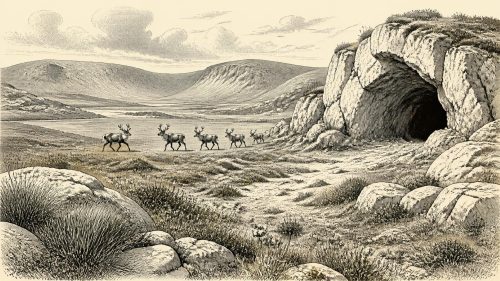
Labelled 31,134 BCE, this period in Ireland belongs to unstable MIS 3, before the Last Glacial Maximum, and can only be reconstructed through uncertain dated evidence. Castlepook Cave, County Cork, preserves a assemblage of mammoth, giant deer, reindeer, bear, hyena and other Ice Age fauna, indicating a fluctuating, open, cold environment. A marked reindeer femur may record stone-tool butchery about 33,000 years ago, potentially Ireland's earliest human trace. However, mixed cave deposits and absent associated artefacts or habitation prevent claims for settlement or continuous occupation. Glaciation and erosion obscured evidence; renewed dating, sediment and biomolecular research could resolve its significance.
Read Article


