
Castlepook’s Single Incision30670 BCE
30,670 BCE is a label within a broad Late Pleistocene environmental horizon, not a datable Irish event. At Derryvree, County Fermanagh, freshwater sediments between glacial tills indicate locally ice-free, cold tundra conditions, with wetland plants and insects, before later glaciation. Castlepook Cave, County Cork, yielded diverse fauna, including mammoth, reindeer, giant deer and predators, demonstrating an open, cold environment, though mixed cave deposits cannot provide a snapshot. A marked reindeer femur may record stone-tool butchery around 31,000 BCE, but remains unconfirmed and cannot prove settlement. Secure evidence for humans in Ireland is later, while political and social history remain unknown.
Dateline
The label 30,670 BCE cannot identify a witnessed Irish event. No calendar used in Ice-Age Ireland survives, and archaeology cannot distinguish a particular year, season or individual at this depth of time. It is better understood as a modern point within the Late Pleistocene, broadly Marine Isotope Stage 3, when climates around the North Atlantic changed abruptly and Ireland’s ice, vegetation and animal populations were in flux. The most responsible account is therefore one of calibrated ranges, buried sediments and cave bones rather than kings, battles or dates in an annal.
The nearest Irish evidence is not evenly distributed across the island. It is concentrated in rare deposits that escaped destruction by later glacier ice, notably freshwater sediments under drumlins in County Fermanagh and animal remains from limestone caves in Munster. Those archives do not show what happened everywhere at once. They do, however, reveal that parts of Ireland could support cold-adapted plants and large mammals during intervals before the Last Glacial Maximum.
A Date Range, Not a Date
At Derryvree, near Maguiresbridge in County Fermanagh, roadworks exposed silts and fine sands trapped between two layers of glacial till. The lower till records an earlier phase of ice cover; the organic-rich freshwater deposits accumulated after that ice had withdrawn locally; the upper till shows that ice later returned. This sequence is important because it preserves a landscape between glacial advances rather than merely the traces left by ice.
Organic material from Derryvree produced a conventional radiocarbon result of 30,500 years before present, with a large statistical uncertainty. “Present” in radiocarbon terminology is AD 1950, not today. At this age, radiocarbon years are especially unlike calendar years, because atmospheric carbon varied markedly during the Ice Age. Published calibrations place the deposit broadly at about 36,900–31,700 calibrated years before present, or approximately 34,950–29,750 BCE. The modern label 30,670 BCE falls within that wide environmental horizon, but cannot be attached to a specific layer, pond episode or human action.
Other Fermanagh sites strengthen the general picture while also showing its limits. Organic muds at Hollymount near Maguiresbridge and deposits at Greenagho near Belcoo indicate cold, non-glacial conditions at differing points in the Middle Midlandian sequence. Their dates and palaeobotanical records are not precise enough to create a seamless annual chronology. What they establish is regional variability: north-central Ireland was not simply and continuously buried beneath ice throughout the later Ice Age.
Wet Tundra Beneath Later Ice
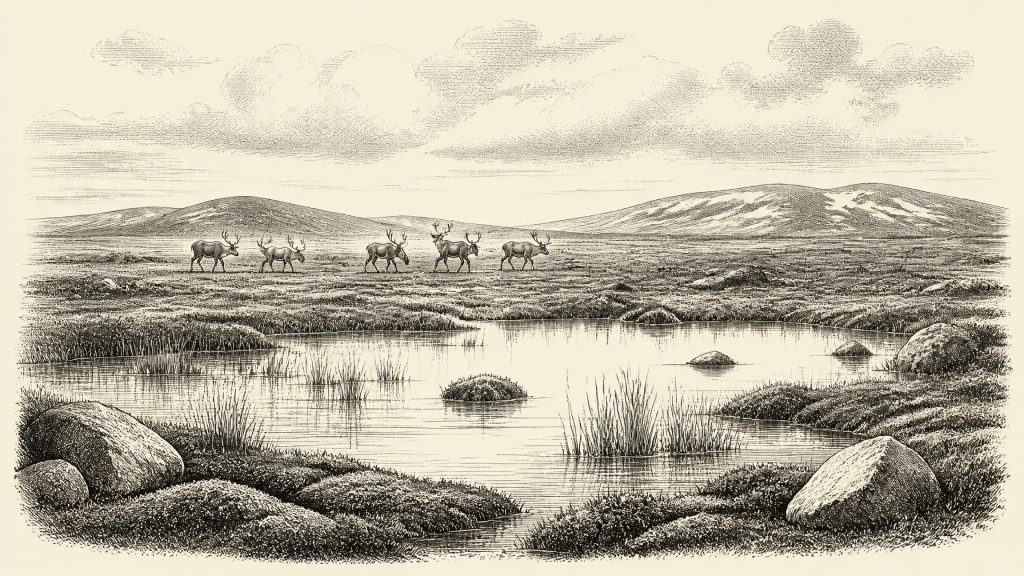
Derryvree’s plants and insects give the clearest view of everyday conditions in one Irish locality. Mosses, sedges, grasses, herbs and low shrubs point to open, treeless ground, with wet mossy vegetation around pools and freshwater channels. The insect assemblage is of cold northern aspect. Rather than a featureless expanse of snow, the evidence suggests a periglacial mosaic: shallow water and saturated ground in sheltered hollows, seasonally productive vegetation, exposed mineral surfaces and longer-distance views across low cover.
This was not the green, wooded island of later millennia. Winters were probably severe, growing seasons short and conditions strongly seasonal. Yet local wetland habitat could still sustain plants, invertebrates and grazing animals. The survival of aquatic and marsh plants is a reminder that cold does not mean biologically empty. A shallow pool can preserve a detailed ecological archive even where later glaciers have removed most older soils and land surfaces.
The wider setting was unstable. The British–Irish Ice Sheet had not yet reached the fullest expansion associated with the Last Glacial Maximum, generally dated later, around 27,000–23,000 calibrated years before present. Ice margins, rivers and sediment routes changed repeatedly before that maximum. It would be misleading to draw Ireland at 30,670 BCE as either wholly ice-covered or wholly open. The evidence permits a more cautious conclusion: local ice-free terrain existed in some periods and regions, while glaciers and permafrost-related processes remained decisive forces in the landscape.
Animals of the Cave Country
In County Cork, Castlepook Cave near Doneraile, also called Mammoth Cave, preserves a different kind of record. Excavations conducted in the early twentieth century recovered a large and complicated collection of animal bones from cave passages in the Awbeg Valley beneath the Ballyhoura Hills. The collection includes remains attributed to woolly mammoth, reindeer, giant deer, brown bear, wolf, Arctic fox, spotted hyaena, hare and lemmings. Together with other Irish cave finds, it demonstrates that an unexpectedly diverse cold-stage fauna reached Ireland between at least about 45,000 and 20,000 years ago.
The cave must not be treated as a neatly sealed snapshot. Carnivores could have carried prey or scavenged bones into it; animals could have died there; water, collapse and older excavation methods may have mixed deposits. Nor need every species represented in the collection have lived at Castlepook simultaneously. Nevertheless, the fauna is strong evidence for an open, cold environment capable of supporting herbivores and their predators. Reindeer and mammoth belong to the wider mammoth-steppe and tundra world of north-west Europe, although Ireland’s wet ground, Atlantic weather and broken terrain would have produced its own local variation.
The animal evidence also corrects an old misconception of Ireland as permanently isolated from Pleistocene fauna. Lower sea levels altered coastlines and narrowed sea crossings, but the exact routes by which individual species arrived remain debated. It is not necessary to assume a simple, dry land bridge from Britain. Animals may have moved during particular low-sea-level and ice-margin configurations, and some species were capable swimmers. What the dated bones securely establish is presence, not the precise route, season or size of any migration.
The Reindeer Bone Question
One Castlepook object has particular bearing on people. A reindeer femur from the old collection has been assigned approximately to 31,000 BCE in County Cork heritage material. It carries a deep linear mark which zooarchaeologist Ruth Carden has interpreted as damage made by a sharp stone tool during butchery. If that assessment is confirmed by full specialist publication and secure contextual analysis, it would be the closest evidence for human activity in Ireland around the broad period represented by 30,670 BCE.
Its possible importance should not obscure its limitations. The bone gives no basis for naming a people, culture, language or territory. It does not establish that a hunter killed the reindeer, that butchery happened inside the cave, or that anyone lived nearby. The cave collection was formed through antiquarian excavation rather than modern, fully recorded recovery. No securely associated lithic assemblage, hearth, dwelling floor, burial, art or repeated occupation sequence of comparable age has yet been published from Castlepook. A marked bone, even if unequivocally humanly modified, would demonstrate carcass processing by at least one person, not settled occupation of the island.
This caution matters because the securely dated evidence for people in Ireland remains far later. At Alice and Gwendoline Cave in County Clare, a brown-bear kneecap bearing stone-tool cut marks has been radiocarbon dated to about 12,810–12,590 and 12,810–12,685 calibrated years before present. That peer-reviewed find demonstrates a Late Upper Palaeolithic human presence after the main ice-sheet phase. It cannot simply be projected backwards to prove permanent human residence thirty thousand years earlier.
Society Beyond the Evidence
There are no political affairs to report for Ireland at this point: no rulers, states, tribal names, alliances, diplomatic exchanges or identifiable conflicts. There is likewise no direct Irish evidence for villages, farming, animal husbandry, formal trade networks, seafaring, monuments, graves, religious rites, artistic traditions or systems of learning. Such absences chiefly reflect the tiny and fragmentary record, not a claim that Upper Palaeolithic people elsewhere lacked social complexity.
If the Castlepook incision is anthropogenic, the most that can responsibly be said about economy is practical and immediate. Reindeer could provide meat, marrow, hide, sinew, antler and bone; a sharp stone edge could be used to separate tissues from a carcass. That is a plausible interpretation of the mark, not evidence for a developed Irish hunting economy. There is no basis for estimating population size, seasonal rounds, exchange partnerships or social organisation.
The dominant historical development around this date was environmental rather than political: life persisted in a changing, cold landscape before a later, more extensive glaciation transformed it again. Derryvree’s buried freshwater plants, Castlepook’s cave fauna and the unresolved reindeer incision are therefore valuable precisely because they are so limited. They preserve fragments of a lost Irish world—wet tundra, large herbivores, predators and perhaps a brief human encounter—while insisting that the past cannot be made more exact than its evidence allows.
Primary Sources
- A Middle Midlandian Fresh-Water Series at Derryvree, Maguiresbridge, County Fermanagh, Northern Ireland
- Early Midlandian–Middle Midlandian, Pleistocene, Northern Ireland
- The Irish Quaternary Fauna Project
- The Exploration of Castlepook Cave, Co. Cork
- Castlepook Caves, Area of Scientific Interest: County Cork
- Heritage Artefacts of County Cork
- Archaeology Research Excavation Grant 2022: Final Report
- Phylogeographic, Ancient DNA, Fossil and Morphometric Analyses Reveal Ancient and Modern Introductions of a Large Mammal: The Complex Case of Red Deer (Cervus elaphus) in Ireland
- First Evidence of a Late Upper Palaeolithic Human Presence in Ireland
- New Insights on the Fauna of Ireland’s Younger Dryas and Early Holocene from Alice & Gwendoline Cave
- Our Ancient Landscapes: Hunter-Gatherers in Ireland
- Figure 6—The Subdivision of the Quaternary Period in Ireland
- Late Pleistocene Chronostratigraphy and Ice Sheet Limits, Southern Ireland
- A 10Be-Dated Record of Glacial Retreat in Connemara, Ireland, Following the Last Glacial Maximum and Implications for Regional Climate
- Character of Advance and Retreat of the Southwest Sector of the British-Irish Ice Sheet During the Last Glaciation
- Stratigraphic and Palaeo-Geomorphological Evidence for the Glacial-Deglacial History of the Last British-Irish Ice Sheet in the North-Western Irish Sea
- Dimensions and Chronology of the Last Ice Sheet in Western Ireland
- Glacial Geomorphology in the Wicklow Mountains, Ireland
- The Late Quaternary History of East-Central Ireland
- Clogher Valley: Earth Science Conservation Review