

The Castlepook Incision31134 BCE
Labelled 31,134 BCE, this period in Ireland belongs to unstable MIS 3, before the Last Glacial Maximum, and can only be reconstructed through uncertain dated evidence. Castlepook Cave, County Cork, preserves a assemblage of mammoth, giant deer, reindeer, bear, hyena and other Ice Age fauna, indicating a fluctuating, open, cold environment. A marked reindeer femur may record stone-tool butchery about 33,000 years ago, potentially Ireland’s earliest human trace. However, mixed cave deposits and absent associated artefacts or habitation prevent claims for settlement or continuous occupation. Glaciation and erosion obscured evidence; renewed dating, sediment and biomolecular research could resolve its significance.
Dateline
A Year Without a Calendar
The label 31,134 BCE is a useful modern point on a long chronological scale, but it cannot identify an event that happened in a single Irish year. Nobody in Ireland then used a calendar that can be converted into BCE years, and the surviving evidence is neither precise nor evenly distributed. Treated simply as arithmetic, the label lies about 33,083 years before AD 1950, the conventional reference point for “before present”. Yet radiocarbon ages require calibration and carry ranges of uncertainty; deposits may also have formed over long periods. The responsible history of Ireland at this depth is therefore a history of dated ranges, fossils, sediments and probabilities, not named people or dated episodes.
In broad archaeological terms, this point falls within the Late Pleistocene, during Marine Isotope Stage 3 (MIS 3), an unstable middle phase of the last Ice Age. It preceded the fullest expansion of the last British–Irish Ice Sheet. The Last Glacial Maximum in Ireland came later, broadly between about 28,000 and 20,000 calibrated years before present, although the timing and extent of ice advance differed between regions. Around the notional year represented here, Ireland was not yet simply a featureless ice sheet. Parts of the island supported animals, while the climate, coastlines, vegetation and access routes altered repeatedly over millennia.
Castlepook’s Uneasy Evidence
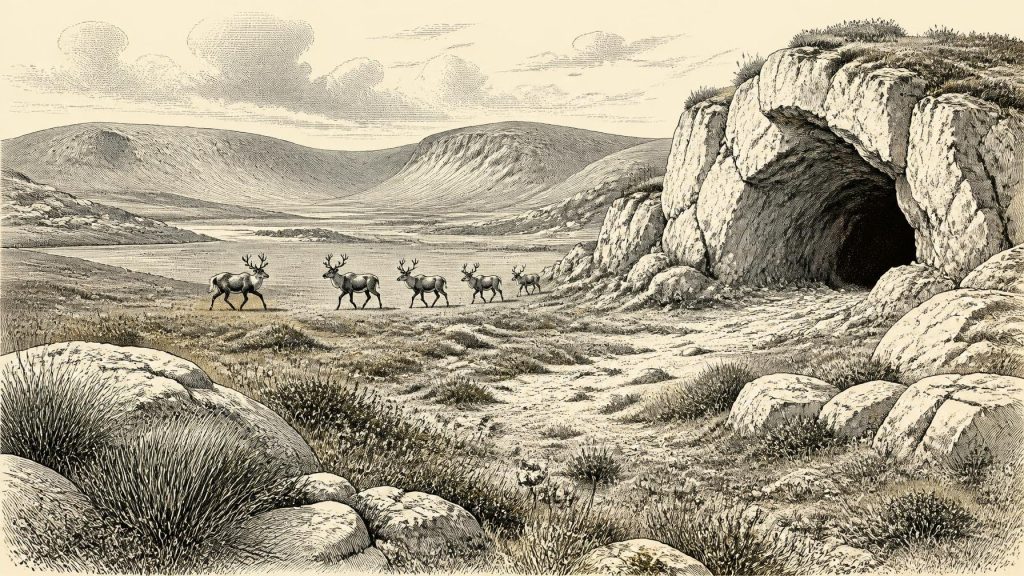
The crucial Irish locality is Castlepook Cave, also known as Mammoth Cave, near Doneraile in north County Cork. Set in Carboniferous limestone above the Awbeg valley, it has yielded Ireland’s richest known assemblage of vertebrate remains from the period leading towards the Last Glacial Maximum. Early twentieth-century excavators recovered bones and teeth from a complex cave system; the collection is now principally associated with the National Museum of Ireland. Re-examination, improved sample preparation and modern accelerator radiocarbon dating have shown that several old dates from Castlepook had been too young, in some cases by thousands of radiocarbon years. This moved important parts of the assemblage firmly back into MIS 3.
The cave’s record supports the presence in Ireland, at different times within that long interval, of woolly mammoth, giant deer, reindeer, brown bear and spotted hyena. Later cold-stage material includes Arctic fox, wolf and lemmings. This is compelling evidence for a varied Ice Age animal world, but it is not a census of one landscape on one day. Cave deposits accumulate through many processes: animals die naturally, carnivores drag in prey or carrion, water shifts bones, people disturb deposits, and early excavations rarely recorded the microscopic layers and positions expected today. A mammoth tooth, a hyena skull and a reindeer limb need not represent a single herd, season or generation.
One specimen makes the modern date especially arresting: a reindeer femur from Castlepook bearing a deep linear mark interpreted as damage from a sharp stone implement during carcass processing. Public discussion has associated the bone with an age of roughly 33,000 years ago and, by extension, with a date around the thirty-first millennium BCE. If the mark is securely identified as a cut or chop made on fresh bone, it may be Ireland’s earliest evidence of human handling of an animal carcass. It would be an exceptional discovery. But it remains a narrow and difficult piece of evidence, rather than proof of an established settlement.
The bone does not come with a securely associated hearth, stone-tool assemblage, dwelling floor, human burial, refuse pit or repeated occupation surface of comparable age. Its date concerns the death of the animal, not necessarily the moment when the mark was made, the place where the animal was killed, or the identity of whoever made it. Carnivore damage, sediment movement and the complicated history of old collections demand caution. The mark may record butchery; it cannot demonstrate a camp at Castlepook, still less a continuous Irish population.
An Open, Cold Country
Even with those qualifications, Castlepook changes the scale on which Ireland’s past can be imagined. Reindeer and mammoth imply environments very unlike modern wooded and Atlantic Ireland. The most defensible picture is of a generally open, cold landscape with grassland, herb-rich tundra or steppe-tundra elements, broken by wetter hollows, river corridors, exposed rock and patches of low vegetation. Such habitats could sustain grazing and browsing mammals and the predators or scavengers that followed them. They should not be visualised as an unchanging polar desert: MIS 3 climate was marked by abrupt fluctuations, and local conditions would have varied with altitude, shelter, soils and proximity to the sea.
Spotted hyena is particularly important. Castlepook is the only Irish site known to have produced a substantial record of this carnivore. Hyenas are likely to have helped create parts of the cave assemblage, carrying and chewing bones, and their presence signals a food web with sizeable herbivores. Their role also explains why a cave cannot automatically be treated as a human hunting station. The animals and bone deposits reveal ecological opportunity, but also danger and competition for sheltered places.
Sea level was substantially lower than today during the Ice Age, exposing more of the continental shelf. The geography of Ireland, Britain and the western European mainland was consequently different, but changing sea level alone cannot prove a convenient land bridge at this precise moment or a particular route taken by animals or people. Faunal movements may have depended on shifting coastlines, temporary connections, ice-free corridors and short sea crossings. The Irish record shows that mammals reached the island during MIS 3; the exact pathways remain a subject for geological and genetic research.
People, If They Came
If the Castlepook incision does preserve human butchery, the people responsible were mobile hunter-gatherers rather than members of a known Irish “culture” in the later archaeological sense. They would have required expert knowledge of animal movement, weather, stone-working and the value of meat, hide, sinew, bone and fat. Processing a carcass could have followed a hunt, scavenging, or the recovery of an animal found dead. The single marked bone cannot decide among these possibilities. Nor can it establish language, ancestry, social identity or whether the visitors arrived from Britain, continental Europe or elsewhere.
There is no evidence from around 31,134 BCE for political institutions, chiefs, territories, warfare, diplomacy, tribute or formal law in Ireland. Equally, there is no basis for describing trade networks, farms, villages, monuments, graves, shrines or a settled religious system. Absence from the record is not proof that people never spoke, cooperated, exchanged gifts or held beliefs; such practices leave little trace after tens of millennia. But responsible history must distinguish that universal human possibility from evidence specific to Ireland. At present, the evidence does not permit an Irish narrative of rulers or communities for this date.
Culture and learning are best understood here as practical knowledge, if humans were present at all: reading snow, tracks and animal behaviour; selecting suitable stone; keeping warm; and moving through a hazardous terrain. No artwork, ornament, musical instrument or securely dated tool from Ireland demonstrates such activity at this time. The best-established later Palaeolithic evidence for human activity on the island remains the cut-marked brown-bear patella from Alice and Gwendoline Cave, County Clare, dated to roughly 12,810–12,590 calibrated years before present. That much later find is more securely dated, but it cannot be projected backwards to fill the huge gap at Castlepook.
Loss, Survival and Future Work
The apparent thinness of the record has a physical explanation. Subsequent ice advance, erosion, meltwater, changing sea level and soil formation destroyed, buried or rearranged much of the evidence that might once have existed. Caves offer rare protected archives, yet they too are difficult: they mix natural and human histories, and many Irish cave collections were recovered before modern excavation methods. The lack of a visible campsite may reflect brief visitation, poor preservation, later glacial damage or simple failure to search the right places. It cannot be converted automatically into proof that nobody ever came.
Recent work at Castlepook has therefore concentrated on locating undisturbed deposits and applying methods unavailable to the original excavators: renewed excavation, direct radiocarbon dating, sediment study, microscopic assessment of bone surfaces, and potentially ancient DNA and other biomolecular analyses. These methods may confirm, refine or overturn individual claims. Their greatest value is not the promise of a dramatic “first” but the chance to separate a genuine human trace from the far larger, older story of animals, caves and ice.
For the notional year 31,134 BCE, Ireland emerges not as a nation with a recoverable political history, but as a changing northern landscape within the Ice Age world. Castlepook’s fauna demonstrates that large mammals and predators occupied, or repeatedly reached, part of the island during MIS 3. A marked reindeer bone raises the serious possibility of a brief human encounter with that world. It does not yet give us a settlement, a society or an event. Its importance lies precisely in that disciplined uncertainty: one incision, one cave and a landscape whose deeper human history is still being tested.
Primary Sources
- A Reconsideration of the Radiocarbon Dating of the Marine Isotope Stage 3 Fauna from Southern Ireland
- The Irish Quaternary Fauna Project
- Castlepook Cave, Cork County Geological Site Report CK032
- Spotted Hyena Skull
- 2022:564 – Castlepook Cave, Castlepook South, Cork
- Late Pleistocene Chronostratigraphy and Ice Sheet Limits, Southern Ireland
- Growth and Retreat of the Last British–Irish Ice Sheet, 31,000 to 15,000 Years Ago: the BRITICE-CHRONO Reconstruction
- BRITICE-CHRONO Maps and GIS Data of the Last British-Irish Ice Sheet 31 to 15 ka
- The IntCal20 Northern Hemisphere Radiocarbon Age Calibration Curve (0–55 cal kBP)
- IntCal Publications
- First Evidence of a Late Upper Palaeolithic Human Presence in Ireland
- First Evidence of a Late Upper Palaeolithic Human Presence in Ireland
- New Insights on the Fauna of Ireland’s Younger Dryas and Early Holocene from Alice & Gwendoline Cave
- New Insights on the Fauna of Ireland’s Younger Dryas and Early Holocene from Alice & Gwendoline Cave
- Heritage Artefacts of County Cork
- Archaeological Heritage of County Cork
- Areas of Scientific Interest in County Cork: Castlepook Caves
- Mammoth Cave
- Irish Quaternary Association
- Palaeolithic Ireland – New Evidence Emerges from the Emerald Isle
- New Data for the Last Glacial Maximum in Great Britain and Ireland
- Geology Collections