The Castlepook Bone Debate30916 BCE
30,916 BCE is an approximation within a broad, uncertain MIS 3 chronology, not a recoverable Irish year. Derryvree, County Fermanagh, preserves freshwater sediments between glacial tills, indicating cold, open tundra-like wetlands during fluctuating regional ice conditions. Castlepook Cave, County Cork, contains time-averaged remains of reindeer, mammoth, hyaena and mammals, demonstrating changing ecological opportunities rather than a uniform fauna. An incised reindeer femur may record human butchery around 31,000 BCE, but its old documented context prevents conclusions about settlement or society. No evidence supports claims about politics, belief or culture. The records instead reveal environmental change before the Last Glacial Maximum.
Dateline
The label 30,916 BCE cannot be treated as a date in the modern historical sense. Nobody in Ireland recorded a year, a season, a ruler or an event at this depth in time, and no archaeological sequence can distinguish one calendar year from the next. The number is a modern chronological convention, approximately 32,865 years before the radiocarbon reference year of AD 1950. The responsible frame is a broad one: Ireland in the later part of the Last Glacial Period, within Marine Isotope Stage 3 (MIS 3), before the fullest expansion of the last British–Irish Ice Sheet. Radiocarbon dates must be calibrated rather than read as calendar years, and their uncertainty at this antiquity is substantial.
The evidence nearest this point is not a settlement, grave, monument or tool-making floor. It is a scattered archive of cave bones, freshwater muds, fossil plants, insects, glacial deposits and landforms. Together these sources indicate a harsh, open and ecologically variable Ireland. They can illuminate animals, vegetation, water and changing ice margins; they cannot responsibly supply a named people, a political system, a religious practice or a particular annual occurrence.
A Date Within Wide Ranges
The most useful northern record comes from Derryvree, near Maguiresbridge in County Fermanagh. Road works in 1969 exposed a drumlin cut through by a sequence of two separate tills—unsorted material left by glacier ice—with freshwater silts and fine sands between them. The stratigraphy establishes an important order of events: ice deposited the lower till; an interval of open water and vegetation followed; then a later ice advance laid down the upper till and sealed the deposit.
Organic material from the intervening freshwater beds, known as Birm-166, returned a conventional radiocarbon age of about 30,500 radiocarbon years before present, with an uncertainty of more than a thousand years. Published calibration places the deposit broadly at about 36,900–31,700 calibrated years before present, approximately 34,950–29,750 BCE. Thus 30,916 BCE lies inside a very wide possible span, but cannot be pinpointed within it. Derryvree documents a cold-stage landscape over a long interval, not conditions in one recoverable year.
This distinction matters. Ireland was not simply either “covered by ice” or “ice-free”. Glaciers advanced and retreated in different sectors at different times, while local basins could preserve water, vegetation and animal life between phases of ice activity. The later Last Glacial Maximum was still to come. Recent reconstruction of the British–Irish Ice Sheet stresses both rapid growth and major regional variation between about 31,000 and 15,000 years ago; a single island-wide ice edge cannot be assigned to this date.
Wet Ground in Fermanagh
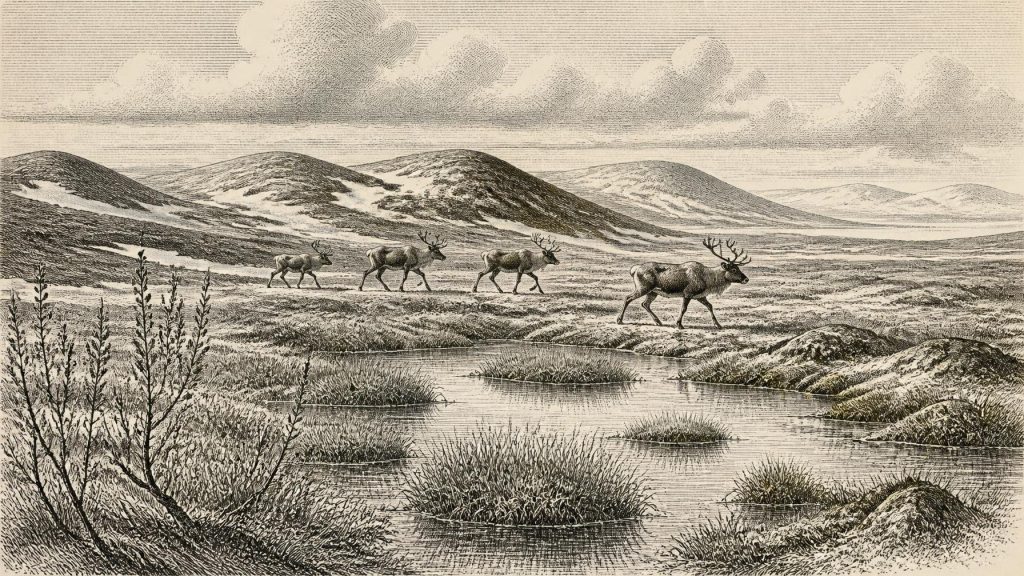
Derryvree offers Ireland’s clearest local environmental picture for the wider period. Its fossils include plants associated with treeless or very sparsely wooded cold environments: sedges, grasses, mosses, bogbean, dwarf willow, mountain avens and other herbs. Aquatic and wetland remains show that this was not an unbroken desert of snow and bare ground. There were pools, shallow water, marshy margins and sediment-rich freshwater habitats, supplied by meltwater or local drainage.
The wider setting was nevertheless severe. Low temperatures, short growing seasons, frost disturbance and exposed ground would have limited tree growth and made the landscape resemble tundra or mammoth-steppe mosaics elsewhere in north-west Europe. Such terms are interpretative shorthand, not photographs of a uniform countryside. A wet basin could stand beside stony, wind-scoured slopes, braided streams and patches of herb-rich grassland. The key evidence is local, and it should not be stretched into a detailed map of every Irish region.
Environmental change was probably a central fact of life for every animal that crossed this terrain. Watercourses shifted, shallow wetlands appeared and filled, vegetation responded quickly to temperature and moisture, and growing ice altered both drainage and access. These processes help explain why the Irish record is so fragmented: later ice frequently eroded, mixed or buried older deposits. The survival of Derryvree’s organic bed beneath a drumlin is exceptional rather than routine.
Castlepook’s Animal Archive
In the south, Castlepook Cave, also called Mammoth Cave, near Doneraile in County Cork, is the most important Irish archive of mammals from the last cold stage. Excavated principally in the early twentieth century, it produced remains attributed to reindeer, giant deer, red deer, brown bear, wolf, Arctic fox, hare, lemming, woolly mammoth and spotted hyaena. The National Museum of Ireland describes it as Ireland’s most important site for mammal remains of the last cold stage, while modern re-dating has confirmed that some Castlepook fauna belongs to MIS 3.
The assemblage does not mean that all these animals lived together in precisely 30,916 BCE, or that each occupied every part of Ireland simultaneously. Cave collections accumulated over long periods and through several processes. Carnivores dragged in prey and scavenged carcasses; animals could die in or near caves; water could move bones; early excavators did not record deposits to modern standards. Reindeer and hyaena are especially useful indicators of the cold, open and connected north-west European world in which Ireland participated, but individual bones require careful dating and taphonomic study.
Spotted hyaena is particularly revealing. It was not an Irish curiosity but a formidable social carnivore whose denning and scavenging activities could collect bones in a cave. Its presence, alongside large herbivores, indicates a food web with sufficient prey and usable terrain during at least some ice-age intervals. Mammoth and giant deer similarly demonstrate that Ireland could, at times, sustain very different large-animal communities from those of the present island. Yet a faunal list is evidence of changing ecological opportunity, not proof of a stable “Ice Age fauna” enduring unchanged for millennia.
The Reindeer Femur Question
One Castlepook specimen has transformed discussion of Ireland’s deepest human past: a fragment of reindeer femur reported to carry a deep incision interpreted by zooarchaeologist Ruth Carden as a cut made by a sharp stone tool on fresh bone. County Cork’s heritage publication presents it as evidence that Palaeolithic hunters processed a reindeer around 31,000 BCE. If that interpretation is upheld, it would be a remarkable indication that a person, or a very small group, handled animal tissue in Ireland during MIS 3.
Its importance must be matched by caution. The bone derives from an old cave collection, not from a freshly excavated occupation layer containing a hearth, stone tools, butchered bones and shelter evidence in secure association. A cut mark can indicate carcass processing; it cannot tell us whether people killed the animal, scavenged it, stripped hide or sinew, removed meat or marrow, or whether the bone was subsequently carried to the cave by carnivores. Nor can one marked specimen establish a permanent population, a camp, a migration route or a named archaeological culture.
There is also a wider methodological warning. Improved radiocarbon pretreatment has shown that several earlier Irish cave-bone dates were too young, in some cases by thousands of years. The Castlepook debate is therefore a useful example of science revising its own evidence: new measurements can strengthen the case for early fauna while also making old chronologies less secure. The careful conclusion for this date is not that Ireland certainly possessed settled Palaeolithic communities, but that the possibility of episodic human presence deserves serious investigation.
People, Power and Belief: What Cannot Be Known
There is no evidence from Ireland around this time for political authority, warfare, diplomacy, territorial lordship, formal institutions or identifiable ethnic groups. Such categories belong to much later archaeological and written worlds. If people entered Ireland, they would have done so in a landscape where survival depended on knowledge of animals, weather, fuel, water and safe movement, rather than on states or kingdoms. But this is a general inference from Upper Palaeolithic lifeways elsewhere in Europe, not direct evidence for an Irish society.
The same restraint applies to everyday life. No securely dated dwelling, hearth, clothing, ornament, stone-tool assemblage or burial is known from Ireland for 30,916 BCE. It is possible that mobile foragers elsewhere in north-west Europe pursued reindeer and other seasonal resources, using hides, bone, antler and stone; it is not legitimate to turn that possibility into an Irish household, hunting party or campsite. A single possible butchery mark is evidence of an action, if correctly identified, rather than a complete social world.
Nothing can be said directly about religion, ritual, language, learning, art or oral tradition in Ireland at this date. Cave bones and wetland sediments have not preserved symbols, images or structures that would support such claims. Nor is there evidence for trade in the later prehistoric sense. Animal and perhaps human movement shows that Ireland was not ecologically isolated at all times, especially when lower sea levels and changing ice affected surrounding seas and coasts. It does not demonstrate regular exchange networks.
An Island on the Edge of Change
Ireland around 30,916 BCE was therefore a place of environmental transition rather than a country with a recoverable annual history. In Fermanagh, freshwater sediments preserve a rare glimpse of cold wetlands and tundra-like vegetation between glacial advances. In Cork, Castlepook preserves a time-averaged animal archive of reindeer, hyaenas and other large mammals, plus a disputed but consequential sign of possible human butchery. These traces show a landscape capable of supporting life, but vulnerable to rapid climatic and glacial change.
The most important historical development is not a named event. It is the narrowing of ecological possibilities as the last ice sheet built towards its later maximum. Ireland’s land, waters and animal corridors were being repeatedly remade. Whether or not the Castlepook incision ultimately proves an early human visit, it directs attention to a profound truth: the island’s human story may have roots far deeper than its once sparse archaeological record appeared to allow, but the evidence must remain proportionate to what bones and sediments can actually bear.
Primary Sources
- A Middle Midlandian Freshwater Series at Derryvree, Maguiresbridge, County Fermanagh, Northern Ireland
- The Irish Quaternary Fauna Project
- A Reconsideration of the Radiocarbon Dating of the Marine Isotope Stage 3 Fauna from Southern Ireland
- Growth and Retreat of the Last British–Irish Ice Sheet, 31,000 to 15,000 Years Ago: the BRITICE-CHRONO Reconstruction
- The IntCal20 Northern Hemisphere Radiocarbon Age Calibration Curve (0–55 cal kBP)
- Spotted Hyena Skull
- Heritage Artefacts of County Cork
- Castlepook Cave: County Geological Site Report
- Figure 6.—The Subdivision of the Quaternary Period in Ireland
- Quaternary Site Descriptions
- Irish Pleistocene Biostratigraphy
- Freshwater Organic Deposits and Stratified Sediments Between Early and Late Midlandian (Devensian) Till Sheets, at Aghnadarragh, County Antrim, Northern Ireland
- Mammoth and Musk Ox ESR-Dated to the Early Midlandian at Aghnadarragh, County Antrim, Northern Ireland, and the Age of the Fermanagh Stadial
- Mammoth and Musk Ox ESR-Dated to the Early Midlandian at Aghnadarragh, County Antrim, Northern Ireland, and the Age of the Fermanagh Stadial
- New Insights on the Fauna of Ireland’s Younger Dryas and Early Holocene from Alice & Gwendoline Cave
- New Insights on the Fauna of Ireland’s Younger Dryas and Early Holocene from Alice & Gwendoline Cave
- Trimlines, Blockfields and the Vertical Extent of the Last Ice Sheet in Southern Ireland
- New Data for the Last Glacial Maximum in Great Britain and Ireland
- Exposure-Age Constraints on the Extent, Timing and Rate of Retreat of the Last Irish Sea Ice Stream
- IntCal Publications
- IntCal History
- Prehistoric Details: Stone Age
- The Mesolithic in Ireland: When Was It?