Membership is completely free, giving members unlimited access to all available resources, services, features, and benefits without any restrictions or fees.
Welcome back. Sign in to continue enjoying unlimited access to all available resources, services, features, and member benefits at no cost.
The most firmly dated political-religious development came on 8 March, when the Lords’ committee report on the ‘state of popery’ was presented. The inquiry had been set in motion during 1731 under Hugh Boulter, Church of Ireland archbishop of Armagh and primate of all Ireland. Its title and stated purpose make its standpoint plain. It was not a neutral religious census, but an instrument of a Protestant political order concerned by what it regarded as the numerical strength and institutional persistence of Catholicism.
The Dublin Society was founded at Trinity College on 25 June. It was not yet the chartered Royal Dublin Society of later memory, nor did it possess the extensive public funds, schools, collections and exhibition programmes with which it would subsequently be associated. Its first name was descriptive of its ambition: the Dublin Society for improving husbandry, manufactures and other useful arts. At a subsequent early meeting, “and sciences” was added. Such language mattered. The founders proposed that practical knowledge—about cultivation, materials, craftsmanship and production—could make Ireland wealthier and provide work.
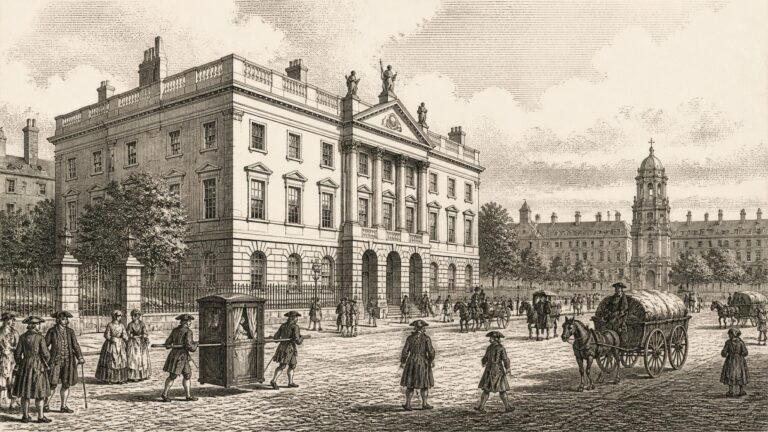
The most securely dated public event occurred on 3 February, when the foundation stone of the new Parliament House was laid at College Green, Dublin. The building was designed by Edward Lovett Pearce, an MP as well as an architect, who had won the commission in 1728. Its construction replaced the inadequate and decaying Chichester House, where the Irish parliament had previously met. The scheme was remarkable: it was intended from the outset to house both the Commons and Lords, making it an exceptionally early purpose-built bicameral legislature.
The parliament which enacted the measure sat in Dublin, but it was not a sovereign legislature in the modern sense. The British parliament’s Declaratory Act of 1720 had asserted its authority to make laws binding Ireland, while the older Poynings’ Law machinery restricted the initiation of Irish bills. The Irish House of Commons nonetheless mattered greatly in domestic administration: it voted supplies, passed local legislation and represented the interests of the Protestant landowning and office-holding elite. Catholic disfranchisement therefore narrowed the political nation within an already constrained kingdom. It also meant that disputes over rents, tithes, trade and local government would be debated in an assembly from which most of those affected by them were legally absent.
On 11 June, George I died at Osnabrück and his son succeeded as George II, king of Great Britain and Ireland. The change of monarch was immediately carried into Irish administration. A proclamation of 13 June ordered George II’s recognition in Ireland, required absent army officers to return to their regiments, and called an Irish parliament. Its intended meeting date was later altered; the new parliament ultimately assembled in Dublin on 28 November. The transition was orderly, but that calm should not be mistaken for broad political consent. Ireland’s government remained tied to London through the Crown, the lord lieutenant and English ministers, while the Irish executive operated from Dublin Castle.
Ireland in 1726 was a separate kingdom sharing George I with Great Britain, but its political autonomy was sharply limited. The Declaratory Act of 1719 had asserted Westminster’s authority to legislate for Ireland and made the British House of Lords the final court of appeal. Poynings’ Law also constrained the Irish parliament’s ability to initiate legislation. Dublin’s parliament nevertheless remained important: it voted supplies, passed Irish statutes and provided the arena in which great landowners, office-holders, bishops and lawyers bargained for influence.
The immediate issue was a patent granted in 1722 to the English manufacturer William Wood to mint copper halfpence and farthings for Ireland. Ireland genuinely needed small change: modest daily transactions in towns, markets, workshops and fairs depended upon coin of low value, while gold and silver were scarce in ordinary exchange. The difficulty was not therefore that copper currency was inherently unwelcome. It was the scale, control and trustworthiness of Wood’s proposed supply, and the fact that it had been authorised in London without consultation that satisfied Irish political opinion.