Membership is completely free, giving members unlimited access to all available resources, services, features, and benefits without any restrictions or fees.
Welcome back. Sign in to continue enjoying unlimited access to all available resources, services, features, and member benefits at no cost.
Henry III was Lord of Ireland, but royal authority depended on the cooperation of magnates, ecclesiastics, local officials and military households. The justiciar was Henry of London, archbishop of Dublin, whose government had to preserve royal castles and revenues while managing ambitious Anglo-Norman lords. The greatest private lordship was that of William Marshal, earl of Pembroke and lord of Leinster. In 1223 Marshal drew men and resources from Ireland for his successful campaign in south Wales. That movement of forces mattered in Ireland: it reduced the immediate availability of one of the lordship’s most powerful military patrons and helped create an opening for rivals.
The most firmly documented political development was the removal of Geoffrey de Marisco as justiciar, the king’s chief officer in Ireland. Geoffrey had held office since 1215. A substantial landholder in Munster, Leinster and Offaly, and connected by marriage and patronage to leading colonial families, he was exceptionally powerful. He was also under sustained pressure to account for royal income. The minority government of Henry III in England had received complaints about Irish revenues, while Geoffrey had previously been ordered to pay crown receipts into the Dublin exchequer and to answer for his conduct.
The most consequential development for the Anglo-Norman colony was William Marshal’s death at Caversham on 14 May 1219. Marshal was an English magnate and regent for Henry III, but he was also directly important to Ireland through his wife Isabel de Clare, daughter of Richard de Clare, or Strongbow, and Aífe, daughter of Diarmait Mac Murchada. Through Isabel, Marshal had acquired the great lordship of Leinster. In the previous two decades he had strengthened its administration, supported borough development and reshaped its defensive landscape around centres including Kilkenny, Carlow, New Ross and Wexford.
Henry III was still a child in 1218, and William Marshal, earl of Pembroke, governed England as regent. That mattered greatly in Ireland. Marshal was not merely an English statesman: through his wife Isabel de Clare, heir of Richard ‘Strongbow’ de Clare, he was lord of vast Leinster estates. His interests joined the administration of the English crown to the concerns of a great landholder whose castles, manors, towns and tenants lay on both sides of the Irish Sea.
The Annals of Loch Cé record an unusually prolonged frost and snow, lasting from the Kalends of January—1 January—to the feast of St Patrick, 17 March. The notice does not quantify hunger, mortality or lost livestock, so it would be unsafe to turn it into a general famine. Nevertheless, more than ten weeks of severe winter weather mattered in a predominantly rural society. Travel over roads and tracks, movement of cattle, access to mills and markets, and the routine journeys of clerics, tenants and messengers would all have been more difficult. Its preservation in the annals is a reminder that weather was a political as well as a domestic fact: hosts could not easily move, and communities dependent upon stored food faced a demanding season.
Connacht had been divided by a prolonged struggle within the Ua Conchobair dynasty. Cathal Crobhdearg, whose byname means “Red Hand”, had competed for power with Cathal Carrach, son of the former king Conchobar Maenmaige. The conflict was rooted in rival claims within a ruling family rather than in a fixed rule of primogeniture: kingship in Gaelic Ireland was contested among eligible members of a wider kindred, and military backing, hostages, clientage and alliance mattered greatly.
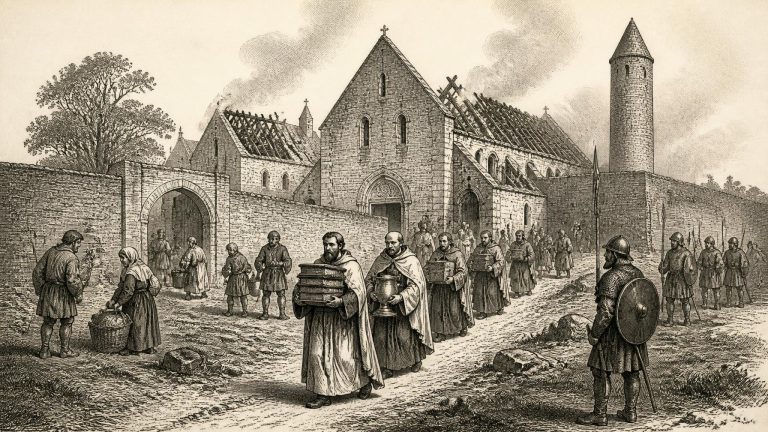
The most immediately striking event was the burning of the house of the Canons Regular of Saints Peter and Paul at Armagh, together with its churches and a substantial part of the surrounding enclosed precinct, or rath. The Annals of Ulster date this firmly to 1196, but do not name those responsible or explain how the fire began. It would therefore be unsafe to attach it to a particular raid or faction. Nonetheless, the destruction was grave. Armagh was both a major religious settlement associated with St Patrick and an important political place in the north. Its churches, clerical community, books, movable treasures, food stores and dependent households would all have been exposed to loss or disruption.
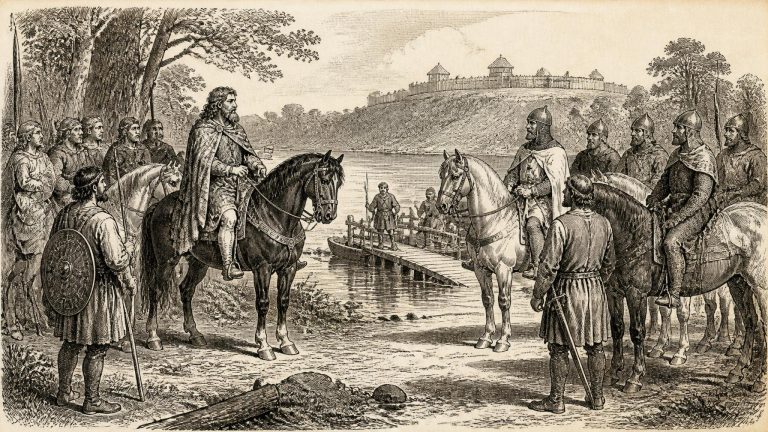
The pivotal development was Cathal Crobderg Ua Conchobair’s intervention beyond Connacht. Cathal was king of Connacht, though his position was neither uncontested nor secure from internal rivals. The Annals of Loch Cé record a great muster at Athlone, a strategic Shannon crossing where Connacht met the lordship’s midland frontier. Cathal reportedly assembled 1,200 men or more. There John de Courcy, Walter de Lacy—the son of Hugh de Lacy—and leading Anglo-Norman nobles came to meet him, and peace was made.
On 15 May, John issued a substantial charter to the citizens of Dublin. It was addressed in deliberately broad terms to his French, English, Irish and Welsh men and friends, present and future; the privileges themselves, however, belonged to the city’s recognised citizens. The document confirmed the bounds formerly perambulated under Henry II and set out the legal and commercial liberties available within them. It was an important act of written government for the principal town of the English colony in Ireland.
Mac Lochlainn entered the year near the summit of his power. In 1161 he had forced submissions from important rulers, including Diarmait Mac Murchada of Leinster and Ruaidrí Ua Conchobair of Connacht. The Four Masters consequently described him as king of Ireland “without opposition”. Such language expressed acknowledged supremacy rather than government through a central administration. Provincial kings still commanded armies, collected tribute and made war, while Mac Lochlainn’s authority depended upon personal alliances and the willingness of subordinate rulers to provide hostages and troops.
The crisis in Munster began within the ruling Uí Briain dynasty. The Annals of the Four Masters record that Tadc son of Diarmait Ua Briain turned against his kinsman Tairdelbach Ua Briain, deposed him and entered the protection, or ‘house’, of Tairdelbach Ua Conchobair. Mac Carthaigh’s Book preserves a more complicated southern account, involving a further revolt by Muirchertach, Tairdelbach Ua Briain’s own son, and his capture through treachery. Although the precise sequence is difficult to reconstruct, the sources agree that internal divisions left Ua Briain authority dangerously weakened.
The dominant political figure was Toirdhealbhach Ua Conchobhair, king of Connacht and the leading claimant to the high-kingship. Ireland had no central government capable of issuing commands everywhere. An ambitious overking instead sought submissions, hostages, military service and tribute from lesser rulers. Ua Conchobhair’s authority was substantial, but opposition remained strong in Meath, Bréifne and elsewhere. The campaigns of 1140 marked his return to aggressive eastward expansion after several difficult years.
The most unusual firmly dated undertaking was Tairdelbach Ua Conchobair’s alteration of the River Suck. The Annals of Tigernach say that the river was dug so that its waters entered marshes, created large lakes and flowed onwards towards the Shannon system and Lough Ree. A muster of Connachtmen carried out the work. This was not simply drainage or water supply. It formed part of Tairdelbach’s wider programme of controlling strategic routes, river crossings and frontier strongholds, especially around Dunamon in eastern Connacht.
Ireland remained a patchwork of provincial kingdoms and smaller lordships linked by tribute, hostages, fosterage, marriage and frequently changing alliances. Toirdelbach Ua Conchobair, king of Connacht and claimant to the high-kingship, was still the island’s most formidable ruler, but his authority was neither uniform nor uncontested. In 1138 he joined Tigernán Ua Ruairc of Bréifne and Donnchad Ua Cerbaill of Airgialla in an advance against Murchad Ua Máelshechlainn, king of Meath. Ua Ruairc’s participation marked a significant realignment, for he had previously opposed Ua Conchobair and had close family connections with the Meath dynasty.
Diarmait had risen from the Uí Cheinnselaig of south-east Leinster to dominate Leinster, Dublin and much of southern Ireland. Control of Dublin gave him access to ships, warriors, craftsmen, commerce and connections across the Irish Sea. His position was nevertheless less secure than its grand titles suggest. Irish overkingship depended upon personal authority, alliances, tribute and the delivery of hostages; it was not a permanent office supported by a central administration. A king who lost relatives, military strength or the obedience of subordinate rulers could see his influence contract rapidly.
More than a quarter-century had passed since Brian Bóruma’s death at Clontarf, and eighteen years since the death of Máel Sechnaill mac Domnaill, the last ruler whose authority had extended widely from the traditional kingship of Tara. Brian’s son Donnchad mac Briain remained king of Munster and the principal representative of Dál gCais power. He possessed considerable military and political weight, but Ireland in 1040 was not a centralised kingdom. Provincial and regional rulers governed through personal followings, tribute, hostages, ecclesiastical connections and negotiated submission. Their authority could expand rapidly after victory and contract just as quickly after defeat.