
Democratic Algorithms
At a Glance
Digital Publics
Irish debates about AI and democracy begin from a policy language that treats digital systems as tools for public benefit rather than inevitable threats. The national strategy says Ireland should aim to be an international leader in using AI through a people-centred and ethical approach. That framing matters for democracy because it places legitimacy, not only efficiency, at the centre of development. It is an aspiration, however, rather than proof that such principles are already secure in practice.
The same broad public sphere is also reflected in the scale of national and university-based digital humanities infrastructure. UCC describes CELT as a long-running humanities computing project with a searchable online textbase of more than 18 million words, and notes that it exists for scholars, students, and the general public. That does not by itself settle democratic questions, but it shows how Irish knowledge institutions have become part of the digital public realm in which AI now operates.
AI Governance
By 2026, Irish governance had shifted from strategy to institutional design. The Department of Enterprise announced a Regulation of Artificial Intelligence Bill to give domestic effect to the EU AI Act and create an AI Office of Ireland as a central coordinating authority. The text stresses that the framework is meant to be strong, independent, and enforcement-oriented. For democracy, this is significant because it places oversight inside the state rather than leaving it to voluntary compliance alone.
The same bill also ties Irish regulation to a wider European model in which AI rules apply across public and private sectors on a risk-based basis. That matters for democratic practice because risk-based regulation implies that some uses of AI are more likely than others to affect rights, accountability, and public confidence. The evidence does not show how Irish parties, agencies, or media will adapt, but it does show that the state now accepts the need for structured enforcement.
Election Integrity
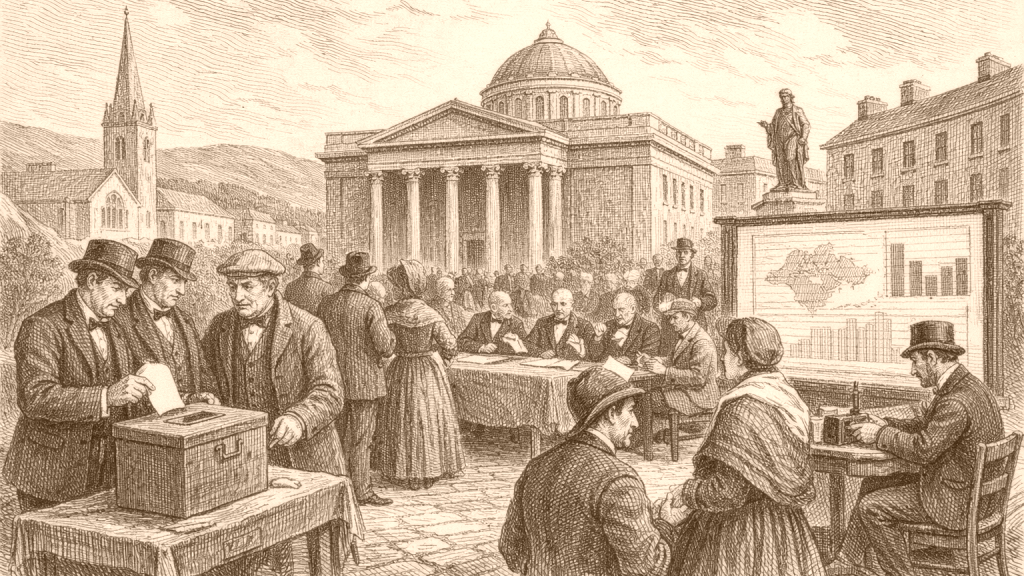
Electoral integrity is one of the clearest areas where AI is already being framed as a democratic risk. The Electoral Commission’s research call identifies online electoral interference, misinformation, and disinformation among the areas it seeks to study. It also funds work on generative AI as a political information source in Irish elections. These are not claims that AI has already overturned Irish elections; rather, they show official recognition that persuasion and falsehood now move through computational channels.
The European Commission’s transparency rules strengthen that reading by requiring some AI systems to tell users when they are interacting with AI and when content has been generated or altered. Chatbots must identify themselves, and deepfakes must be labelled. Those measures are not specifically Irish, but they help explain the regulatory context within which Irish democracy now sits. The interpretive gap is whether disclosure alone can restore trust once political communication becomes synthetic.
Judicial Mediation
Democratic legitimacy does not depend only on elections; it also depends on whether institutions adjudicate disputes fairly. The AI Act Service Desk treats administration of justice and democratic processes as areas where certain AI uses can pose significant risks to fundamental rights. It gives examples of systems that draft judicial decisions or select relevant precedents, while warning that systems closer to decision-making are especially sensitive. This is relevant to Ireland because public confidence in justice supports confidence in democracy.
At the same time, the guidance distinguishes between analytical systems and more limited administrative tools such as transcription or public-facing chatbots. The latter may assist visitors without influencing legal judgment. That distinction matters for Irish democracy because it shows a line between technological assistance and delegated authority. The evidence does not indicate that Irish courts are using such systems in any particular way, so any claim about adoption must remain cautious.
Civic Knowledge
Irish digital cultural projects help explain why AI and democracy are not only regulatory subjects but also knowledge questions. CELT presents itself as a free digital humanities resource for Irish history, literature, and politics, while Irish Sagas at UCC links reliable texts to wider electronic resources and welcomes volunteer contributions. These projects are not democratic institutions in the narrow constitutional sense, but they shape what citizens and researchers can access, compare, and debate. That access conditions democratic literacy.
CELT’s FAQ also notes that its bibliographies are not complete and that errors may remain from original texts or from the limits of conversion and markup. This is useful for understanding AI and democracy because it shows that digital knowledge systems always involve mediation, selection, and residual uncertainty. The point is not that the archive is unreliable, but that democratic users need to understand how machine-readable cultural memory is assembled before treating it as neutral.
Research Agenda
The strongest conclusion is that Irish democracy is being redefined through overlapping layers of strategy, regulation, and research rather than through a single dramatic transformation. Official policy promotes AI as ethical and people-centred; regulators stress transparency and enforcement; and the Electoral Commission is already funding work on misinformation and generative AI. Together, these sources suggest that the democratic question is no longer whether AI belongs in public life, but under what controls and with what safeguards.
What remains uncertain is how these frameworks will interact in everyday political communication, campaign practice, and public administration. The available material supports a cautious interpretation: Ireland is preparing governance structures for AI’s democratic effects, but the evidence does not yet show their full consequences. A useful research programme would therefore track enforcement, media use, civic trust, and institutional practice together, since democracy will be shaped as much by implementation as by law.








How is artificial intelligence being framed in contemporary Irish policy, regulation, and research as a force shaping democratic participation, electoral integrity, and public trust?