
Eowyn Recovery
At a Glance
Power Strain
Storm Éowyn left a wide electricity burden behind it. Met Éireann described hurricane-force winds and gusts up to 184 km/h, while ESB Networks said the storm produced extensive damage to the electricity network and widespread customer outages. RTÉ’s reporting from early February described hundreds of thousands of homes and businesses plunged into darkness. Taken together, these accounts show that recovery began with a basic struggle to restore power and keep daily life functioning.
Local accounts show how uneven that restoration was. In Conamara and north Galway, households were still without electricity a week after the storm, and phone services were described as down or only patchy. One man said the lack of power was exhausting and frightening, while another account described a makeshift food kitchen in Dunmore for people without gas cookers. The recovery phase therefore included not only repair work but continued dependence on temporary arrangements.
Home Damage
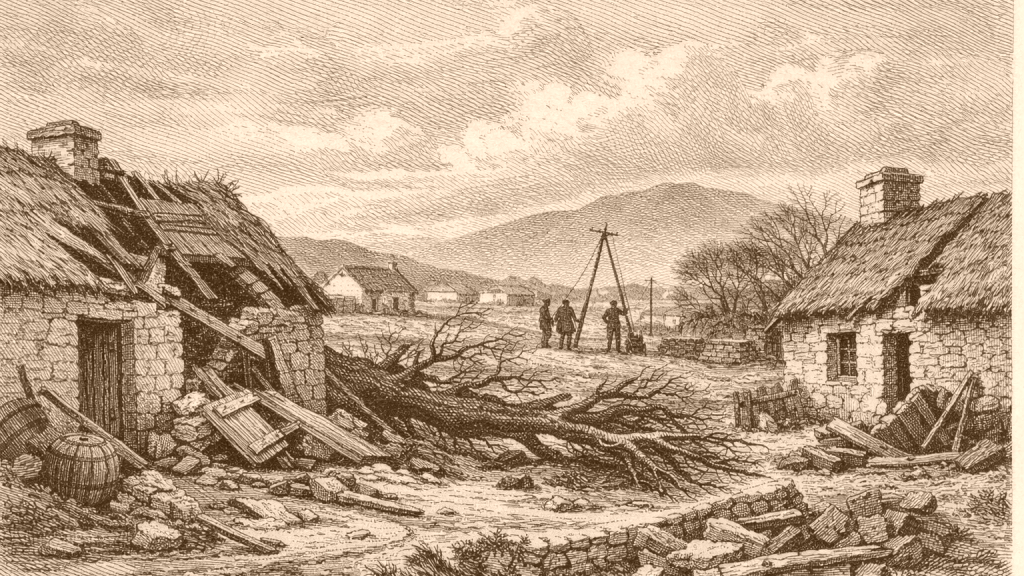
Housing damage appears in the reporting as both sudden and severe. In Carna, Maureen Folan returned from staying in her son’s house to find the roof of her 120-year-old home ripped off, leaving the property uninhabitable. The account states that the roof had been completely detached and that heavy rain then flooded the interior. This was not described as a minor repair but as a ruined domestic space requiring major rebuilding work.
A parallel account from the same region shows the wider pattern of domestic loss. One report says the house in question had a new roof installed fifteen years earlier, yet even that did not withstand the storm. The piece also notes that the roof was found across the road and that locals arrived quickly to rescue furniture and other belongings. These details point to recovery as a practical salvage effort before any formal rebuilding could begin.
Food Relief
With homes without electricity, some people turned to improvised food support. In Dunmore, hundreds of people went to a makeshift food kitchen, where a charcoal barbecue was used to provide hot meals for those who could not use gas cookers. The account also records the emotional shift from initial concern after the storm to mounting exhaustion and despair as the days passed. Recovery here meant securing daily food and warmth, not simply waiting for services to return.
Other testimony shows that the disruption had direct financial consequences. One Mayo resident described money spent on food, petrol for a generator, and washing clothes, alongside several days without a decent meal. Another said spoiled food, takeaways, generators, fuel, bottled water, hotels, loss of earnings, and storm damage all had to be covered before any insurance or assistance process could begin. The recovery burden was therefore immediate, repeated, and expensive.
Signal Loss
The storm’s recovery was complicated by failures in communications. One Galway account says some areas still lacked electricity, while many phone services remained down or only partly usable. The same report gives an example of a family that could not contact a doctor despite being an hour and a half from hospital. This suggests that recovery involved more than repairing wires: it also depended on restoring the means to summon help and coordinate ordinary care.
National reporting linked these failures to broader infrastructure fragility. RTÉ described the storm as exposing vulnerabilities in electricity, water, and telecommunications, and said that when one system failed the others went down as well. The same piece emphasised that recovery had to include people and communities, not only the speed of electrical restoration. That framing is not a general theory here; it is a direct description of the interdependence observed after Éowyn.
Forest Damage
Forestry recovery formed a separate and longer phase. Coillte said over 26,000 hectares of forest were damaged and estimated about 50 million trees were blown over or harmed. It added that around 20 percent of the material had been recovered so far and that the work would continue into 2027. The report also says the clean-up had originally been expected to finish in 2026, but that expectation no longer held.
The same reporting shows that recovery was uneven between state and private land. Coillte said just over half the trees impacted were on its land, while 11,000 hectares belonged to private forest owners. One Cavan owner said his eight hectares were bare, that 1,200 tonnes of timber were lying up, and that the value had fallen sharply. He also said the timber had a limited shelf life and might have to be sold at a lower grade.
Repair Plans
Institutional recovery is visible in the later responses of utilities and agencies. ESB Networks said the storm caused unprecedented damage and acknowledged hardship to customers, businesses, farmers, schools, and emergency services. It also thanked staff, contractors, visiting crews, and partner organisations for restoring power safely. In another update, the company said a Governmental decision led to an Enhanced Winter 2025 Grid Resilience Plan, showing that recovery moved into planning for future storms.
The official response also included scrutiny and revision of standards. ESB Networks said a review of storm preparedness had been completed and that it would examine distribution design standards for extreme wind events using climate data and future climate models. RTÉ meanwhile reported insurance claims mounting into the tens of thousands and warned that full recovery would take time. These references do not describe a finished restoration; they show recovery as an ongoing process of repair, review, and loss accounting.
