
Fusco Footprints
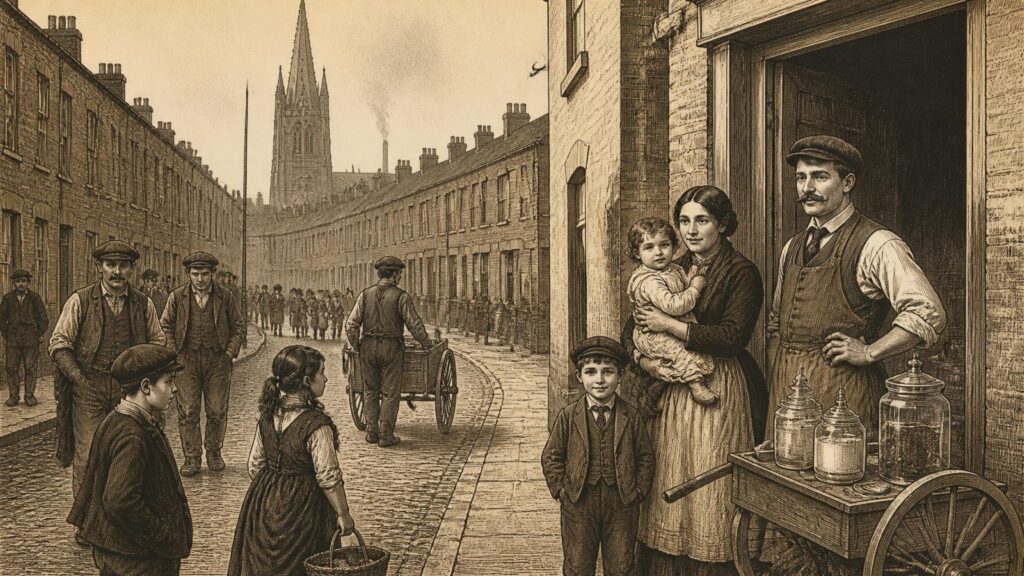
AI generated historical illustration, not a contemporary photograph.
At a Glance
The Fuscos of Irish history were not an ancient Gaelic kindred, nor a single family whose descent can safely be presumed from a shared name. They were part of a small but conspicuous Italian presence in Ireland, most strongly rooted in Belfast, where migration, kinship, retail enterprise and neighbourhood life gave the surname a durable local meaning. The surviving evidence makes the Fuscos especially useful for understanding an often-neglected fact: Ireland, long defined by outward migration, also contained communities formed by newcomers who made homes, businesses and descendants on the island.
Italian Origins
Fusco is an Italian surname, generally understood to derive from the Italian word fusco, itself related to the Latin fuscus, meaning dark or dusky. That etymology may describe an original nickname or a personal name, but it says little by itself about any one bearer in Ireland. A surname is not a pedigree. Different Fusco households may have been related closely, distantly, or not at all, and historical writing should resist turning every bearer of a familiar name into a member of one imagined clan.
The Irish connection belongs principally to the wider history of Italian migration during the nineteenth and early twentieth centuries. This was not simply a movement from Italy to a single destination. People left particular villages and districts, travelled through commercial and family networks, and often moved repeatedly between Italy, Britain, Ireland and elsewhere. Such mobility could be seasonal, experimental or permanent. The archival record therefore captures only part of the story: a birthplace in a census, a child’s registration, a business address, an electoral entry, a church record, or a remembered shop.
For the Fusco name, the strongest documented geographical connection is with the Val di Comino in Lazio, especially the commune of Casalattico and its surrounding villages. This was one of several Italian localities that supplied migrants to Britain and Ireland. It did not mean that every Irish Fusco necessarily came from Casalattico, but it provides an important context for many of the people encountered in Belfast records. The movement was shaped by chain migration: established migrants transmitted practical knowledge, temporary accommodation, employment contacts, credit and introductions to relatives or neighbours. That mechanism helps explain why a comparatively obscure Italian rural district could become connected to particular streets in an industrial city far away.
It is tempting to tell this as a simple story of poverty driving people northwards. Economic pressure in rural Italy mattered, but the evidence supports a fuller account. Migration demanded information, money, trust and routes. It was made possible by networks as much as by deprivation. A person leaving the Val di Comino for Belfast was not crossing an empty social map; he or she was often entering a chain already forged by predecessors. The family name became one element in that chain, useful for identifying connections but never sufficient proof of them.
Belfast Arrival
Belfast offered conditions attractive to small migrant communities. In the later nineteenth century it was a rapidly expanding port and industrial city, associated above all with linen, shipbuilding and engineering. It was also a city of dense working-class districts and a large market for low-cost food, refreshment, entertainment and small-scale services. This setting differed substantially from Dublin, even though both cities had Italian residents. Belfast’s scale, commercial intensity and proximity to British transport networks made it a plausible destination for migrants who had already learnt to navigate routes through Scotland or England.
Scholarship based on census material provides a striking measure of the Fusco presence. In 1911, fewer than four hundred people of Italian stock were recorded across Ireland. Within that modest total, the census suggests that all twenty-eight people named Fusco in Ireland lived in Belfast. The figure should be read carefully. It is a snapshot, not a count of every person of Fusco descent, and it cannot include people missed by the census, those who had departed, or all children whose names and identities were recorded in complicated ways. Even so, the concentration is remarkable. It demonstrates that the Fuscos were not scattered randomly across the island but were closely associated with one urban setting.
The same research identifies ninety-three of 104 people with surnames associated with Casalattico living in County Antrim or in neighbouring Down and Armagh in 1911. This does not turn surname analysis into certainty; names can travel, change spelling and occur in more than one district. It does, however, reinforce the conclusion drawn from the Fusco count. Belfast and its surrounding region were a major centre of settlement for migrants from this Italian network.
Contemporary descriptions and later historical accounts refer to a Belfast “Little Italy”, centred around Little Patrick Street and nearby streets. The phrase must not mislead. It was not an enclosed ethnic quarter with rigid boundaries, and it was far smaller than the Italian districts of London or Glasgow. Italian households lived among local residents rather than apart from them. Yet neighbourhood concentration mattered. It allowed businesses, lodgings, marriages, religious practice, dialects and news from home to circulate at close range. It also meant that an Italian surname could become a familiar feature of streets otherwise shaped by Belfast’s sectarian, industrial and class divisions.
Family Networks
The record of named individuals gives the broad pattern human texture. The Italians in Ireland prosopographical database, which brings together census, civil-registration and other archival research, lists a substantial series of Fusco people connected with Belfast, Lisburn, Coleraine, Dublin, Scotland, England and Italian places of origin. It includes people such as Gaetano Fortunato Fusco, Gerardo Fusco, Giuseppe Fusco, Pietro Fusco and Vittorio Alberto Fusco, as well as children born in Belfast and Lisburn. The database’s value lies not in providing a final genealogy but in showing how family histories crossed jurisdictions and generations.
Its entries illustrate a fundamental difficulty in migration history. A household can be identified in a census at one moment, while births, deaths and marriages may occur in another town or country. A child born in Belfast may later appear in Scotland; a parent born in Italy may be recorded under an anglicised forename; a widow may appear under a married surname, a maiden surname or both. For this reason, the history of the Fuscos should be approached as a set of overlapping households and relationships, rather than as a tidy uninterrupted line.
Several locations recur in the material. Belfast was plainly central, but Lisburn appears as well, indicating that Italian settlement and family formation extended beyond the city’s immediate Little Italy district. The presence of Fusco entries connected with Coleraine, Dublin, Blackburn and Scotland similarly points to a wider Irish Sea world. These were not isolated Italian arrivals who happened to settle in Ireland. They belonged to mobile networks in which the same people, relatives or acquaintances could move between ports, industrial centres and market towns.
There is an important distinction here between documentation and interpretation. Documentation can establish that certain named people were recorded in certain places at particular times. Interpretation can reasonably suggest that chain migration and family ties helped sustain movement. What it cannot do without specific evidence is assign every relationship, motive or business arrangement. A shared birthplace, surname or occupation can be a clue, but it is not conclusive proof. That restraint is especially necessary where later family reminiscence has filled gaps left by fragmentary records.
Urban Livelihoods
Italian migration to Ireland is often remembered through ice cream, cafés and fish-and-chip shops. The association is grounded in evidence, though it can become reductive if repeated as though every Italian migrant followed the same path. Cormac Ó Gráda’s research notes a Val di Comino group that included Fortes, Fuscos and other recognisable Casalattican surnames, described as street sellers of ice cream or café proprietors. Elsewhere, Italian migrants included craftsmen, sculptors, musicians, organ grinders, plasterers and traders. The community’s occupational variety was greater than later culinary memory alone suggests.
Still, food retail was historically significant. It needed modest premises compared with large manufacturing, relied on family labour, and served customers across communal lines. A café or shop could be both workplace and domestic centre: children might grow up above or behind the business; relatives could assist during busy periods; newcomers might find an initial foothold through a cousin or neighbour. Such enterprises also made Italian families publicly visible. Customers who did not know much about Italy might know a local Italian shopkeeper by name.
This visibility carried opportunities and hazards. A business embedded a family in the economic life of its district, but it could also mark them as foreign during moments of suspicion. The public identity of Italian businesses has encouraged a simplified image of migrant success. In reality, small retail could mean long hours, precarious margins and the continual management of rent, credit, supplies and competition. It is more accurate to view the shops as sites where work, family strategy and belonging were negotiated day by day.
The Fusco surname thus has a place in the commercial history of Belfast and, later, in the wider culture of Northern Irish food retail. That does not mean the name should be treated as a brand detached from people. Behind the remembered business names were individual migrants, spouses, children and workers whose experiences varied by generation, gender, age and legal status. The historical importance lies not merely in the survival of particular enterprises but in what they reveal about settlement: Italian families became part of ordinary urban routines while maintaining links of kinship and memory that stretched beyond Ireland.
Community Boundaries
“Little Italy” is useful as a historical shorthand, but it should be handled with care. It describes neighbourhood association, not complete separateness. Belfast’s Italian residents lived alongside local people, attended Catholic institutions, traded with a broad public and brought up children in an Irish and British urban environment. At the same time, marriages within Italian families or connected households, shared religious observance, Italian-language services and return visits to Italy could maintain a distinctive communal life.
St Patrick’s Church, near the old Italian district, was one important setting. Local historical research records that Italian-language services were held there on a small scale for parishioners. This detail matters because it corrects an assumption that integration necessarily required abandoning language or custom. Religious institutions could provide a space in which newcomers joined the established Catholic life of Belfast while also receiving recognition in their own language. The Italian community was neither wholly separate nor instantly absorbed; it developed forms of belonging that were layered and practical.
Language itself was likely complex. The migrants who came from rural Lazio did not necessarily speak standard Italian as their principal everyday tongue. Italy’s national language had uneven reach, and regional dialects were powerful. In Belfast, people might have moved among a home dialect, Italian, English and local speech. The historical sources seldom preserve ordinary conversation, so it would be wrong to reconstruct precisely what a Fusco household spoke at its kitchen table. But the presence of Italian religious services and the sustained links to particular Italian places make linguistic continuity plausible.
The notion of community must also accommodate difference. A shared Italian origin did not abolish distinctions of class, locality, politics, kinship or personal rivalry. Nor did it erase the wider divisions of Belfast. The Italian population was small, and its members navigated a city in which religion and political identity could be charged with consequences. Their Catholic affiliation might create points of contact with nationalist communities, but Italian origin was not reducible to any one local political category. The surviving record asks historians to avoid easy equations between ethnicity, religion and allegiance.
War Years
The world wars exposed the insecurity that could accompany foreign birth or foreign ancestry. During periods of conflict with Italy, Italian residents in Britain and Northern Ireland could be treated as enemy aliens, regardless of how long they had lived locally, whether they had Irish- or British-born children, or how fully their livelihood depended on the community around them. Local historical accounts record intermittent xenophobia and the internment of some Belfast Italians on the Isle of Man. Such policies remind us that settlement did not remove the state’s power to classify people as suspect outsiders.
The Fusco surname appears in this uneasy context. A Queen’s University Belfast study of policy under Northern Ireland’s New Industries Act records that the application of an Italian-born Joseph Fusco was deferred while officials sought information about whether he was a British national. The application was later refused. This is a narrow piece of evidence, and it cannot be used to narrate Joseph Fusco’s entire life or to identify him with every other Fusco in Belfast. It does show, however, how nationality could become an administrative obstacle. Foreignness was not merely a social label; it could affect access to official schemes and economic opportunity.
War also altered the meaning of Italian identity within families. First-generation migrants had direct memories of Italy and practical connections there. Their children, born in Belfast or elsewhere in these islands, could be locally rooted while still being classified through their parents’ nationality. Some families endured internment, surveillance or public hostility; others may have experienced these pressures indirectly. The documentary record is uneven, and the absence of a named Fusco from a surviving file does not prove an absence of hardship. What can be said is that the political climate placed special strain on communities whose position had always depended on a mixture of local acceptance and transnational connection.
Postwar Change
After the Second World War, Belfast’s old Italian district changed physically and socially. Accounts of Little Italy emphasise that redevelopment dispersed residents from the Little Patrick Street area. The process was not unique to Italian Belfast: post-war planning transformed many older working-class neighbourhoods. Yet for a small community whose life had depended partly on proximity, dispersal had particular consequences. Family businesses and networks could endure, but the visible concentration of Italian streets receded.
This transformation makes memory especially important. Later generations have preserved stories of cafés, ice-cream parlours, shops, church connections and village origins. Such testimony has genuine historical value, particularly where official documents are silent about domestic life, food, accents or local reputation. But oral history and family tradition should be distinguished from contemporaneous proof. A remembered account may accurately convey the emotional truth of migration while being uncertain about a date, a precise address or a relationship. The best historical approach is not to dismiss folklore, but to identify it as folklore and set it alongside records capable of corroboration.
The continued recognition of Fusco businesses in Northern Ireland demonstrates that the name did not vanish with the old district. It survived through descendants, commercial activity and communal memory. That survival should not be read as a seamless story of uncomplicated assimilation. Families could remain culturally Italian in some settings, wholly local in others, and linked by marriage, work and friendship to many people beyond the original migrant circle. Identity was not a choice between two fixed national boxes; it was something lived across generations.
Historical Meaning
The Fuscos matter in Irish history because they illuminate a subject larger than one surname. Their presence challenges a narrow national narrative in which Ireland is only a country of emigration and ethnic uniformity. Long before recent debates about immigration, Belfast contained people who had arrived through international networks, opened businesses, raised children and negotiated their place in local society. Their numbers were small, but small communities can be historically revealing.
The evidence also cautions against romanticism. “Little Italy” can evoke warmth, entrepreneurial success and neighbourhood colour, yet the historical record includes precarious work, administrative discrimination, wartime suspicion and the loss of a concentrated district through redevelopment. The Fusco experience should therefore be understood neither as a tale of complete exclusion nor as an effortless success story. It was a history of adaptation under conditions that changed repeatedly.
Most importantly, the Fusco footprint is a record of connection. It joins the Val di Comino to Belfast; family names to streets and shops; Catholic institutions to migrant language; and individual lives to the wider currents of European movement. Census figures provide the clearest statistical sign: in 1911, all twenty-eight Fuscos recorded in Ireland were in Belfast. Behind that compact number lay births and deaths, work and worship, departures and returns, and the ordinary labour of making a home. The documentary record cannot recover every one of those lives in full. It does, however, establish beyond doubt that the Fuscos formed part of Ireland’s historical mosaic, and that their story deserves to be read within the history of Irish cities, migration and belonging.
Generational Traces
The Fusco footprint in Ireland is clearest when it is read across generations rather than through a single celebrated shop, street or migrant ancestor. A prosopographical reconstruction of Italians in Ireland presently gathers ninety-three recorded Fusco profiles, with dates ranging from 1837 to 2018. That total is not a population census, nor a final count of everyone who bore the name. It is a record of people who can presently be identified through surviving public material. Nevertheless, its breadth changes the scale of the story. The name belongs not only to adult migrants and proprietors, but also to spouses, daughters recorded under married surnames, children born in Ireland, people who moved through Britain, and relatives whose connection to Ireland was brief but documentable.
This is particularly important because conventional accounts of migration often privilege the first man to arrive, the business he opened, or the public institution with which he was associated. Such evidence is valuable, but it can make settlement appear more masculine and more commercially simple than it was. The Fusco entries include women whose Irish lives are indexed through marriage as well as birth and death, including Maria Adelina Fusco, later Cassoni; Angela Domenica Fusco, later Green; Francesca Domenica Elizabeth Fusco, later Kelly; Florinda Fusco, later Matassa; Rosa Maddalena Fusco, later Nardone; and Annie Fusco, later Staudt. Their changing surnames show why a history confined to one inherited family name can lose sight of women who remained central to household, kinship and community life.
For historians, the form in which these women appear is instructive. A maiden name preserved in parentheses can reconnect an apparently separate household to the Fusco network, while a married name may point towards relationships that crossed Italian, Irish, British or other family circles. It would be unsafe to infer the character of every marriage or household from an index entry alone. Yet the entries establish that the community was reproduced through more than male descent. Marriage created new domestic ties, altered how individuals were named in official documents, and carried family memory into lines which later no longer appeared publicly as Fusco.
The same record restores childhood to the history. It includes children born in Belfast, Lisburn, Coleraine and elsewhere, alongside people whose lives were very short. Adelina Rosa Fusco is recorded first for 1908–1910 and again for a child born in 1911; Palmorina and Palmorina Carmina, Mary, Ernesto, Francesco and Gerardo also appear in entries marked by early death. These bare notices should not be used to construct an emotional narrative for families whose private experiences are unknown. They do, however, prevent the past from becoming a parade of successful adults. Migration was lived amid ordinary hazards of infancy, illness and bereavement, and official registration often preserves these children more clearly than later local memory does.
Place names reveal another dimension of family continuity. Belfast dominates the recorded births of many younger Fuscos, but Lisburn appears repeatedly, as do Bangor, Newtownards and Coleraine. The result is not a map of a closed Belfast enclave. It is evidence of movement through a wider northern region in which residence, work and family formation could extend beyond the streets associated with Little Italy. Some profiles also begin in Scotland, England, France or Italy before acquiring an Irish connection. Such patterns support a view of the Irish Sea as a zone of linked migration rather than a firm boundary separating national histories.
Names themselves record adaptation. The database contains Italian forms such as Gaetano Fortunato, Vittorio Alberto and Antonio Nunziato, but also John, Dominick, Philip and Louis. This should not be mistaken for a neat progression from Italian identity to Irish or British identity. A person might be known differently in civil registration, census returns, family usage and commercial life. The coexistence of Italian and English-language forms instead shows the practical flexibility required by people living between administrative systems and linguistic worlds. It also warns researchers against assuming that a missing person is truly absent merely because a record uses a variant forename.
The long date range also complicates any claim that the Fuscos were solely a nineteenth-century arrival or a vanished immigrant community. The earliest recorded individuals belong to an older Italian generation; many later profiles were born in Belfast, Lisburn or other places outside Italy; and the latest dates reach into the twenty-first century. Continuity did not require every generation to repeat the journey from Lazio. Once children and grandchildren were born locally, the family’s history became simultaneously Irish and Italian in a more settled sense. Their origins remained meaningful, but birthplace, schooling, marriage and work increasingly tied individual lives to places on this island.
These generational traces therefore offer a different measure of historical importance. They do not replace the familiar history of cafés, ice-cream parlours and neighbourhood businesses, but they reveal what that public history can conceal: women whose names changed, children whose lives were brief, households spread across several towns, and descendants for whom migration was an inherited condition rather than a personal voyage. The Fusco story survives because records preserve fragments of these lives. Read together, those fragments show a community sustained not by one uninterrupted family line, but by many intersecting lives across time.
The article’s careful distinction between records, interpretation and family memory is valuable when considering how Belfast’s Fusco households maintained connections to Casalattico while becoming embedded in local cafés, parish life and neighbourhood commerce. Their experience suggests that belonging could be layered rather than a simple choice between Italian and Irish identities, especially amid wartime suspicion and post-war dispersal from Little Italy. It also raises questions about what disappears when a concentrated community is physically scattered but its businesses and stories endure. How might census records and oral histories deepen understanding of Fusco families’ belonging across generations in changing local Belfast?