
Tarnished Constables
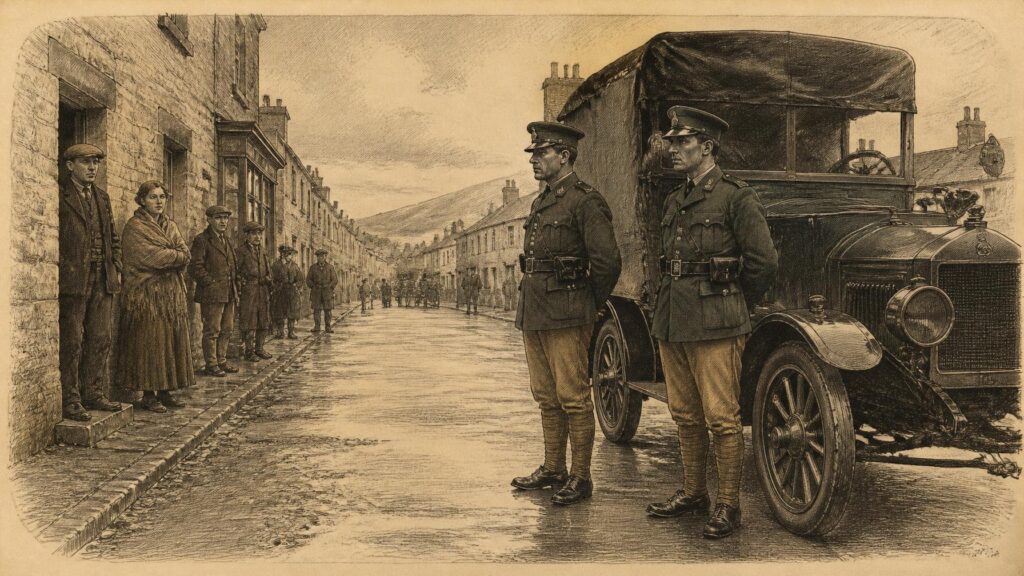
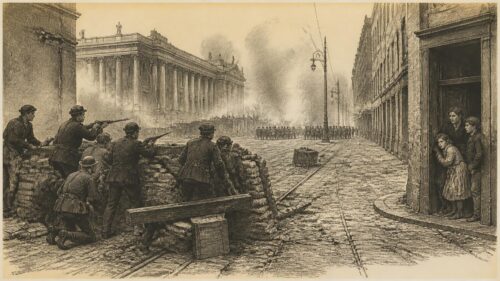
AI generated historical illustration, not a contemporary photograph.
At a Glance
The Black and Tans were not, despite the enduring force of the name, an independent army sent to Ireland. They were recruits to the Royal Irish Constabulary, brought into a failing system of British administration during the Irish War of Independence. Their improvised uniforms gave them their nickname; their conduct, and the reprisal system within which many served, made that nickname one of the most bitterly remembered in Irish history.
Falling Authority
To understand who the Black and Tans were, it is necessary to begin with the institution that absorbed them. The Royal Irish Constabulary, usually called the RIC, had been one of the principal instruments of government in Ireland since the nineteenth century. It was a centrally directed armed police force, distinct from the largely unarmed police tradition that later became familiar in Britain. Its members lived and worked in barracks distributed across towns, villages and rural districts. For generations the force carried out ordinary policing as well as political and security duties: collecting information, enforcing state regulations, supporting the courts and confronting agrarian, sectarian or nationalist unrest.
By 1919 that long-established force was under extraordinary pressure. The republican movement which had emerged from the aftermath of the Easter Rising and the general election of December 1918 had created an alternative political authority in the form of Dáil Éireann. The Irish Volunteers, increasingly known as the Irish Republican Army, began an armed campaign against Crown forces. The RIC was a logical target. It represented the state in almost every locality, possessed arms and intelligence, and provided the connective tissue between Dublin Castle, the courts and rural administration.
The campaign against the police did not consist solely of ambushes and shootings. RIC men and their families experienced social ostracism; businesses were discouraged from dealing with them; intelligence gathering made local service dangerous; and isolated barracks became difficult to defend. The IRA also attacked and burned evacuated police stations, denying their former use to the authorities. By 1920 the British government faced not simply a shortage of policemen but a widening crisis of authority in much of southern and western Ireland.
Its response was shaped by a political assumption. The government of David Lloyd George refused to treat Dáil Éireann or the IRA as a recognised belligerent force. It presented the conflict as a problem of law and order, to be addressed by police action supported by the army. In practice this distinction steadily blurred. The RIC was reinforced, armed and increasingly deployed in a military manner. The arrival of new men from Britain was part of that transformation.
Emergency Recruitment
Recruitment was extended in Great Britain late in 1919 and early in 1920. The intended candidates were former servicemen, many recently demobilised after the First World War and facing unemployment in a difficult post-war economy. Newspaper advertisements appealed directly to ex-service men of good character and sound physique. The pay was attractive by contemporary standards, and the prospect of regular employment appealed to men for whom wartime service had not been followed by a settled civilian life.
These recruits were sworn into the RIC as constables. This point is important because popular usage has often obscured it. In the House of Commons on 25 October 1920, the Chief Secretary for Ireland, Sir Hamar Greenwood, stated that the men called Black and Tans were not a separate force but recruits to the permanent establishment of the RIC. That official description did not make their arrival less disruptive, nor did it remove the obvious difference between an old constable with local experience and a newly enrolled veteran from Britain. It does, however, correct the widespread impression that the Black and Tans possessed a wholly separate legal identity.
The first contingents began arriving in Ireland in the early months of 1920, with deployments increasing from March. They were sent into an organisation already suffering casualties, resignations, poor morale and severe public hostility. Training could be brief, and the new constables entered a conflict for which ordinary policing offered no adequate preparation. Some had military experience but little knowledge of Ireland; some had never previously been police officers; and some found themselves posted among men whose local knowledge, accents and established habits differed sharply from their own.
The term “Black and Tans” arose from dress rather than formal designation. The RIC uniform was dark bottle green, near enough to black in many circumstances. Owing to a shortage of complete police uniforms, new recruits initially wore a mixed outfit: elements of military khaki alongside RIC tunics, caps, belts or other police equipment. The contrast of dark and tan clothing was conspicuous. Contemporary recollections and later accounts commonly linked the nickname to the celebrated Scarteen hunt hounds of Munster, whose black-and-tan colouring made the comparison instantly intelligible in Ireland.
The precise moment at which the nickname became universal cannot be fixed with certainty. It was an informal label, generated in public speech and quickly adopted by critics, newspapers and republicans. It was not a title chosen by the recruits themselves or a formal branch name entered into the administrative structure of the police. Yet it became so powerful that it eclipsed the bureaucratic reality of their status as temporary or newly recruited RIC constables.
Uniform Confusion
The clothing explains the name, but it also explains only part of the historical confusion. In common memory, “Black and Tan” is frequently used for every British or Crown force member who appeared in Ireland during the war. That shorthand is understandable. To civilians confronted by armed raids, lorries, curfews and reprisals, distinctions between units could be secondary to the experience of violence. Historians nevertheless need to retain those distinctions if the record is to remain clear.
The Black and Tans were recruits, many from Britain, enlisted as ordinary RIC constables. Alongside them stood the Auxiliary Division of the RIC, usually called the Auxiliaries or “Auxies”. The Auxiliaries were introduced later, from July 1920. They were predominantly former British Army officers, organised in companies, better paid, heavily armed and more overtly military in character. Their distinctive tam o’ shanter headgear often helps to identify them in photographs. They too were technically part of the RIC, but their recruitment, organisation and field role were different from those of the temporary constables.
There were also regular RIC men, many of them Irish-born; British Army units; intelligence personnel; and locally based loyalists or other armed actors whose conduct might be attributed broadly to “the Tans” in recollection. An incident described in a witness statement as the work of Black and Tans may therefore require corroboration through police records, military papers, newspapers, court material or multiple independent testimonies before exact responsibility can be assigned.
This does not mean that the name was merely an error. The Black and Tans were real, recognisable and feared. Rather, the label developed two meanings. Strictly, it referred to the temporary RIC recruits, initially conspicuous in mismatched uniforms. More broadly, it became a popular name for the coercive counter-insurgency apparatus which arrived with the escalation of the war. The broad usage entered songs, family memory and political speech. It remains important evidence of how the period was experienced, even where it is not sufficiently precise to identify every uniformed man in a particular event.
War Experience
Most Black and Tans were recruited in Great Britain, and a large proportion had First World War service. Their backgrounds were varied. They were not all hardened adventurers, nor were they a homogenous body of criminals or ideologues. Many were young working-class veterans seeking wages, security or a continuation of a life structured by uniform and discipline. A smaller number came from Ireland. The presence of Irish recruits complicates the later image of the force as exclusively English, though it does not alter the overwhelmingly British character of the emergency recruitment drive.
The experience of the Great War mattered, but it should not be used as a simple explanation for everything that followed. Service in France, Flanders, Gallipoli, the Middle East or at home could leave men accustomed to weapons, hierarchy and danger. It could also leave them physically injured, emotionally strained or economically insecure. Yet wartime experience did not automatically turn a man into a participant in unlawful violence. The conditions in Ireland mattered: poor preparation, inadequate supervision, fear of ambush, an official appetite for forceful measures, and a setting in which police work was becoming indistinguishable from war.
New constables arrived in a country where attacks could occur suddenly and where the enemy was often unseen. IRA volunteers depended on local knowledge, mobility, intelligence networks and civilian support. Crown forces responded with patrols, raids, arrests, roadblocks, searches and the occupation of buildings. Barracks were fortified and transport moved in convoys. In such circumstances the distinction between suspect, bystander and hostile combatant could be treated dangerously lightly.
It would be misleading to assume that all Black and Tans acted alike. Individuals differed in temperament and conduct; some left the force early; some objected to what they witnessed; others participated in or accepted violent methods. The historical problem is not resolved by replacing one stereotype with another. The decisive point is institutional: the force was inserted into an escalating counter-insurgency campaign, and a substantial body of evidence shows that reprisals and intimidation became recurrent features of that campaign.
Reprisal Violence
Reprisals lie at the heart of the Black and Tan legacy. After attacks on police or soldiers, Crown forces frequently damaged or destroyed property, assaulted civilians, fired into streets, or punished communities believed to shelter republicans. Such actions were sometimes portrayed by officials as spontaneous responses by angry men. Evidence assembled by historians, however, has shown a more complicated picture. Some violence was indeed undisciplined and immediate. But the wider pattern of reprisals was enabled by policy, tolerated by superiors, or carried out in an atmosphere where punishment of communities was thought useful.
Responsibility cannot be placed upon the Black and Tans alone. Regular RIC personnel, Auxiliaries and, in some instances, British soldiers were also involved in reprisals. University College Cork’s research on the destruction of property during 1920 and early 1921 stresses precisely this point: the full deployment of Black and Tans and Auxiliaries coincided with the sharp rise in attacks, but they were not the only Crown personnel responsible. This qualification matters because it prevents history from converting a system of counter-insurgency into the misbehaviour of one notorious group.
At the same time, the Black and Tans cannot be detached from that system. Their arrival increased the manpower available to the RIC at the moment when it was being militarised. Their lack of local ties, their wartime background and their rapid deployment made them especially visible. Communities associated their raids and patrols with the loss of property, arbitrary treatment and physical danger. The effect was to intensify hostility to the police and to damage what remained of the RIC’s older, locally embedded character.
Balbriggan in September 1920 became one of the earliest notorious examples of a reprisal attack. After the killing of an RIC officer, parts of the County Dublin town were attacked and property was destroyed. The event attracted international attention and became a potent illustration of the damage done to Britain’s reputation by its Irish policy. It also showed how quickly local violence could become an international political embarrassment when reporters, relief organisations and foreign observers carried the news abroad.
The burning of Cork on the night of 11–12 December 1920 remains the most dramatic symbol of the period. Fires destroyed or severely damaged a large part of the city centre after an IRA ambush killed an Auxiliary officer. The event involved several categories of Crown forces, and accounts differ in individual detail. Yet the destruction was unmistakable. University College Cork’s mapping project records fifty-seven premises destroyed, twenty badly damaged and twelve wrecked and looted. The material loss was immense, thousands of workers were affected, and the blaze became a defining image of the war.
The evidence from Cork also illustrates why cautious language is necessary. Eyewitnesses spoke of Auxiliaries, Black and Tans, soldiers and “men in uniform”. Their testimony is indispensable, but testimony was shaped by darkness, fear, smoke, uniforms that could be difficult to distinguish and the passage of time. The broad conclusion—that Crown personnel carried out destructive reprisals and obstructed attempts to control the fire—is strongly supported. The precise identity of every participant in every street cannot always be proved.
Public Memory
Why did the Black and Tans become so much more famous than the administrative facts of their service might suggest? The answer lies partly in the name itself. It was vivid, contemptuous and memorable. It conjured an image of mismatched uniforms and unwanted outsiders. It also arrived at a moment when the conflict was becoming a war in the everyday spaces of civilian life: shops, homes, creameries, roads, public houses and town streets.
Republican propaganda used stories of raids, burnings and assaults to demonstrate the brutality of British rule. Such propaganda had political purposes, but this does not mean it was fabricated. It should instead be tested against the surviving evidence: official inquiries, insurance claims, newspapers, photographs, private letters, court records, witness statements and later historical research. In many cases the independent record confirms broad patterns of destruction and intimidation. In others, details remain uncertain, disputed or exaggerated by wartime partisans.
Family memory has preserved another layer of the story. In households across Ireland, “the Black and Tans” could become a collective name for men who searched a house, commandeered a building, struck a relative, damaged a business or passed through a district in armoured lorries. Such memories must not be dismissed simply because they were transmitted orally. They reveal the civilian experience of insecurity. But neither should every remembered detail be treated as final proof without comparison to contemporary sources. Memory is historical evidence of experience and commemoration; it is not always a complete identification parade.
Folklore has also accumulated around the period. Tales of extraordinary cruelty, improbable escapes, disguised volunteers and named perpetrators sometimes contain a factual core and sometimes reflect the needs of later remembrance. The distinction is especially important where a dramatic story appears only decades after the event, without contemporary corroboration. A responsible account neither ridicules inherited memory nor repeats it as certainty. It asks what can be documented, what is plausible, and what remains unverified.
Political Failure
The deployment of the Black and Tans was intended to restore control. In a narrow sense, the British state did reinforce the RIC and made it more capable of conducting raids and patrols. The IRA suffered losses; volunteers were arrested, killed or forced into hiding; and many areas experienced intense pressure. It would therefore be inaccurate to say that the emergency force achieved nothing on the ground.
Politically, however, the policy was deeply damaging. The militarisation of policing and the repeated association of Crown forces with reprisals weakened British claims to be defending normal law. Each destructive episode strengthened republican arguments that British authority in Ireland rested on coercion rather than consent. International opinion, especially in the United States, became more hostile to the British position. The Irish conflict was increasingly understood abroad not as a domestic policing problem but as a struggle between an imperial state and a national movement.
The Black and Tans also helped destroy the RIC’s remaining legitimacy. The old force had long been unpopular in nationalist Ireland, but it had nevertheless contained many men with local roots and community knowledge. The recruitment of outsiders and the deployment of special formations marked a visible break. Even where a newly recruited constable behaved correctly, he served within a force now commonly regarded as an occupying arm rather than a police service.
The Truce of 11 July 1921 ended the principal fighting between Crown forces and the IRA. The Anglo-Irish Treaty followed in December. The RIC was disbanded in 1922, and members who remained eligible received compensation or pensions under the arrangements made for the force. The Black and Tans did not leave behind an enduring police organisation in the new Irish state. They left behind something more enduring in public culture: a name that became synonymous with the violence of the final years of British rule in most of Ireland.
Historical Balance
Who, then, were the Black and Tans? Documented evidence provides a clear core answer. They were chiefly ex-service recruits, enrolled as temporary constables in the Royal Irish Constabulary from 1920, most of them recruited in Great Britain to reinforce a police force under severe republican pressure. They were given the nickname because initial uniform shortages produced a mixture of dark RIC clothing and khaki military dress. They were distinct from, though often confused with, the Auxiliary Division.
Interpretation begins with their significance. They should be understood not as an isolated band of villains detached from government, nor as merely unfortunate policemen caught in a hostile country. They were part of a British counter-insurgency response that militarised policing and permitted or encouraged collective punishment. The wider state, not simply individual constables, bears responsibility for creating the conditions in which reprisal became a recurring method.
The popular meaning of “Black and Tan” is consequently broader than a personnel category. It is a memory of state violence, fear and the collapse of ordinary civil relations during the War of Independence. That memory can compress differences between constables, Auxiliaries, soldiers and officials. Historians should restore those differences without diminishing the suffering that gave the name its force.
More than a century later, the phrase remains emotionally charged because it stands at the meeting point of fact and memory. The facts are sufficiently stark: emergency recruits were sent into Ireland; policing became warlike; reprisals caused grave harm; and the policy failed to secure a stable political settlement. The memory is equally significant: for many Irish people, the Black and Tans became the most recognisable emblem of an unwanted authority at its most coercive. To explain the name properly is not to soften it. It is to place it accurately within the history that made it endure.
The article’s distinction between the Black and Tans as temporary RIC constables and the wider popular label for Crown coercion is especially thought-provoking. It shows how administrative categories can differ from civilian memory, particularly when raids, reprisals and destruction made individual uniforms difficult to distinguish. The article also argues that responsibility belonged within a broader militarised counter-insurgency system, rather than to one group alone, while recognising why the Black and Tans became its enduring symbol. How might historians preserve the specificity of the Black and Tans, Auxiliaries, regular RIC and army units while respecting lived memory of violence and insecurity?