
Galway Neolithic
At a Glance
Galway Burials
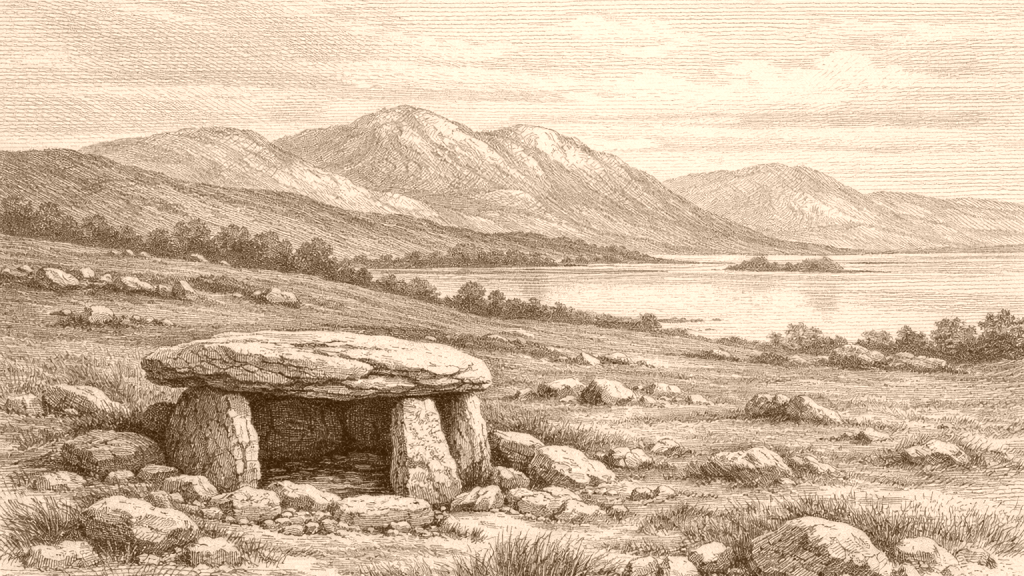
The Galway records preserved here centre on prehistoric burials and a prehistoric structure rather than on a single site. One report from Annaghkeen describes a short cist in Co. Galway with an inhumation, a vase, a flint blade, and pig bones. Another from Carrowntober East records a short cist near Athenry with an inhumation, a cremation, and an inverted vase. A third report, from Lettershea, concerns a prehistoric hut site with later discussion of quartz and lithics. [1] [3] [2]
Across these reports, the evidence is strongest for burial practice and associated objects, but weaker for exact dating. Annaghkeen is identified as Early Bronze Age graves, while the Lettershea site is described as prehistoric and the lithic finds there are said to provide conclusive evidence of Late Neolithic or Early Bronze Age activity. The reports therefore permit comparison of form and content more securely than comparison of precise dates, which remain broad in several cases. [1] [2]
Annaghkeen Cist
At Annaghkeen, a short cist was found during ploughing after the capstone lay just below the surface. The report notes a rescue excavation and places the site in a field on the edge of a break of slope, near other cemetery cairns in the wider area. The grave was short and trapezoidal, aligned north-east to south-west, and made of four split limestone slabs set on edge with packing stones visible in the fill. [1]
The Annaghkeen burial contained a crouched juvenile inhumation, described as a 14 to 15 year old lying on the right side, with the head in the southern corner and the feet toward the north. The vase stood in the eastern corner beside the flexed knees, a small flint knife lay in the western corner, and mussel shells were found on the floor. The report also states that lime deposit and disturbance affected the original positions of some bones and the skull. [1]
Carrowntober Burial
Carrowntober East presents another short cist, discovered in a sandpit near Athenry and investigated the next day after reporting to the Garda. The burial lay at a depth of 0.9 metres and was rectangular, with its long axis aligned north-east to south-west. It was built from five limestone slabs set on edge, sealed by a carefully dressed capstone, and seated on undisturbed gravel rather than on a paved floor. [3]
The human remains and objects within the Carrowntober cist are more complex than at Annaghkeen. The report records a crouched articulated burial of an adolescent female together with a cremation representing an adult female and an adolescent. The burial goods comprised an inverted vase and two flint scrapers. The inhumation lay on its right side with the head to the south-west, facing the southern wall, while the vase stood to the north of the skull near the north-western corner. [3]
Lettershea Structure
Lettershea differs from the burial cists by preserving a prehistoric hut site rather than a grave. Before excavation it appeared as a peat-covered stone setting, but the excavation revealed an integral prehistoric building with a ring wall, rough packing, and a roughly paved floor. The report also notes upright stones on the west side and a possible narrow entrance feature on the east. The interior was slightly dished and surfaced with flat irregular slabs and stones. [2]
The Lettershea report is notable for the way it joins architectural description to artefact identification. Eight finds were identified as lithics, made from flint and chert, and the report says these provide conclusive evidence of Late Neolithic or Early Bronze Age activity. Among them was a fine thumb-nail scraper, while three pieces of honey-flint were also noted. The evidence supports prehistoric use, but not a more exact chronological division. [2]
Comparative Evidence
Placed side by side, the Galway reports show repeated attention to cist construction, body position, and associated objects. Annaghkeen and Carrowntober East both used limestone slabs set on edge and both contained crouched inhumations with vase pottery and flint tools. Yet the two graves differ in plan, size, and the additional material found with them: Annaghkeen included pig bone and mussel shell, while Carrowntober East included a cremation alongside the inhumation. These are direct contrasts in the records themselves. [1] [3]
The evidence also shows different forms of disturbance and recovery. At Annaghkeen the capstone had been struck and shifted during discovery, while at Carrowntober East quarrying may already have destroyed part of the pit. At Lettershea, by contrast, the excavation concerned a building with no archaeological finds of significance other than the lithics and structural features described. These differences matter because they shape what can be observed, and what remains uncertain, in each case. [1] [3] [2]
Chronology Limits
Annaghkeen is identified as an Early Bronze Age graves site, where a short cist contained an inhumation, a vase, a flint blade and pig bones. Lettershea is described as prehistoric, and the excavation report says the lithics provide evidence of Late Neolithic or Early Bronze Age activity; the artefacts included five flint pieces and three chert pieces. Carrowntober East is also classed as an Early Bronze Age graves site, and its 1931 report records a short cist with an inhumation and a vase. [1] [2] [3]
Taken together, these Galway discoveries show that prehistoric field archaeology in the county has preserved several kinds of evidence rather than a single archaeological pattern. The burial reports preserve graves, bodies, and objects; the Lettershea report preserves structure, paving, and lithics. The common thread is close observation of material form. What remains unshown in these excerpts is any broader settlement map, wider regional sequence, or direct explanation for how the sites related to one another. [1] [2] [3]
Source References
Hover over a number to see the source. Select it to open the source.




What do the Galway excavations reveal about the forms, contents, and contexts of late Neolithic burial and activity sites?