
Public Trust
At a Glance
Manuscript Record
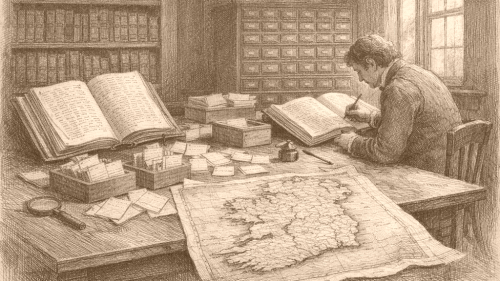
The Annals of Tigernach are presented through manuscript description rather than narrative commentary. One witness is dated to about the eleventh century and linked with Clonmacnoise, while another manuscript from the fourteenth century preserves fragments of the same work alongside the Irish World-Chronicle. The edition history also names earlier scholarly work and later electronic preparation. These details show a text known through copying, fragmentary survival, and editorial reconstruction rather than through a single complete book. [1]
The opening material for the Annals of Tigernach also identifies the electronic edition as a restricted academic resource, compiled from earlier translation work and proof corrections. That description is administrative rather than interpretive, but it makes the editorial labor visible. In this framing, the text is not only a historical source; it is also a managed scholarly object with named contributors, manuscript provenance, and controlled access for research and teaching. [1]
Munster Continuity
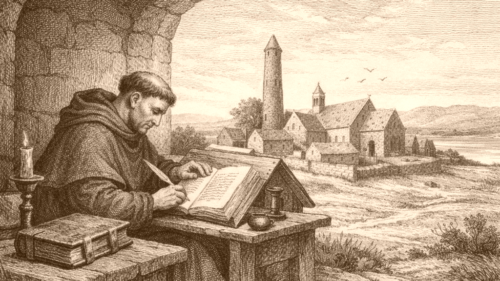
The Annals of Inisfallen present an even more layered manuscript history. The surviving manuscript is described as beginning in the eleventh century, continuing into the early fourteenth, and passing through later ownership by Sir James Ware. The same notice lists lacunae in the record and remarks that later passages use phonetic spellings. These features are direct evidence of continued use, partial loss, and textual variation across time rather than of a single unbroken production stage. [2]
The same record also says that the manuscript passed to a West-Munster monastery, most likely Inisfallen, and that a translation of part of the annals was made for Ware by Dubhaltach Mac Fir Bhisigh. The edition history then moves from facsimile reproduction to a later edited text. This sequence shows custodianship, translation, and editorial reuse, all visible in the bibliographic notice without requiring any further inference about intent. [2]
Chronicle Work
The notice for Friar John Clyn identifies the chronicle as created by him and states a date range of 1333 to 1349. It also says that the original, from which the surviving manuscripts derive directly or indirectly, is now lost. The digital edition records that the text contains annals from the beginning to 1346, with later additions for 1467 and 1480 in a later hand. These facts show layered transmission and later expansion. [3]
The edition notes for Clyn also describe the editorial treatment of the text: the electronic version follows a printed edition, the main annals were proof-read three times, and gaps are marked. Standardized dates, tagged names, and marked marginal additions indicate a modern presentation that keeps the structure visible. The notice is technical, but it demonstrates a careful attempt to preserve the record as an ordered series of entries rather than as a smooth narrative. [3]
Civic Orders
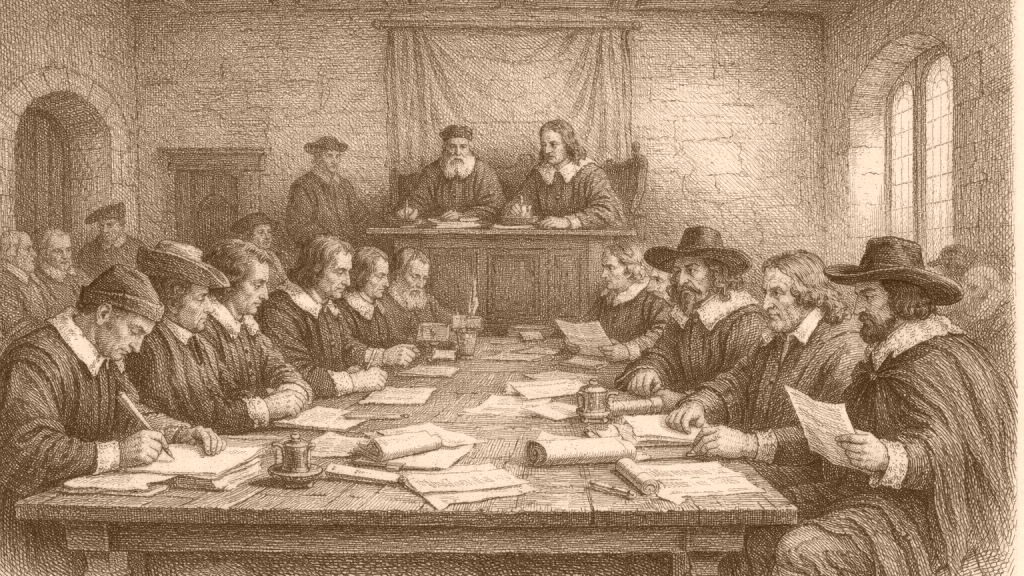
The Kilkenny assembly text is the clearest direct example of institutional order. It states that catholic prelates, nobles, gentry, and clergy met at Kilkenny in May 1642, set up a supreme council, and issued orders to be observed as the model of government. The assembly grounds its authority in the city and in summons sent to lords, counties, and boroughs. Here public organization is explicit, formal, and written as binding procedure. [4]
The same orders define obligations for law, allegiance, and jurisdiction. They specify that Roman catholic privileges should be enjoyed, that common law and statutes should be observed where compatible with religion and native liberties, and that civil and criminal proceedings should follow those laws. They also name Dublin as the usual and principal seat of justice and describe the wartime necessity that led the assembly to deviate from normal procedures. [4]
Council Powers
The Kilkenny text gives the supreme council defined powers and procedures. It is to consist of twenty-four members, with twelve resident in the kingdom or where expedient, and decisions require specified majorities. The council is also to have a president. These provisions make authority legible through numbers, residence, voting rules, and office-holding, which are all stated in the orders themselves rather than inferred from later history. [4]
The same document extends that authority over military and civil officers. Lords general, commanders of armies, civil magistrates, and other officers in the provinces are ordered to observe the council's directions and report their proceedings. The wording shows a chain of command that joins civil administration and military oversight. The passage records the power claimed, but it does not itself show how fully those commands were obeyed in practice. [4]
Public Trust
Taken together, these texts show different documentary forms in which trust is organized through record keeping, custody, and procedure. The annalistic notices preserve manuscript provenance and editorial care; the Kilkenny orders preserve public norms of allegiance, law, and command. What can be observed directly is not a single theory of trust, but several written practices that make authority, continuity, and responsibility readable within the surviving texts. [1] [2] [3] [4]
The surviving wording allows only a limited comparison. The annal material described here is identified through manuscripts, fragments, editions, and the work of different hands, while the Kilkenny orders present themselves as rules to be observed in the governance of the kingdom. They also provide for a supreme council and require civil magistrates and officers in the provinces to observe its orders, decrees, and directions and to give account of their proceedings. Beyond that, the texts do not speak for themselves. [1] [3] [4]
Source References
Hover over a number to see the source. Select it to open the source.

How do these Irish texts represent public authority, communal order, and trust in civic institutions across their different settings?