

Language Claims
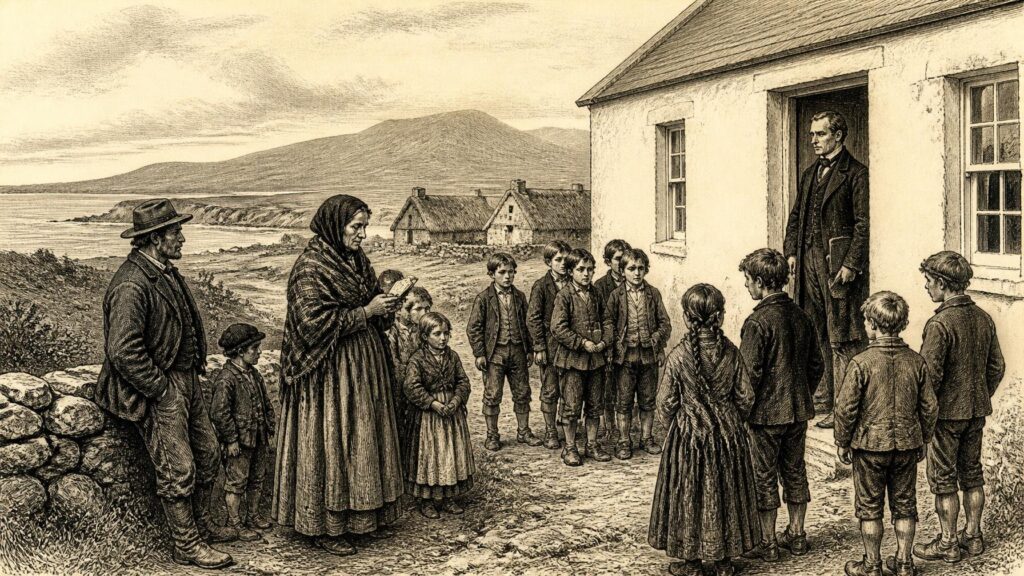
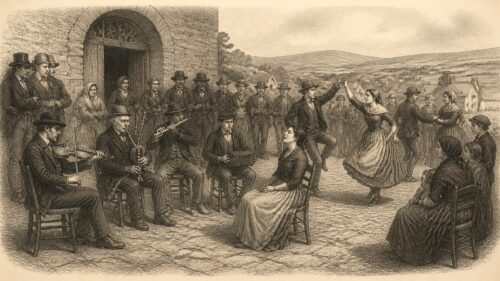
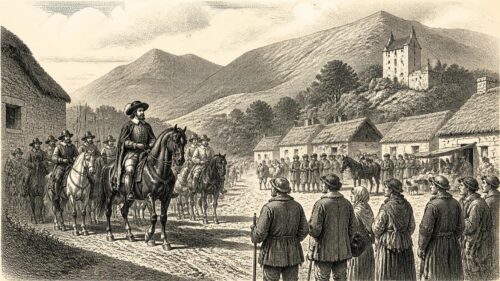
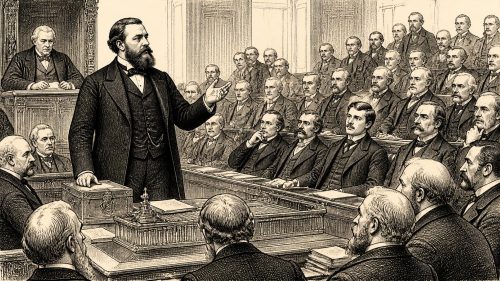
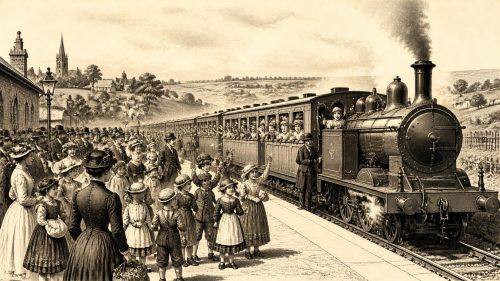
AI generated historical illustration, not a contemporary photograph.
At a Glance
Irish language rights did not emerge from a single declaration or law. They were fashioned over generations from the experience of language loss, the work of cultural revivalists, the claims of Irish-speaking communities, constitutional nation-building and repeated arguments about what equality with English should mean in daily public life. Their history is therefore both a history of Ireland and a warning against confusing official status with secure social survival.
Living Language
Irish is among the oldest continuously recorded vernacular languages of Europe, yet its antiquity should not be treated as a simple guarantee of permanence. The language survived because communities used it: in households, farms, fishing settlements, marketplaces, religious life, poetry, song, correspondence and local memory. Its early written evidence, including ogham inscriptions and later manuscript culture, establishes a deep history, but the precise beginnings of spoken Irish cannot be fixed by documentary evidence. Assertions of an exact prehistoric arrival date belong to speculation rather than demonstrable history.
For many centuries Irish was the principal language of the island’s majority, though never the only language heard there. Latin had religious and learned authority; Norse, Anglo-Norman, English and Scots all left their marks; and bilingualism existed in various districts and social settings. The historical issue was not the existence of contact between languages, which was normal, but the increasing inequality of power between them. As English government, law, commerce and education acquired greater reach, English became more than a neighbouring language. It became the language through which access to offices, advancement and imperial institutions was commonly mediated.
To speak of language rights is thus to speak of power. A right may concern the freedom to use a language without punishment or contempt. It may mean a right to schooling, an interpreter, a court process, official correspondence, a place-name, a public sign, a parliamentary speech or a service from a State body. It can also mean collective protection for a community whose language is vulnerable even where individual speakers are formally free to use it. Irish history contains each of these meanings, though they did not arrive in a neat sequence and were often contested.
Older romantic accounts sometimes present Irish as a language suddenly silenced by conquest. That is too simple. Language shift was gradual, uneven and shaped by regional economies, migration, schooling, class, family ambition and state power as well as coercion. Yet it would be equally misleading to treat the spread of English as merely a voluntary consumer choice. The choices available to parents and children were made within a political order in which English carried substantial institutional advantage.
Colonial Change
The long consolidation of English rule altered the public standing of Irish. Medieval and early modern statutes, administrative practices and elite culture repeatedly represented English as the language of order and authority. Such evidence shows official preference and pressure, but it does not prove that Irish ceased to be widely spoken. In fact, Irish remained the ordinary language of much of the population for centuries. The important historical distinction is between governmental prestige and social prevalence: a language may be dominant in official business while another remains predominant in domestic and local life.
The decisive nineteenth-century change was not produced by one prohibition. It arose from a convergence of social catastrophe and practical calculation. English opened paths into wage labour, state institutions and overseas migration. The National School system, established in 1831, generally operated through English. In Irish-speaking districts, children could therefore encounter education in a language other than the one spoken at home. Later testimony and memory have often described harsh schoolroom hostility towards Irish. Some practices are well documented, while the familiar image of every child universally subjected to a punitive “tally stick” belongs partly to a more varied body of recollection and folklore. The wider conclusion, however, is secure: Irish was poorly accommodated within the dominant educational structure.
The Great Famine intensified an already serious language shift. Its effects were not confined to Irish speakers, but many of the places most damaged by death, eviction and emigration were poor western and southern districts where Irish remained strong. Survival strategies encouraged English. A parent who had experienced scarcity and watched relatives leave for Britain, the United States or elsewhere could reasonably see English as an instrument of security. This does not make the language shift an uncomplicated free choice. It shows instead how economic catastrophe narrowed the terms on which choice could be made.
By the closing decades of the nineteenth century, Irish had become a minority community language concentrated in particular districts, even while large numbers elsewhere retained some knowledge of it or a cultural attachment to it. The modern Gaeltacht had not yet become a fixed administrative concept, but the social geography that would later shape policy was already visible. The loss was linguistic, but also archival and emotional. Where a community ceased transmitting Irish, songs, place-names, oral history and local idiom could remain, yet the ordinary medium in which they had flourished became less secure.
Revivalist Demands
The late nineteenth-century revival changed the terms of debate. Earlier scholars and collectors had preserved manuscripts, dictionaries and folklore, but a new movement insisted that Irish should not be treated simply as an ancient relic. Organisations such as the Society for the Preservation of the Irish Language and the Gaelic Union helped secure a limited place for Irish in education. The Gaelic League, founded in Dublin in 1893, gave the revival a more extensive national organisation. It promoted classes, publications, examinations, festivals and Irish-speaking networks, while making the language a central emblem of a distinct Irish nationality.
Its achievement was not merely sentimental. Revivalists made practical demands about teachers, curricula, university requirements and public recognition. They argued that Irish-speaking pupils should be educated with respect for their first language and that English-speaking pupils should have a meaningful chance to learn Irish. The campaign helped shift Irish from the margins of the school system. Irish was accepted as an extra subject; bilingual programmes were developed in Irish-speaking areas; and Irish acquired a stronger place in higher education. These advances did not undo the nineteenth-century shift, but they established an important principle: a language could be a legitimate subject of public policy rather than an embarrassment to be overcome.
There was nevertheless a tension within revivalism. Some supporters sought to preserve living vernacular communities; others approached Irish principally as a national badge, literary resource or route to a distinctive Irish civilisation. These purposes could reinforce one another, but they were not identical. A learner in Dublin and a native speaker in Connemara did not necessarily need the same institutions, nor did they always have the same influence over policy. The later history of language rights repeatedly returns to this question: should the State concentrate on protecting communities where Irish remains a social language, or spread a national bilingual ideal throughout the country?
The language movement also became entwined with political nationalism. This connection brought energy and influence, but it had consequences. Irish could be portrayed by opponents as the property of one political tradition, despite the participation of people from varied religious and social backgrounds in the revival. Once cultural revival and constitutional politics became interwoven, a claim for linguistic equality could be heard either as a democratic demand or as a nationalist test. The ambiguity has remained particularly important in Northern Ireland.
State Foundations
The establishment of the Irish Free State in 1922 gave language activists a power they had not previously possessed: the ability to make policy through a national administration. Article 4 of the 1922 Constitution declared Irish the national language while recognising English equally as an official language. The formula expressed aspiration as much as settled social fact. English remained the overwhelmingly dominant language of administration, commerce and urban daily life. Nevertheless, the Constitution marked a major legal departure from the preceding order by associating the State with restoration rather than assimilation.
The new State made Irish central to its educational programme. It expanded compulsory teaching, developed Irish-medium instruction in some subjects and linked competence in Irish to aspects of public employment and educational progression. The policy was animated by sincere hopes of national renewal. It also reflected a belief that school could reverse the language shift that school had allegedly helped to accelerate. That belief contained a genuine insight, since education shapes linguistic opportunity. But it also overstated what formal instruction could accomplish without wider use in workplaces, homes and communities.
Compulsion became one of the most enduring controversies. Critics objected that Irish was imposed through examinations and that poor teaching could foster resentment. Supporters replied that a language weakened by historical inequality could not recover if it were left entirely to voluntary preference within an English-dominant environment. Both arguments identified real difficulties. Rights to learn a language are not necessarily fulfilled by making it a high-stakes examination subject; equally, a State that provides only optional and marginal instruction may reproduce the very imbalance it claims to regret.
The Free State also began identifying Irish-speaking districts for special attention. This was the origin of the administrative Gaeltacht, later reshaped by official review. The designation offered recognition and targeted measures, but it also created boundaries around a linguistic reality that was fluid. People used Irish in varying degrees, and communities did not always fit neatly into official maps. The State’s language policy thus developed two distinct faces: a nationwide programme focused largely on schools, and a territorial programme intended to sustain Irish as a community language.
Constitutional Status
Bunreacht na hÉireann, which came into force in 1937, supplied the best-known statement of Irish linguistic status. Article 8 provides that Irish, as the national language, is the first official language; English is recognised as a second official language; and legislation may provide for exclusive official use of either language for particular purposes, whether across the State or in part of it. The wording is consequential, but it is not a self-executing blueprint for bilingual government.
“First official language” has enormous symbolic force. It recognises Irish not merely as cultural inheritance but as a language of the State. The Constitution’s Irish text also has special legal importance where a conflict with the English text arises. Yet Article 8 does not require every citizen to know Irish, nor does it automatically make every service instantly available through Irish at the same practical level as English. Constitutional status created a foundation from which rights might be argued and legislation built; it did not by itself supply trained staff, interpreters, translated forms, schools or local speech communities.
This distinction is essential to a sober history. It is possible for Irish to have a higher formal constitutional rank than English while English remains the normal language of most public transactions. That apparent contradiction is not a legal error. It reflects the difference between status planning and use. The Constitution chose to state a national ideal. The work of making that ideal meaningful required administrations, budgets, regulations and citizens willing and able to use Irish.
Constitutional language rights have also reached the courts. The relevant principle is not that a person using Irish forfeits access to justice, but that either official language may be used in court proceedings and court documents. In civil proceedings involving the State or a public body, the public authority must use the language chosen by the other party, subject to the statutory framework. Such provisions illustrate a broader development: Irish ceased to be only an object of cultural policy and became, in defined circumstances, a language through which a person could insist on being addressed by public power.
Gaeltacht Claims
The Gaeltacht occupies a special place in this history because it is where language rights most plainly concern the survival of a living community rather than the availability of a subject in school. The Gaeltacht was never a timeless enclave untouched by social change. Its communities have experienced emigration, economic hardship, tourism, improved transport, media change, inward movement and the pervasive influence of English. Its boundaries have also changed, notably following the mid-twentieth-century review that narrowed the officially recognised area.
Economic policy became inseparable from linguistic policy. A community cannot sustain a minority language easily if younger people must leave in search of work. State bodies therefore pursued industrial and regional-development measures in Gaeltacht districts. From the later twentieth century, local campaigns called for greater democratic control over such development. The establishment of Údarás na Gaeltachta in 1980 followed this pressure and gave Gaeltacht residents a more direct role in an agency concerned with regional and linguistic development.
These developments demonstrate that language rights are not exhausted by signs or translations. Housing, employment, childcare, planning and communications can influence whether a family is able to raise children through Irish. This is especially true where the language is socially vulnerable. A public office may offer forms in Irish, yet a community may still experience language shift if housing costs displace younger speakers or if local employment proceeds exclusively through English. The strongest interpretation of Gaeltacht rights is consequently ecological: it asks whether conditions exist for Irish to be transmitted and used naturally across generations.
That interpretation should not obscure the agency of Gaeltacht people themselves. Communities have founded co-operatives, schools, media projects, cultural organisations and campaigns. They have resisted the idea that they are merely passive guardians of a national treasure for others to admire. The language is a means of ordinary life and social relationship. Treating it only as heritage risks turning its speakers into symbols; treating their demands as claims for equal civic participation better reflects the modern language-rights tradition.
Legal Practice
The Official Languages Act 2003 was a landmark because it moved beyond broad constitutional recognition towards enforceable administrative duties. Its central purpose was to improve the quantity and quality of public services available through Irish. It established the office of An Coimisinéir Teanga, the Language Commissioner, to investigate complaints and safeguard the public’s language rights. In this form, Irish-language policy acquired an oversight mechanism rather than relying entirely on ministerial goodwill.
The Act addressed practical matters that may appear modest but determine whether a right can be exercised. Public bodies must reply in Irish to written or electronic communications received in Irish. Regulations can govern oral announcements, stationery, signage and advertisements. The Act also provided that members of the Oireachtas, and people appearing before its committees, may use either official language; official reports of proceedings are published in both languages, subject to defined exceptions. Acts of the Oireachtas are to be published in Irish and English. These provisions place Irish within the routine machinery of public authority.
Legal practice has inevitably exposed limits. A right on paper can be delayed by shortage of qualified personnel, uneven institutional capacity or a culture in which English is assumed to be the default. For that reason, disputes about Irish-language rights often concern implementation rather than the abstract desirability of Irish. Is the service timely? Is the translation adequate? Is staff competence available where it is required? Does a bilingual sign conceal an English-only working practice? Such questions are less dramatic than constitutional declaration, but they determine the everyday worth of a legal entitlement.
The Official Languages (Amendment) Act 2021 strengthened the framework. It set an objective that 20 per cent of new recruits to the public sector and Civil Service should be competent in Irish by the end of 2030, provided for Irish-language public services in Gaeltacht areas, and replaced the older language-scheme model with language standards. Its later commencement measures brought further duties into effect, including obligations affecting public communications and digital engagement. The history here remains unfinished. Statutory targets create a direction of travel, but the eventual measure is whether service users can choose Irish without delay, inconvenience or special pleading.
Northern Framework
The history north of the border differs sharply from that in the State. After partition, Irish did not possess the constitutional position it held in the Free State or later the Republic. The language nevertheless endured in families, schools, voluntary organisations, urban networks and cultural activity. Its status was shaped by the constitutional conflict of Northern Ireland, where Irish could be treated as an expression of Irish national identity and consequently became entangled with disputes over symbols, public space and political allegiance.
The Belfast or Good Friday Agreement of 10 April 1998 altered the framework. It recognised linguistic diversity, including Irish, Ulster-Scots and the languages of ethnic communities, as part of the cultural wealth of the island. In relation to Irish, it committed the British Government, where appropriate and where people wished it, to promote the language, facilitate and encourage its use in speech and writing in public and private life, and seek to remove discouraging restrictions. The Agreement did not create a simple individual right to receive every public service in Irish. It did, however, embed the language in a peace-settlement vocabulary of respect, parity and cultural recognition.
The United Kingdom’s ratification of the European Charter for Regional or Minority Languages added further commitments. Irish in Northern Ireland received protection under the Charter, while the North South Language Body, including Foras na Gaeilge, institutionalised cross-border co-operation. These arrangements are historically important because they moved Irish away from an exclusively southern constitutional narrative. The language was recognised as part of the island’s shared cultural inheritance, even while its political meaning remained contested.
The Identity and Language (Northern Ireland) Act 2022 provided official recognition of the status of Irish in Northern Ireland, created provision for an Irish Language Commissioner and envisaged standards of best practice for public authorities. It also expressly preserves the status of English and sits alongside provision concerning Ulster-Scots and the Ulster British tradition. This structure is significant. Rather than copying the Republic’s constitutional hierarchy, it frames language within a plural institutional settlement. Its effectiveness depends on implementation, standards and public-authority practice, not on the statute’s title alone.
European Dimension
Ireland’s membership of the European Communities, later the European Union, added another arena for language rights. Irish was initially a treaty language after accession in 1973, meaning that the treaties were translated into Irish, but it was not fully used as an official and working language across the institutions. That restricted position reflected the practical demands of translation, staffing and institutional usage, but it also demonstrated that national status did not automatically travel into international administration.
Irish became an official and working language of the European Union on 1 January 2007. A temporary derogation limited the range of material translated while institutional capacity was developed. The derogation ended on 1 January 2022, placing Irish on the same formal footing as the Union’s other official languages. The change carried both practical and symbolic importance: EU legislation and documentation became more widely available in Irish, and Irish speakers gained a clearer route to communicate with European institutions in their language.
European recognition should not be exaggerated. It cannot by itself reverse language shift in the Gaeltacht, repair weak teaching or ensure that a local public counter can operate through Irish. But it has helped expand professional opportunities for translators, lawyers, administrators and language specialists. It also undermines an older assumption that Irish belongs only to the past or to the cultural margin. A language used in European law and administration is visibly capable of modern public functions, although that capacity has always existed in principle.
Rights Meaning
The history of Irish language rights resists a triumphal conclusion. The language has travelled from institutional marginalisation to constitutional recognition, statutory duties, parliamentary use, court protections, European status and a changing rights framework in Northern Ireland. Those are substantial developments, achieved by generations of speakers, teachers, activists, civil servants, scholars and public representatives. They should not be dismissed because they have not created a fully bilingual society.
Equally, rights cannot be reduced to ceremonial bilingualism. A sign, emblem or translation may carry real recognition, particularly after a history of exclusion, but recognition becomes shallow if an Irish speaker cannot complete an important public transaction, obtain schooling, find housing or work in a community where Irish can be lived rather than displayed. The historical record suggests that durable language protection requires more than affection for a national symbol. It requires institutional competence, resources and policies designed with speakers rather than merely for them.
There is also no single Irish-speaking public. Native speakers in Gaeltacht districts, urban families raising children through Irish, adult learners, pupils, writers, bilingual public servants and those who value Irish without using it daily may all claim a stake. Their interests sometimes overlap and sometimes diverge. A mature rights framework does not require one group to prove itself more authentic than another. It does, however, recognise that a community language under pressure needs forms of territorial and social support that differ from the needs of an individual learner.
Irish language rights are therefore best understood as an unfinished constitutional and communal undertaking. The law can require public bodies to answer, translate, recruit and plan. It can protect a speaker in court and make Irish visible in parliament, on maps and within European institutions. It cannot command a family to transmit a language or a community to use it with confidence. Those acts remain voluntary, social and intimate. The historical task of the State is not to manufacture them, but to ensure that choosing Irish is possible, respected and practical.
The article usefully distinguishes Irish’s constitutional standing from the practical conditions required for everyday use. Its discussion of the Gaeltacht suggests that language rights extend beyond translated documents and bilingual signs to housing, employment, childcare and local democratic influence. This ecological understanding complicates the familiar contrast between symbolic national recognition and individual public-service entitlements. It may also explain why school-based revival has limited effect where families cannot remain in Irish-speaking communities or use the language at work. How should policy balance nationwide access to Irish-language services with place-based measures that help Gaeltacht communities transmit Irish naturally between generations within communities?