Health Infrastructure
At a Glance
Plague Arrival
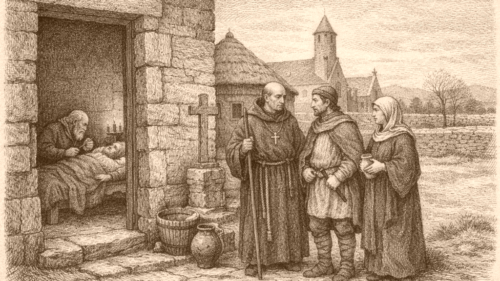
The earliest notice places plague in Ireland in 664 and says it reached the island on the Kalends of August. The same year adds that the plague first raged in Mag Itha of Fotharta. In the same cluster of entries, an abbot is also recorded as having died, showing that a disease notice and an ecclesiastical death notice can stand side by side. The passage is brief, but it ties illness to place with unusual directness.
Later entries repeat this pattern on a larger scale. In 1383 a great and virulent plague is said to have raged universally throughout Ireland, after which several people are listed as dying of it. The record does not explain how the illness spread or how it was treated. It does, however, present plague as both a general condition and a sequence of individual deaths across named families and regions.
Urban Damage
The record for 1478 describes a great plague arriving by ship at the harbour of Es-ruadh and spreading through Tir-Conaill, Fir-Manach, and the province in general. In the same year, a great wind after Christmas destroyed much of the cattle of Ireland and broke down many monasteries, churches, and houses throughout the island. The two notices are separate, but they place disease and physical damage in one annual frame. That makes built structures visible as part of the same troubled landscape.
The same entry also preserves signs of places where people gathered or were held. It notes a man who kept a general guest-house, another described as an eminent physician and historian, and a church-door killing in the same year. The harbour, the guest-house, and the church appear as concrete locations, not as abstract settings. Their presence shows that the year’s record moved easily between illness, travel, learned status, and violence in built places.
Food Scarcity
The annal for 1492 gives famine its own brief notice: there was great famine in Ireland that year. Immediately after, the text notes a hot summer. The entry does not say that the weather caused the shortage, but it places the two notices next to each other. In the same year the annals also continue with raids, slayings, and captures, yet the famine line stands apart as a countrywide condition worth recording on its own.
Another 1492 notice shows destruction of a settlement in sharper detail. A church at Cell-Srianain was burned, and sixteen persons, along with much property, were burned there as well. This is not a weather passage; it is an act of burning linked to people and goods inside a named church. The same year also includes other raids and captures, but this entry is the clearest example of a built place suffering direct destruction.
Built Places
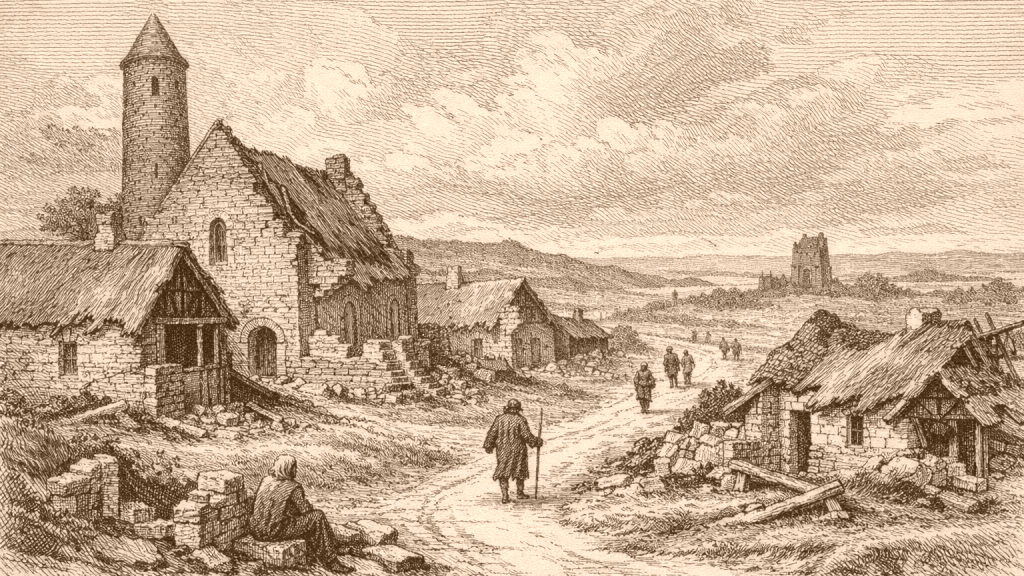
Built spaces repeatedly appear as vulnerable rather than secure. In 1492 the church at Cell-Srianain was burned on the same day that men, women, and property were burned in it. The entry gives a rare glimpse of a named church as a physical structure under attack. It also shows that damage extended beyond walls and roofs to the people and goods inside, though the passage does not describe repair or replacement.
Other notices mention monasteries, churches, houses, and castles as places affected by weather or force. In 1478 a wind broke down many of them throughout Ireland, and in 1444 Dundalk was plundered and burned during a military campaign in Oriel. The same annals also mention a monastery as a burial place and a guest-house as a site of hospitality. These are not architectural descriptions, but they do locate social life in built places.
Hospitality Networks
Several notices connect illness and infrastructure through people associated with shelter, learning, or care. In 1383 the abbot of Boyle is described as eminent for charity and humanity. In 1443 an ollav of Munster in law is said to have kept a house of public hospitality for all. In 1478 another man is described as keeping a general guest-house. The passages do not define these offices, but they do place hospitality within the record of public life.
The same broad pattern appears in notices of confinement and movement. In 1383 Art Magennis died of plague at Trim while detained in prison by the English. In 1492 Domnall Ua Neill was taken, and later escaped from a castle after a week. These entries do not say that prisons or castles were public-health measures. They do show that bodily vulnerability and controlled space could overlap in the yearly record.
Record Pattern
Across these entries, the language remains spare and local. A plague may be said to reach Ireland, to rage universally, or to spread through named territories. Weather may destroy cattle, churches, monasteries, and houses, while famine is reported in a single line. Because the passages are so concise, they preserve direct notices rather than explanation. They also make comparison possible: health crises and infrastructure damage are both entered as events worth recording.
What these passages do not provide is also clear. They do not explain remedies, repairs, or administrative response, and they do not trace a single outbreak from origin to aftermath. Instead, they preserve moments when disease, weather, hunger, and destruction were notable enough to enter the yearly record. Read together, the excerpts show recurring exposure of people and places to disruption, while leaving the larger context unstated.