

Monstrous Ireland
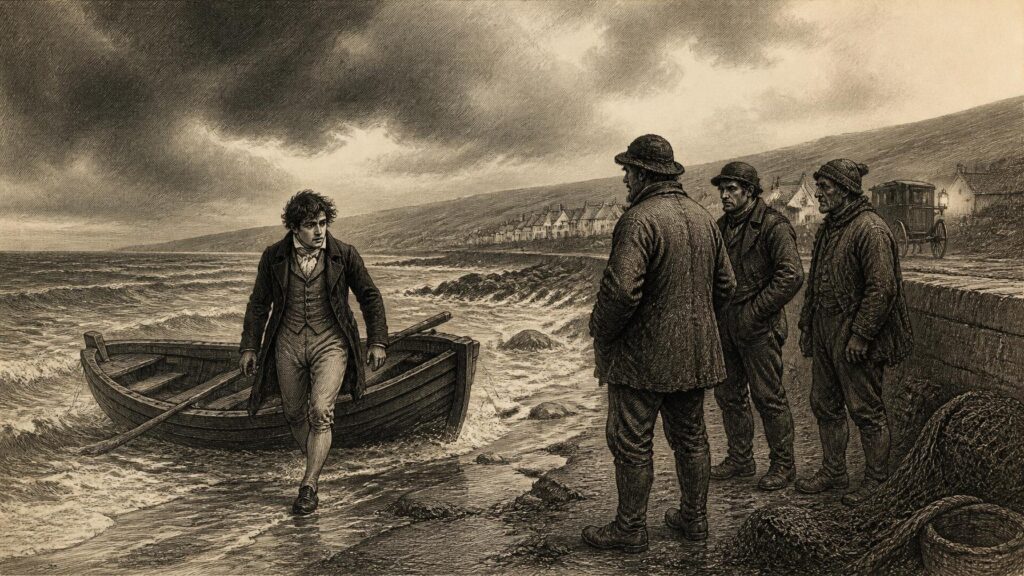
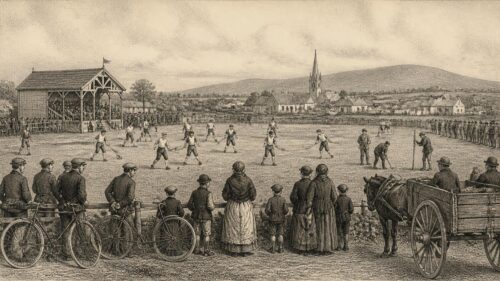
AI generated historical illustration, not a contemporary photograph.
At a Glance
Mary Shelley’s Frankenstein; or, The Modern Prometheus is neither an Irish novel nor a tale principally set in Ireland. Yet its Irish chapters are far more than a passing excursion across the water. On an unnamed coast, amid storm, suspicion and bereavement, Victor Frankenstein encounters an Ireland which first unsettles his assumptions and then frustrates them. Later Irish writers, politicians and hostile British cartoonists turned the name “Frankenstein” into a charged political metaphor. The result is a revealing history of place, power and misunderstanding: Ireland in Shelley’s novel, and Ireland as subsequently imagined through Shelley’s monster.
Irish Arrival
The Irish portion of Frankenstein comes late in the original 1818 three-volume novel, after Victor has abandoned his promise to manufacture a female companion for the being he created. He has travelled with his friend Henry Clerval through England and Scotland, then withdrawn to a remote island in the Orkneys to undertake the dreaded work. There, fearful that a second creature might be more destructive still, he tears apart the unfinished body and consigns its remains, together with his apparatus, to the sea.
That decision gives the novel’s Irish setting its immediate dramatic cause. The creature, who has watched Victor’s work from afar, threatens vengeance. Victor attempts to remove the evidence of his labour by boat, is overtaken by bad weather, loses his bearings and lands on an unfamiliar shore. He assumes, at first, that he remains in Britain. The first local man whom he addresses sharply corrects him: whatever the habits of Englishmen may be, he says, the Irish have their own custom of hating villains. The exchange is brief, but it is one of the novel’s clearest acknowledgements that Ireland is not simply an undifferentiated extension of England or Scotland.
The revelation is brutal. Victor is arrested on suspicion of murder. The victim is Clerval, whose body has been recovered from the water after the creature fulfilled his threat. Victor’s personal catastrophe has therefore crossed the Irish Sea. His secret history of creation, rejection and revenge has become an Irish legal case, investigated by Irish witnesses and judged by an Irish magistrate. Shelley does not name the harbour, town or county. The Ireland of the novel is specific enough to have inhabitants, institutions and recognisable surnames, but deliberately or economically vague in its geography.
That vagueness has encouraged readers to try to identify a precise landing-place. Donegal, Ulster, Mayo and the north-western coast have all been proposed or implied by commentators considering the winds, the Orkney departure and the possible course of Victor’s small boat. Such reconstructions can be illuminating as exercises in reading the novel’s maritime imagination. They cannot establish a historical location. Shelley supplied no named Irish destination, and her priority was the moral and emotional disorientation of the traveller rather than a navigational chart.
The episode matters because it transforms Victor from master and maker into an accused stranger. Much of the book follows his attempt to control knowledge: he conceals his experiments, refuses confession and seeks to manage the creature’s demands alone. In Ireland he is compelled into public procedures of testimony, identification and judgment. The isolated experimenter, who has tried to make private decisions with immense human consequences, must now answer to a community he does not know.
Stormy Passage
The sea passage is essential to this reversal. Shelley repeatedly uses water, weather and difficult travel to expose the frailty of human plans. Victor has attempted to dispose of the fragments of the female creature in darkness and solitude. The sea, rather than obediently erasing the evidence of his act, becomes the medium through which he is carried into a new jurisdiction and a new crisis. The movement from the Orkneys to Ireland also joins two island worlds that English literary history has too often treated separately.
In the novel’s terms, the storm does not simply transport Victor from one picturesque coast to another. It interrupts a chain of control. He had chosen the Orkneys precisely because of their remoteness; he had hoped the night voyage would conceal the remains of his abandoned work; he had expected to return from the shore without notice. Instead, the wind delivers him to people who have seen a boat, noticed a body and are prepared to ask questions. His nightmare becomes intelligible to others, although never fully explainable by him.
There is also a striking contrast between movement and confinement. Victor’s journey to Ireland is involuntary and chaotic. Once there, he is held in prison for almost two months. The man who had ranged across Europe in pursuit of forbidden knowledge is rendered dependent upon the decency of strangers. He becomes physically ill, mentally broken and unable to offer a rational defence because the real explanation would sound incredible. Shelley’s Irish episode thus turns the Gothic pattern of travel upside down: foreignness does not licence adventure but exposes the traveller to accountability.
The route has attracted attention because Percy Bysshe Shelley had travelled to Dublin by way of Holyhead in 1812 and 1813, publicly associating himself with Irish reform and Catholic emancipation. He addressed Irish readers in pamphlets and speeches, though his brief political intervention was troubled by naivety as well as radical sympathy. The Shelley circle also contemplated, in 1814, the possibility of a community in the west of Ireland. These biographical facts do not prove that Mary Shelley built Victor’s landing upon a particular journey or shore. They do, however, establish that Ireland was not an abstract blank on the map for the people closest to the novel’s composition.
Mary Shelley’s own fictional geography is broader than biography. Switzerland, Germany, France, England, Scotland, Ireland, the Arctic and imagined South American wilderness all appear within a narrative shaped by mobility, migration and empire. Ireland is distinctive within that range because Victor thinks he knows where he is and discovers that he does not. The error is political as much as geographical. His instinctive reference to English custom receives an answer insisting upon Irish difference.
Uneasy Justice
At first glance, the novel’s Irish population appears through Victor’s frightened and prejudiced eyes. He describes hostile faces, rough voices and what he takes to be inhospitable conduct. But these impressions are quickly challenged by the facts. The people who detain him have sound reasons to be suspicious. A murdered man has been found; Victor has arrived in unusual circumstances; witnesses have seen enough to connect his boat with the crime. Their anger is not irrational savagery. It is the reasonable reaction of people confronted with apparent evidence of violence.
This correction is one of the most important features of the Irish sequence. Victor, who has disastrously misread the creature and refused to recognise his obligations towards him, now misreads an Irish community. His first response is self-pity and cultural condescension. His later experience obliges him to revise it. The Irish magistrate, Mr Kirwin in the 1818 text, treats him with patience and humanity. He gathers testimony, arranges proper legal examination and, when Victor’s illness becomes severe, provides care rather than cruelty.
Kirwin is not presented as a sentimental saviour who ignores evidence. His kindness works alongside due process. He investigates the accusation rather than assuming guilt or innocence; he listens to witnesses; he protects a prisoner whose health is failing. The court proceedings finally demonstrate that Victor could not have committed the murder, and his father arrives to assist him. The legal outcome does not erase Clerval’s death, but it prevents a further injustice.
The named figures around the case deepen the setting. Daniel Nugent, one of the fishermen associated with the discovery and identification of the body, bears a recognisably Irish surname. Kirwin likewise signals an Irish context, even though spelling varies in later commentary and editions. Such names do not amount to a documentary key to actual individuals. It is tempting to attach them to particular political acquaintances or family histories, but those identifications remain speculative unless supported by direct evidence. What can safely be said is that Shelley gave the scene local social texture rather than leaving it peopled by anonymous “natives”.
Victor’s departure from Ireland is morally revealing. Cleared of murder and treated with sympathy, he nevertheless calls the country wretched and its shore detested. The words express his association of Ireland with Clerval’s death, his own collapse and the creature’s reach. They are not an objective verdict on Ireland, nor should they be repeated as Shelley’s own uncomplicated opinion. The contrast between Victor’s language and Kirwin’s conduct is deliberate enough to make that distinction essential. Ireland is the place where Victor undergoes misery; it is also the place where strangers extend him legal fairness and personal care.
Political Context
The novel appeared in 1818, two decades after the Irish rebellion of 1798 and seventeen years after the Act of Union came into effect on 1 January 1801. Its Irish episode cannot be reduced mechanically to either event. Shelley nowhere labels the murder of Clerval an allegory of rebellion, identifies a revolutionary organisation, or gives readers a historical date. Yet the setting carried political associations that contemporary readers could scarcely have missed. Ireland was joined to Great Britain by Union, governed amid deep religious and constitutional conflict, and persistently represented in British discourse as a problem of security, order and civilisation.
Fred V. Randel’s influential reading of the novel argues that the journey into Ireland forms part of its political geography of horror. In this interpretation, the sudden violence that reaches the Irish coast recalls the transnational consequences of revolutionary politics and the 1798 uprising. The argument does not claim that Shelley has hidden a neat historical code beneath each plot detail. Rather, it observes that the novel moves through places marked by revolution, conquest, exclusion and imperial expansion, making Ireland a consequential part of its wider map.
This is a persuasive interpretation when kept at the level of interpretation. The creature’s violence is not identical with Irish rebellion, and Clerval is not a historical person in disguise. The novel is crowded with private grief, philosophical debate, Gothic terror and anxious reflection on creation. Nevertheless, Shelley’s choice to send Victor to Ireland after the destruction of the prospective female creature allows a political resonance to emerge. A man who has created life without accepting responsibility becomes vulnerable in a country whose relationship with British authority was profoundly contested.
The Irish witnesses and magistrate also complicate a familiar colonial stereotype. Victor expects rudeness and sees brutality. The narrative demonstrates that the locals’ suspicions are justified and that their leading official behaves honourably. In Randel’s formulation, the novel temporarily voices stereotypes before undermining them. Whether or not every reader accepts the full revolutionary framework, this narrower point is firmly rooted in the plot: Shelley makes Victor’s dismissive perception of Irish people unreliable.
The episode should therefore not be made to carry a falsely simple political message. It neither offers an Irish nationalist programme nor celebrates the Union. Its power lies in ambiguity and reversal. Ireland appears as a separate social world, a place of law and local knowledge, and a site onto which a traumatised outsider projects his own guilt. The text recognises difference while refusing to make Irish people merely monstrous scenery for Victor’s tragedy.
Radical Connections
The intellectual inheritance behind Frankenstein gives the Irish scenes further depth. Mary Shelley was the daughter of Mary Wollstonecraft and William Godwin, writers whose ideas about reason, education, authority and political justice shaped radical debate in Britain and Ireland. The 1818 novel was dedicated to Godwin. Its story of a persecuted and misunderstood being also has affinities with his fiction, especially Caleb Williams, in which an individual is caught within systems of surveillance, accusation and power.
Percy Shelley’s anonymous review of Frankenstein noticed the Irish landing and suggested that it was the novel’s closest approach to imitation. He compared it with the movement towards Ireland in Godwin’s Caleb Williams. The observation is valuable because it shows that the Irish incident was visible to an early, highly informed reader. It does not mean that Mary Shelley simply copied Godwin. In her novel, Ireland is not merely an escape route. It is where escape fails, where a protagonist is detained, and where institutional justice proves more humane than his own assumptions.
The wider radical network had Irish connections. Godwin’s writings circulated in politically engaged circles; Paine, Rousseau and other writers associated with rights, reform and revolution were read and debated in Ireland as elsewhere. The United Irishmen, founded in Belfast in 1791, developed arguments about representative government, religious equality and national self-determination within a volatile Atlantic and European context. That historical world supplies an important background, although the novel itself does not name the society or rehearse its programme.
There is a danger in turning background into proof. Mary Shelley’s surviving novel does not tell us that she intended Daniel Nugent as a portrait of a known Irish radical, or that Kirwin represents a particular magistrate. Claire Connolly has noted possible associations proposed by scholars, including a possible connection between the name Nugent and Catherine Nugent, a Dublin acquaintance of Percy Shelley. Such suggestions are useful prompts for archival inquiry, but they should remain suggestions. The documented fact is simpler and stronger: Shelley placed named Irish people at the centre of the legal and ethical turning-point in her story.
That distinction between record and inference matters especially in Gothic history. Gothic fiction invites readers to identify buried secrets, doubles and concealed origins. Historical method requires a different discipline. It may trace context, publication, reception and language; it may offer interpretations grounded in evidence; it must not turn every suggestive resemblance into a secret code. Ireland’s presence in Frankenstein needs no invented key to be substantial.
Critical Reception
Contemporary responses indicate that the Irish scenes were noticed, if not always generously understood. Percy Shelley’s review connected them to Godwin. John Wilson Croker, the Galway-born Tory politician, administrator and critic, mocked the novel’s geographical range and made particular sport of its Irish names and legal arrangements. His remarks are revealing because they show how quickly Ireland could become a point of satire in British reviewing culture. What Shelley had treated as a setting for error, suffering and equitable justice could be recast by a hostile critic as implausible local colour.
Croker’s mention of Donegal is itself instructive. Donegal is not named in the novel. His reference may have reflected an attempt to imagine the likely coast, a joke directed at the supposed minuteness of the narrative, or assumptions about Irish assizes and provincial identity. It cannot settle Victor’s route. The temptation to turn a reviewer’s taunt into geographical evidence should be resisted.
Over time, the Irish chapters were often eclipsed by more famous elements of the story: the creation scene, the Alpine pursuit, the De Lacey cottage, the Orkneys and the Arctic conclusion. Film adaptations helped to narrow public memory further. The iconic laboratory machinery, neck bolts and lumbering inarticulate monster of twentieth-century cinema are not straightforward reproductions of Mary Shelley’s 1818 book. Nor have screen versions generally preserved Victor’s Irish imprisonment. Even Kenneth Branagh’s 1994 adaptation, directed by a Belfast-born filmmaker and advertised with the author’s name in its title, omitted the Irish section.
This omission changes the moral balance of the narrative. Without Ireland, Victor’s experience of public investigation and unexpected compassion is diminished. The novel can appear to move directly from the destruction in the Orkneys towards Geneva and the final Arctic pursuit. Restoring Ireland reminds readers that the book pauses to consider witnesses, courts, illness and care. It also restores the fact that the creature’s vengeance is not geographically contained: its consequences travel, as imperial and political consequences travelled, across neighbouring seas.
Colonial Metaphors
During the nineteenth century, “Frankenstein” became a portable political word. It could mean an artificial arrangement, a dangerous force brought into being by its supposed master, or a power that had escaped control. This usage often blurred the distinction between Victor Frankenstein and his creature. The blur was useful to polemicists. It made it possible to accuse an opponent of both creating a monster and being monstrous.
Irish political writing drew upon the metaphor early. In 1824, Thomas Moore compared the Act of Union to Frankenstein’s ghastly patchwork, assembled from the remains of political corruption. The image was pointed. The Union was not imagined as an organic partnership but as an unnatural construction, made from compromised and damaged parts. Moore’s use shows that Shelley’s novel had already become a vocabulary for constitutional criticism only a few years after publication.
Later, William Carleton used the figure in discussing Irish landlordism and the forty-shilling freeholders. His argument, made in the shadow of the social and political transformations surrounding Catholic emancipation and its aftermath, held that landowners had fostered a dependent electoral body for their own purposes and then faced the consequences. Here Frankenstein was not chiefly a tale about scientific experiment. It was a warning about elites who manufacture social instruments and then discover that those instruments have interests, grievances and force of their own.
These political metaphors were not neutral literary ornaments. They depended upon the novel’s central ethical question: what does a creator owe a being brought into existence? In Irish usage, the question could be redirected towards legislators, landlords, governments and political leaders. The metaphor made exploitation visible, but it could also dehumanise those described as monsters. Its history in relation to Ireland is therefore double-edged. Sometimes it condemned oppressive structures; sometimes it repeated the very prejudices that made Irish people appear threatening or less than fully human.
Caricature Politics
The most notorious visual example appeared in Punch on 20 May 1882, shortly after the Phoenix Park murders in Dublin on 6 May. Lord Frederick Cavendish, newly appointed Chief Secretary for Ireland, and Thomas Henry Burke, the Permanent Under-Secretary, had been killed by members of the Irish National Invincibles. The murders intensified British fear, anger and political recrimination at a moment of conflict over land, coercion and Home Rule.
John Tenniel’s cartoon, titled “The Irish Frankenstein”, shows a monstrous, armed and masked figure looming over Charles Stewart Parnell. Its caption adapts words from Shelley’s novel to imply that Parnell had created, animated and lost command of violent nationalism. The image is deliberately ambiguous in its use of the name Frankenstein: it invokes both the creator and the creature, allowing Parnell to be blamed as maker while the monster is made to stand for murderous Irish political violence.
The cartoon deserves attention not because it offers a fair account of Parnell, Irish nationalism or the Phoenix Park murders, but because it demonstrates the force of Frankenstein imagery in anti-Irish representation. The creature is rendered with grotesque, simianised features characteristic of Victorian racial caricature. Such imagery did political work. It converted a complex conflict involving constitutional nationalism, agrarian agitation, state coercion and clandestine violence into a visual story of innate bestiality and uncontrollable menace.
The National Library of Medicine’s exhibition on Frankenstein identifies the image as an example of the name being used for people and forces considered out of control. That description is accurate but requires one further step. The cartoon did not merely depict loss of control. It circulated a colonial way of seeing Irish people: as a dangerous collective whose claims could be dismissed by representing them as a degenerate monster. Its literary allusion gave an old prejudice a modern Gothic vocabulary.
There is an irony here. Shelley’s original novel asks readers to consider what happens when a creator refuses care, sympathy and responsibility. Tenniel’s caricature exploited the monster to charge an Irish leader with responsibility for violence, while avoiding any sustained examination of British governance in Ireland. The image borrows the moral energy of Frankenstein but narrows its ethical reach. It turns a novel of reciprocal obligations into an accusation against a racialised political other.
Gothic Neighbours
Frankenstein’s Irish connection also belongs within the longer history of Irish Gothic writing. Ireland had a major, though often underacknowledged, place in the development of the Gothic from the eighteenth century onwards. Charles Robert Maturin, the Dublin-born Church of Ireland clergyman and author of Melmoth the Wanderer, was publishing fiction at the moment Shelley’s novel appeared. Later, Bram Stoker’s Dracula would ensure that an Irish writer stood behind another of the world’s defining Gothic myths.
It would be misleading to claim that Shelley’s Irish episode makes Frankenstein an Irish Gothic novel in the manner of Maturin or Stoker. Its principal settings and intellectual inheritance are transnational. Yet the Irish scenes participate in questions central to Irish Gothic: uncertain belonging, bodies subject to judgment, fractured authority, hidden violence and the uneasy relation between civilisation and barbarism. Most importantly, Shelley exposes the instability of those categories. Victor arrives ready to see rude and brutal people; he discovers grief, evidence, law and compassion.
The word “folklore” should be used carefully here. There is no documented Irish folk origin for Frankenstein’s creature, no evidence that Shelley based the novel on an Irish legend, and no warrant for claiming that a particular Irish ghost story supplied its plot. The book’s familiar origin story lies in the 1816 ghost-story challenge near Geneva, though even that episode is mediated by Mary Shelley’s later recollection. Ireland’s connection is textual, political and cultural rather than folkloric.
Lasting Questions
To read Frankenstein in Ireland is not to annex Mary Shelley to an Irish tradition she did not inhabit by birth or residence. It is to notice that the novel itself crosses the Irish Sea and that later Irish history repeatedly returned the compliment. The Irish episode has consequences for how the whole work is understood. It challenges the assumption that Victor’s story is a purely private tragedy or that its geography is merely decorative.
In Shelley’s Ireland, the outsider is not welcomed without question. He is questioned because there is cause. Nor is he condemned merely because he is strange. The magistrate investigates; the community’s suspicions are tested; an innocent man is released. This is a small but powerful counterpoint to Victor’s own failures. He has judged the creature by appearance, abandoned him without care and concealed knowledge that might save others. Irish strangers do better by Victor than Victor has done by his creation.
The later political afterlife of Frankenstein reveals a second lesson. Metaphors of monstrosity are powerful because they simplify blame. Moore could use Frankenstein to expose the artificiality of the Union; Carleton could use it to condemn manipulative landlord power; Punch could use it to portray Irish political violence as racial menace. The same literary myth could thus assist critique or harden prejudice. Context determines much of its meaning.
For Emerald Archives, the enduring significance of Frankenstein’s Ireland lies in that tension. The 1818 novel gives Ireland neither a tourist’s scenery nor a fantasy of primitive terror. It gives it a storm-battered shore, named inhabitants, a murder inquiry and an unexpectedly humane magistrate. Subsequent writers and artists made the name Frankenstein serve competing accounts of Union, class, nationalism and violence. Their uses should not be confused with Shelley’s own text. But together they show that Ireland was not an incidental margin of the Frankenstein story. It was one of the places where the story’s questions about creation, responsibility, justice and power became most historically charged.
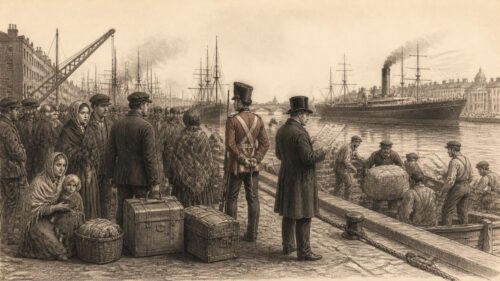
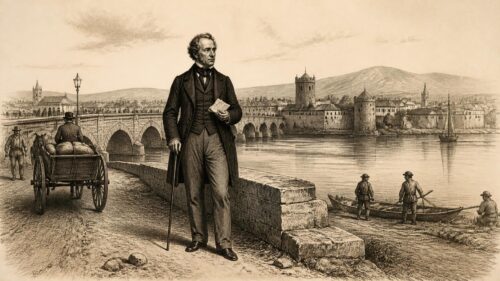
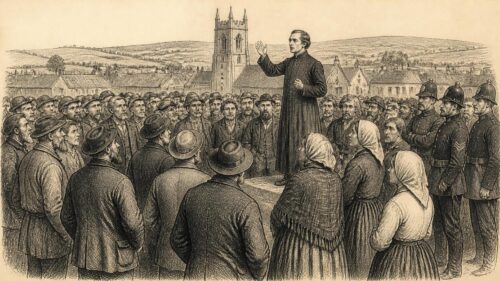
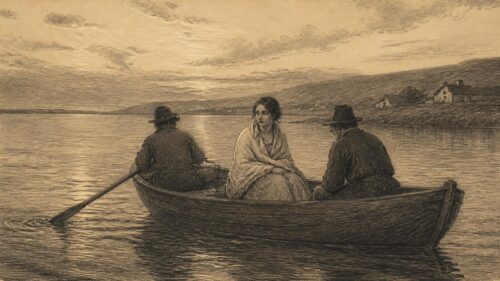
Shelley’s unnamed Irish shore seems especially significant because it turns Victor from secretive creator into an accused outsider, while Irish witnesses and Mr Kirwin expose the unfairness of his fearful assumptions. The episode resists both simple geography and simple allegory: its vague location invites mapping, yet its legal procedures and compassion give Ireland a distinct moral role. Later political uses of Frankenstein, including colonial caricature, show how readily this brief setting acquired meanings beyond the novel. How should readers weigh the Irish episode’s narrative evidence of accountability and hospitality against the broader Union-era and nationalist interpretations subsequently attached to Frankenstein?