
Christian Brothers
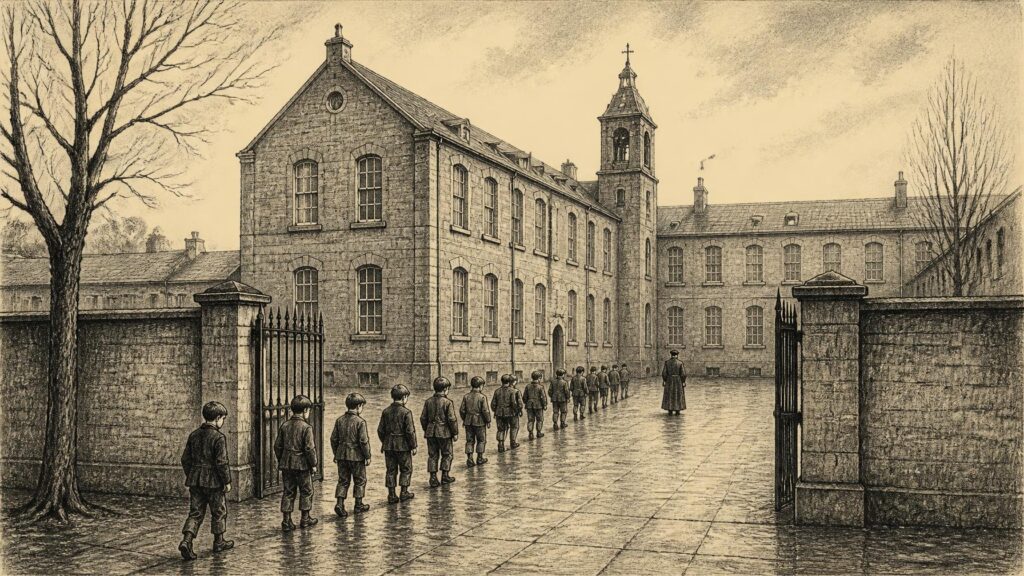
AI generated historical illustration, not a contemporary photograph.
At a Glance
Christian Brothers abuse litigation belongs to the difficult modern history of Ireland’s residential institutions: not a single lawsuit or a self-contained scandal, but a long encounter between survivors, religious authority, the courts, statutory inquiries and the State. Its historical importance lies partly in what the litigation sought to establish—responsibility for abuse and neglect—and partly in the alternative machinery that Ireland created when ordinary adversarial proceedings were judged too slow, costly and painful to bear the whole burden of the past.
Institutional Origins
The Congregation of Christian Brothers emerged from an Irish Catholic educational movement founded by Edmund Ignatius Rice in Waterford in 1802. Rice’s earliest schools were intended to educate poor Catholic boys, and the Commission to Inquire into Child Abuse later noted that corporal punishment was contrary to his expressed ideal. Such origins matter, but they cannot be used to soften or explain away what happened in later institutions. A historical institution is not defined solely by its founding purpose; it must also be assessed by its conduct, its structures of authority and its response when children were harmed.
The Brothers initially concentrated on day schools. Their entry into residential care followed the development of the industrial-school system in nineteenth-century Ireland. State capitation payments, calculated by the number of children placed in an institution, gave the Congregation a secure financial basis for operating residential schools. Artane, opened in 1870, was their first industrial school. Over time the Brothers became the principal male religious providers of such care, administering institutions including Artane, Letterfrack, Tralee, Carriglea, Glin, Salthill and the school for deaf boys at Cabra.
This was not merely a religious enterprise operating beyond public concern. Industrial schools were creatures of a statutory system: children were committed or placed through public processes, institutions were certified and inspected, and public funds sustained them. The later legal and political arguments therefore concerned intertwined responsibilities. The Congregation managed particular schools, but the State designed, financed, regulated and used the institutional system. Litigation and redress became arenas in which survivors sought acknowledgement of injuries produced within that shared structure.
Residential Expansion
The Christian Brothers’ residential schools must be placed within the wider history of twentieth-century Irish institutionalisation. Children entered industrial schools for varied reasons, including poverty, family crisis, perceived neglect, bereavement and court processes. Their experiences were not uniform, and no serious history should pretend that every staff member, period or institution was identical. Yet the Commission’s investigation showed that variation cannot obscure institutional patterns. It examined the Brothers as a centrally governed Congregation, rather than treating every school as wholly isolated from the others.
That centralised structure distinguished the Brothers from some other religious providers. The Commission recorded that the Congregation was under central management and control from 1820, and that more than 700 complaints concerning its institutions reached the Investigation Committee. It conducted full hearings on Artane, Letterfrack, Tralee and Carriglea, while examining documentary material concerning Salthill, Glin and Cabra. The number of complaints is not itself a substitute for findings in individual cases; nevertheless, it helps explain why the Brothers occupied such a prominent place in the public inquiry and in the ensuing disputes over accountability.
Evidence in the Commission’s report came from more than recollection. It included inspection material, institutional records, internal Congregational papers, discovery, oral testimony and cross-examination. That matters because public discussion sometimes reduced the history either to survivor testimony alone or to a contest of competing memories. The Investigation Committee did not proceed on either simplification. It tested allegations, considered documentary context and expressly recognised that some allegations could not safely be sustained. Its conclusions about institutional conditions therefore rested on an accumulated evidential record, not on folklore, rumour or a single type of source.
Survivor Claims
By the late twentieth century, former residents increasingly spoke publicly, organised support networks, made complaints to the Gardaí and consulted solicitors. Their claims concerned physical, sexual and emotional abuse, as well as neglect, inadequate education, harsh discipline and the enduring effects of institutional childhoods. Civil litigation offered one means of seeking damages, but it imposed formidable demands. Events were often decades old; alleged perpetrators might be dead, elderly, infirm or impossible to trace; records could be incomplete; and survivors faced the emotional strain of adversarial proceedings.
Limitations law became one important issue. The Statute of Limitations (Amendment) Act 2000 allowed courts, in specified circumstances, to extend time for certain civil claims relating to childhood sexual abuse. The question was not a technical curiosity. It went to whether a person who had been unable to disclose abuse earlier could obtain a hearing at all. The Christian Brothers drew attention to limitations issues during the Commission process and challenged the reliability of some historical allegations. Such arguments were part of legal representation, but they also reveal how litigation could turn traumatic delay, fragmented memory and the absence of records into central subjects of dispute.
It is essential to distinguish allegation, civil liability and criminal guilt. An allegation could be reported to a religious authority, Garda station, solicitor, redress body or inquiry without producing a criminal prosecution. A civil case had a different standard and purpose from a criminal trial. The statutory inquiry was neither a criminal court nor a conventional damages action. It investigated institutions and systems, while the Redress Board was established to make awards under legislation. Collapsing these distinct processes into a single notion of ‘conviction’ distorts the historical record and can erase the reasons Ireland developed several parallel responses.
Legal Change
Public pressure and survivors’ advocacy helped create a changed legal landscape. In 1999 the Irish Government announced a commission of inquiry into child abuse in institutions. The Commission to Inquire into Child Abuse Act 2000 then placed the body on a statutory footing. Its stated purposes included giving people abused in childhood an opportunity to recount their experiences, investigating the causes, nature, circumstances and extent of abuse, and examining the roles of institutions, management, administration, supervision, inspection and regulation.
The legislation recognised that historic abuse could not be explored solely by the usual public-court model. The Commission had a Confidential Committee, designed to hear accounts in a protected setting, and an Investigation Committee, which conducted inquiries. The design reflected an attempt to reconcile two imperatives that can pull in opposite directions: the survivor’s need to be heard without needless exposure, and the need for fair procedures where allegations could affect institutions and individuals. The result was imperfect and contested, but it was an important departure from earlier institutional silence.
The very creation of the Commission demonstrates a historical change in official language. For generations, industrial schools had commonly been framed as charitable, educational or corrective institutions. The 2000 Act instead made child abuse, its causes and its continuing effects matters of national public inquiry. That did not mean that all prior assumptions disappeared. The inquiry’s later procedural conflicts show how quickly questions of reputation, proof, anonymity and legal rights could complicate a process intended to establish public truth.
Inquiry Design
The Commission’s work was unusually difficult. It had to investigate a system spanning much of the nineteenth and twentieth centuries, much of it dependent on records created by the very institutions under examination. It had to hear testimony from people recounting events long after childhood, while also allowing respondents to challenge evidence. Its report adopted pseudonyms to protect complainants and respondents, including people already convicted in criminal courts. This method was not concealment of the subject matter; it was a procedural decision shaped by privacy, fairness and the risks of identifying individuals in findings outside criminal proceedings.
The Christian Brothers’ chapter in the Investigation Committee report is especially revealing. It notes that some surviving internal records, including Visitation Reports, made a substantial investigation possible. It also records that the Congregation initially withheld some material on privilege grounds but later waived that claim. Such details show why archive work is central to this history. Records could illuminate what leaders knew, what they recorded as discipline or misconduct, and how they moved or dealt with Brothers about whom concerns had arisen. But archives have limits: silence in a file is not proof that no abuse occurred, just as an untested recollection cannot automatically establish every disputed fact.
The Commission considered the Congregation’s own explanations. The Brothers argued that inadequate State funding affected standards of care and that corporal punishment had been widespread and legally permitted in the period. The Committee accepted that historical setting required attention, but concluded that the detailed punishments described in the institutional chapters amounted to physical abuse by any standard and at any time. That distinction is vital. Context can help historians understand systems; it cannot convert cruelty into acceptable practice or dissolve responsibility for those who administered it.
Procedural Contest
Litigation did not occur only between survivors and defendants. The Christian Brothers also challenged aspects of the Commission’s proposed procedures. The dispute arose from the Investigation Committee’s intention to investigate allegations concerning deceased, untraceable and infirm Brothers, and from the possibility of findings against individuals and managers. The Congregation argued that the process had to provide adequate safeguards, especially where a person could not answer an allegation in person.
In 2004, following High Court proceedings and an appeal, the Supreme Court recorded a consent resolution after the Commission decided it would not name individual perpetrators unless they had already been convicted by a court. Earlier declarations concerning the testing and corroboration of evidence, and the conditions under which respondents could cross-examine witnesses, remained significant. Contemporary reporting described the case as producing a major procedural shift in the inquiry. It also imposed substantial costs on the Commission.
There are two historical lessons in this episode. First, due process was not an optional refinement. A public inquiry making grave findings needed procedures that could command legal legitimacy. Secondly, the dispute had consequences for the shape of public memory. The final Ryan Report documented institutional failures and patterns of abuse, but its anonymity framework meant that it did not provide the public with a simple named register of alleged abusers. For some survivors and commentators this was a painful limitation; for the legal system it reflected concern about making findings against people unable to defend themselves in a criminal court.
The procedural contest should not be misrepresented as disproving the underlying history. The Commission went on to make grave institutional findings. Nor should it be portrayed as irrelevant obstruction. It was a real legal disagreement about the powers of a statutory body and the fairness owed to respondents. Historical writing should keep both propositions in view. The law did not erase the suffering described to the Commission, but neither did an inquiry have unrestricted authority to decide individual culpability without procedural constraint.
Evidential Record
The Ryan Report, published in May 2009, became the principal public account of the residential system. In relation to Christian Brothers’ institutions, it found evidence of harsh and pervasive physical punishment, poor care in important respects and serious failures in dealing with sexual abuse. The Commission observed that the Congregation’s own account characterised sexual abuse principally as a moral failing and scandal, rather than fully recognising the harm to children or the criminal nature of the conduct. It found that the Congregation’s actual response to sexual abuse fell short of the measures the Congregation said were in place.
Its findings must be stated carefully. The report did not establish that every Brother abused a child, nor that every allegation made during its work was true. Indeed, the Committee said it was satisfied that some allegations were false, and it explained the difficulties of proving or disproving historic abuse. That candour strengthens rather than weakens the value of the report. It shows an inquiry trying to distinguish corroborated patterns, documented cases, credible evidence and allegations that could not be resolved reliably.
The report also exposed the inadequacy of interpretations that treated the abuses solely as failures by rogue individuals. Its institutional chapters examined supervision, discipline, training, staffing, inspection, governance and the movement of Brothers between posts. In historical terms, the most important question is therefore not simply why a particular individual offended, though that remains crucial for victims and criminal justice. It is how a system endowed with religious authority, State recognition and administrative routines failed to protect children, and in some instances preserved conditions in which abuse could persist.
Redress Framework
While the inquiry was still under way, the Government decided not to wait for its completion before creating a compensation mechanism. The Residential Institutions Redress Act 2002 established the Residential Institutions Redress Board. The Board was intended to make fair and reasonable awards to people who, as children, had been abused while resident in listed industrial schools, reformatories and other institutions subject to State regulation or inspection.
This was a statutory administrative scheme, not a replication of ordinary litigation. Its procedures were intended to be more informal than a civil trial, though applicants could be represented and legal issues remained important. Awards were based on a scale that considered the severity of abuse and the injury or effects of abuse. The model was often described as a route to redress without forcing every survivor through a full contested hearing. It was also a policy response to the prospect of very large numbers of historical claims, with all the evidential and human difficulties that litigation involved.
The scheme nevertheless had limits. Eligibility depended on residence in specified institutions and on the statutory framework. It did not amount to a general remedy for every person abused in every Catholic educational setting. In particular, the Redress Board itself distinguishes its remit from later arrangements relating to certain day-school abuse cases. This boundary is historically important because ‘Christian Brothers abuse’ can refer to both residential and day-school experiences, whereas the 2002 scheme was constructed around a defined category of residential institutions.
By August 2015 the Board reported receiving 16,648 applications and completing 16,631 cases. It had made 12,039 offers after settlement discussions and 3,523 awards following hearings; 1,069 applications had been withdrawn, refused or had resulted in no award. The reported average award was €62,240, with a highest award of €300,500. These figures should not be read as a price placed on trauma. They record the operation of a statutory formula and administrative process, not a measurement of the full human consequences of childhood abuse.
Indemnity Agreement
The most controversial legal arrangement was the 2002 indemnity agreement between the State and eighteen religious congregations, including the Christian Brothers. Under it, the congregations agreed to make a combined contribution valued at €128 million, inclusive of certain earlier contributions. In exchange, the State agreed to indemnify them against legal actions by former residents that fell within the scheme’s remit, where proceedings commenced within the stipulated six-year period.
The agreement is central because it reframed the financial relationship between survivors, State and religious orders. Rather than leaving each eligible civil claim to be fought separately against a congregation, the State accepted a broad financial exposure through the redress system and assumed the indemnity obligation. This did not grant immunity from criminal law, nor did it answer every possible claim outside the scheme. But it significantly altered the practical landscape for civil liability connected with the covered institutions.
Criticism of the agreement has endured because the anticipated overall cost of redress grew far beyond early estimates, while the congregations’ agreed contribution was fixed at a much lower level. The Comptroller and Auditor General later reported that the original policy expectation had been roughly equal State and congregational liability, based on an estimated scheme cost of €250 million. The contrast between that expectation and the later public cost became a powerful symbol of unequal accountability. It also reinforced survivor criticism that a settlement designed for administrative efficiency had insulated wealthy institutions from the full financial consequences of the past.
Costs Accountability
Financial history is not the same as moral history, but it is part of accountability. The Comptroller and Auditor General reported that after the Ryan Report the congregations offered further contributions, including cash and property, originally valued at €352.6 million. That figure was later revised to €225.6 million in 2015 after the Christian Brothers withdrew a proposal involving a joint trust arrangement for forty-nine school playing fields and associated land, valued in 2009 at €127 million. The Brothers indicated that the freehold title would instead be transferred to the Edmund Rice Schools Trust.
Those figures demand precision. A promised value, a transferred asset, a cash payment and a public benefit are not interchangeable categories. Property valuations can alter; transfers can be incomplete; land may be subject to legal or practical restrictions; and funds directed to survivor supports differ from payments into the Exchequer. It is therefore unsafe to reduce the issue to a slogan about what was or was not ‘paid’. The audited record remains the proper basis for judging particular commitments.
The scale of legal administration was substantial. In its 2015 newsletter, the Redress Board stated that it had paid legal costs to 985 firms of solicitors in respect of 15,289 applications, totalling €198.3 million, including costs associated with High Court proceedings. Such expenditure has prompted criticism, but it also reflects the reality that survivors often needed legal advice to navigate eligibility, evidence, medical material, hearings and review. A history of redress must acknowledge both sides: legal processes could assist people in asserting rights, while their cost and complexity could consume resources that survivors believed ought to have reached them more directly.
Interpretive Limits
Historical argument on this subject is vulnerable to two opposite errors. One is institutional nostalgia: the claim that harsh conditions were simply normal for their era, that grateful former pupils disprove abuse, or that charity and education should outweigh the evidence of harm. The other is indiscriminate generalisation: the assumption that every Brother was abusive, every allegation proved, or every former resident had the same experience. Neither approach respects the documentary record or the people whose lives it concerns.
The evidence supports a more demanding conclusion. The industrial-school system placed many vulnerable children in large, closed and hierarchical institutions. The Christian Brothers held major responsibility for several boys’ institutions and were the subject of extensive complaint, investigation and litigation. The State had its own responsibilities as funder, regulator and committal authority. The Commission’s work documented serious institutional abuse and neglect, while also preserving procedural distinctions between established findings, contested allegations and criminal convictions.
Folklore has little legitimate place here. Stories passed among former pupils, local communities or school networks may alert historians to questions worth asking, but they are not equivalent to evidence. Conversely, the absence of a neat paper trail should not be turned into folklore’s opposite: a presumption that unrecorded abuse did not occur. The best historical method compares testimony with inspection reports, institutional documents, legal pleadings, administrative records and the findings of properly constituted inquiries, while being frank about uncertainty where proof cannot reach a firm conclusion.
Historical Legacy
Christian Brothers abuse litigation changed Irish public life because it forced a reckoning with the relationship between authority and childhood. It challenged the presumption that religious management was inherently protective, exposed the weakness of inspection and oversight, and demonstrated that civil law alone could not readily address systemic historic abuse. The inquiry, redress scheme and indemnity agreement were all responses to that failure. None was a complete resolution.
For survivors, litigation and redress could bring recognition, compensation, records, apologies or an opportunity to be heard. They could also bring delay, cross-examination, disappointment and the feeling that bureaucratic categories had narrowed experiences too large to be contained in an award. For the Congregation, the process brought scrutiny of archives, governance and past responses to allegations. For the State, it exposed the consequences of delegating child care while retaining legal and financial control of the system.
The enduring historical significance of the litigation is therefore not merely financial. It lies in the movement from secrecy to evidence, from private institutional discipline to public responsibility, and from isolated claims to a national admission that grave wrongs had occurred in institutions authorised within the Irish State. That admission remains incomplete if it is reduced to ceremony. Its real measure is whether records are preserved, survivors are treated with dignity, legal distinctions are honestly observed, and institutional power is never again permitted to outweigh the safety of children.




The article highlights the tension between collective accountability and procedures designed to protect fairness in investigating historic abuse. The Ryan Commission’s anonymised approach enabled institutional patterns to be documented, yet limited public identification of alleged perpetrators, while redress schemes addressed compensation without reproducing civil litigation. This raises a broader question about what survivors, institutions and the State should reasonably expect from different forms of justice. Can inquiries, compensation boards and criminal or civil courts together provide meaningful acknowledgement of systemic harm, or do their distinct purposes inevitably leave important needs—such as individual accountability, public memory and financial responsibility—only partly met?